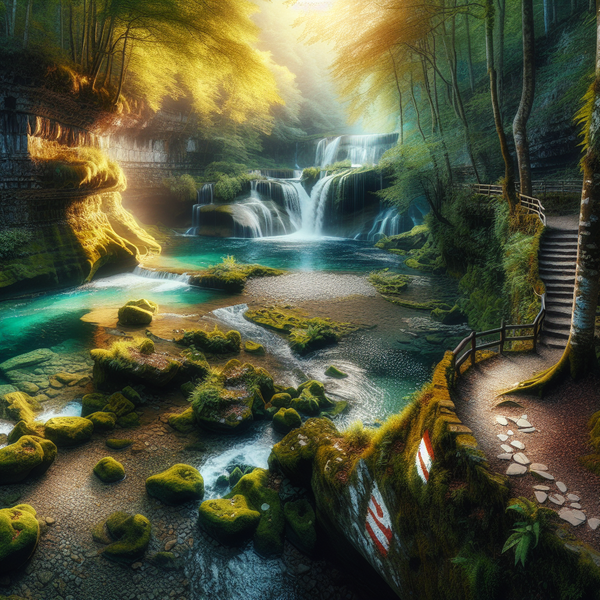
Travelers who venture off the main art-city circuit of Italy soon discover another kind of masterpiece — one sculpted not by Renaissance artists but by water, stone, and time. Italy’s national parks shelter waterfalls so spectacular and remote that even many Italians haven’t seen them in person. These aren’t roadside attractions; they’re natural cathedrals tucked behind chestnut forests, reached by trails that often begin in tiny villages where hikers still pause for an espresso before heading uphill.
Go to the section
ToggleCascata delle Marmore in Parco Fluviale del Nera: The Engineered Wonder of Umbria
Created by the ancient Romans in 271 BCE, the Cascata delle Marmore remains one of the highest man-made waterfalls in the world — a thundering 165 meters of controlled fury inside the Parco Fluviale del Nera near Terni. When the floodgates open, the sound is enough to vibrate through your chest. To see this spectacle, check the release schedule posted at the ticket office in the nearby village of Marmore. The falls run at full flow several times per day, transforming a gentle misty river into a white torrent within minutes.
Five panoramic trails trace different vantage points, each marked with precise elevation gains and estimated times. Trail 2, for example, climbs 45 minutes from the lower viewpoint to the top, passing mossy limestone walls where ferns grow year-round thanks to constant spray. Bring a lightweight rain jacket even in August; you’ll likely be soaked by the viewpoints around the second drop.
Cascate del Serio in Parco delle Orobie Bergamasche: The Seasonal Giant of Lombardy
Hidden near the alpine village of Valbondione, in the northern province of Bergamo, the Cascate del Serio plunge an astonishing 315 meters — Italy’s highest natural waterfall. However, the falls flow in full force only a few times each year when water from the Serio reservoir is released. The park authorities publish the exact dates and times on the Comune di Valbondione’s official site, and on those days, local guides organize dawn hikes winding through scree and larch forest to reach the observation terraces at 1,750 meters. The best view spans across the valley, with Monte Redorta glowing pink in early morning light.
Outside the official opening days, the Serio stream trickles modestly down its basalt gorge, leaving the amphitheater quiet enough for ibex to wander the cliffs. The upper section of the Orobie Park remains wild, accessible only to fit hikers who start from the Capanna Curò refuge, itself reachable by a three-hour ascent from town. Staying overnight allows you to wake early and watch sunrise pour over the Cascate’s frozen edges before the crowds arrive.
Cascate del Stroppia in Parco Naturale delle Alpi Marittime: Italy’s Remote Marvel Near the French Border
In the upper Maira Valley of Piedmont, past the hamlet of Chiappera, lies one of Italy’s least-known wonders: the Cascate del Stroppia inside the Parco Naturale delle Alpi Marittime. The fall, fed by snowmelt from the Rocca Provenzale, drops almost 500 meters in multiple tiers — though its volume depends entirely on the season. From June through early July, water sheets down granite walls into emerald pools, while by late August, only thin veils remain. The trailhead begins behind Rifugio Campo Base at 1,650 meters and continues steeply up to an alpine plateau dotted with gentian flowers. Few places in the Alps combine such dramatic scenery with the possibility of complete solitude.
The same valley connects to cross-border paths leading into France’s Mercantour National Park, allowing multi-day treks through one of the most pristine sections of the Western Alps. Bring proper gear and leave early, as storms often form by mid-afternoon. Remember that cellular signal disappears beyond the rifugio, which is precisely what gives this place its untouched appeal.
Cascata del Toce in Parco Naturale dell’Alta Valle Ossola: Art Deco Beauty Surrounded by Glaciers
Set in the Val Formazza area of Piedmont, the Cascata del Toce is famed for both its photogenic arc and its historic mountain hotel perched at the top. The waterfall, within the boundaries of the Parco Naturale dell’Alta Valle Ossola, drops nearly 143 meters and is released only on weekends from late May through September. The schedule posted at the Hotel Cascata del Toce reception ensures you can plan to be there exactly when the sluice gates open — the short window when the entire Toce River rushes over the cliff in a shimmering curve of mist.
If you’re driving from Domodossola, the access road (SP41) climbs through a series of switchbacks, each revealing wider views of glaciers and stone hamlets. Wooden bridges below the waterfall allow for photographs straight into the spray. Local platters of polenta concia (polenta layered with melted alpine cheese) served at mountain inns are a delicious reward after a morning hike to nearby Lago Sabbione.
Cascate del Dardagna in Parco Regionale del Corno alle Scale: Apennine Serenity Between Emilia-Romagna and Tuscany
Deep inside the Parco Regionale del Corno alle Scale, along the border between Emilia-Romagna and Tuscany, the Cascate del Dardagna tumble down seven separate drops, framed by beech woods so thick that sunlight filters through in silvery rays. The trail begins near the Sanctuary of Madonna dell’Acero at 1,200 meters elevation. A well-marked path of about 40 minutes each way reaches the main cascade, where mountain streams carve shallow baths perfect for cooling tired feet in summer.
The air here smells of pine resin, and in autumn, leaves blanket the forest floor in copper hues. Because this waterfall flows consistently all year, it’s one of the few in Italy you can admire even in winter, when ice curtains hang from the rocks. Nearby, the village of Lizzano in Belvedere makes an ideal base — small enough to feel local, yet with enough B&Bs and family trattorie to sustain a quiet hiking weekend.
Il Pisciadù Waterfall in Parco Naturale Puez-Odle: A Dolomite Gem Accessible from Corvara
For travelers drawn to the Dolomites, few sights beat the contrast between limestone cliffs and cascading streams. The Cascata del Pisciadù lies within the Parco Naturale Puez-Odle, accessible on foot from Corvara in Alta Badia along the trail to Rifugio Pisciadù. The route begins at the base of the Gardena Pass and gains roughly 600 meters of altitude, weaving beneath the Sella massif where marmots whistle from the rocks. The Pisciadù stream crashes down a vertical wall just below the rifugio, forming a white thread visible even from the valley road.
The area doubles as a starting point for via ferrata enthusiasts following the storied Brigata Tridentina route. Yet you don’t have to climb to enjoy it — a clear footpath leads to a viewing balcony within 90 minutes of walking. Afterward, a slice of apple strudel at a mountain hut completes the day, proof that even adrenaline-filled landscapes in Italy pair seamlessly with comfort food.
Cascate del Liri in Parco Naturale Regionale dei Monti Simbruini: The Unexpected Waterfall in Central Italy
South of Rome, the Cascate del Liri descend right through the historic center of Isola del Liri, technically inside the Parco Naturale Regionale dei Monti Simbruini. What makes this site unusual is its urban setting: medieval buildings and an Aragonese castle back a waterfall that drops 27 meters straight into the river’s lower reaches. Illuminated at night, it creates a surreal scene that photographers adore. Yet only a few minutes’ drive beyond town, forest paths climb toward quieter cascades hidden under the same watershed — notably the smaller but equally charming Cascata della Fibreno near Posta Fibreno.
This part of Lazio receives frequent rainfall, so waterproof footwear is essential. For a peaceful afternoon, locals walk the lakeside promenade around Lago di Posta Fibreno, where kestrels hover over the reeds. It’s an easy way to combine light hiking with authentic small-town encounters — exactly the kind of mix Italy excels at when you step beyond its famous cities.
Practical Tips for Exploring Italy’s Waterfalls Inside National Parks
Visiting these waterfalls rewards planning and respect for local conditions. Most parks require hikers to stay on marked paths — fines apply for off-trail shortcuts that erode fragile slopes. Always check provincial park websites for temporary closures, especially after heavy snow or during fire risk periods. In high summer, early mornings offer both better light and fewer crowds, while spring’s thaw produces the strongest flows in alpine regions.
A few essentials make the difference between a good hike and a memorable one:
- Footwear: Waterproof boots with firm grip matter more than walking poles on slick limestone.
- Clothing: Even in warm months, carry a light down jacket; mountain valleys can drop below 10°C overnight.
- Navigation: Download local park maps offline. Cell signals vanish quickly beyond trailheads.
- Safety: Many Italian parks have volunteer alpine rescue units. Save the national emergency number 112 in your phone before leaving town.
Finally, remember that Italian trail culture values courtesy — always greet with a friendly “buongiorno,” step aside for uphill hikers, and never picnic within fenced protection zones. These habits ensure that the same emerald pools and tumbling streams will remain untouched for the next traveler who decides to look beyond the obvious and listen for the hidden sound of Italy’s wild heart.