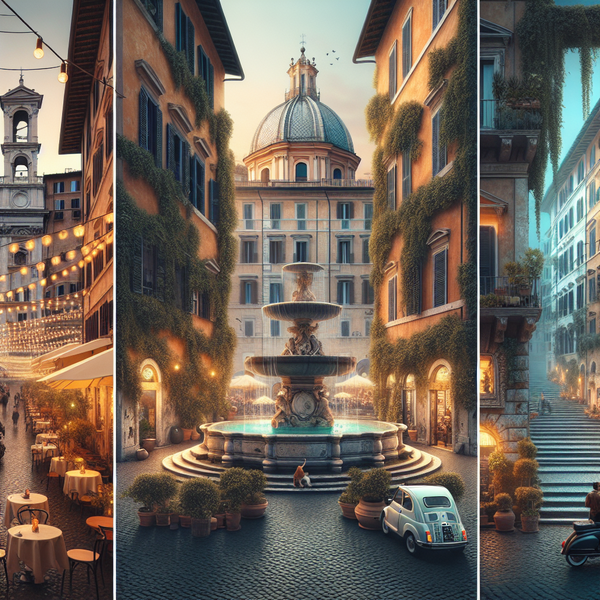
Walk a few streets away from Piazza Navona and you’ll find a Rome that’s no longer posing for postcards. The Eternal City’s other squares—quiet, lived-in, or surprisingly grand—show a texture of daily life that tourists often miss. Locals sip coffee while leaning against centuries-old fountains, students gather on stone steps, and markets unfold under ochre facades. Exploring these beautiful squares in Rome beyond Piazza Navona reveals the city’s heart through its public spaces.
Go to the section
TogglePiazza della Madonna dei Monti: Community Soul Near the Colosseum
Just a seven-minute walk uphill from the Colosseum, Piazza della Madonna dei Monti is a compact square shaded by orange trees and overlooked by baroque windows. In the late afternoon, residents balance espresso cups on the edge of the fountain—it’s a natural gathering point. The church of Santa Maria dei Monti, built at the end of the 16th century, gives the square its name and soft murmuring bell tones.
For travelers, it’s a rare place to pause close to major attractions without feeling overwhelmed. Monti’s independent shops, like the hand-bound leather notebook atelier on Via Urbana, radiate from the square. Order a glass of Sicilian Grillo at Fafiuchè, one of the few wine bars here that stays open past midnight, and you’ll quickly find conversation with locals who treat the piazza as their living room.
Piazza Mattei and the Turtle Fountain: Renaissance Elegance in the Ghetto
Hidden behind Via delle Botteghe Oscure, Piazza Mattei centers on the delicate Fontana delle Tartarughe—four youths supporting bronze turtles attributed to Gian Lorenzo Bernini’s workshop. The fountain’s water still flows from the ancient Acqua Paola aqueduct, reminding visitors that Rome’s civic beauty once depended on its aqueducts as much as its emperors.
The cobbled layout hasn’t changed much since the 16th century. On summer evenings, nearby residents pull chairs outside, chatting under the soft glow of street lamps. Grab a pastry from the family-run Pasticceria Boccione in the nearby Jewish Ghetto, then enjoy it here where time slows. The square’s intimacy makes it an ideal stop between the Capitoline Hill and the Tiber Island, both ten minutes away on foot.
Piazza di Santa Maria in Trastevere: Evening Light and Authentic Rhythm
Cross the Ponte Sisto around sunset and follow the chatter to Piazza di Santa Maria in Trastevere. This square, overlooked by one of Rome’s oldest churches, captures the social pulse of the Trastevere district. Inside the basilica, mosaics shimmer under dim light—gold-backed figures that still dazzle as they did a millennium ago. Outside, the Fontana di Santa Maria provides a steady, calm soundtrack to the square’s hum.
Street musicians, families, and couples all mingle here. The trick is timing: arrive before 7 p.m. if you want to find a seat on the fountain steps. Dinner options surround the piazza—try Da Enzo al 29 on Via dei Vascellari if you enjoy traditional cacio e pepe. At night, the square glows, yet the surrounding alleys offer quiet corners perfect for a digestif at Enoteca Ferrara.
Piazza del Campidoglio: Michelangelo’s Harmonious Vision
Not many visitors realize that Piazza del Campidoglio was completely redesigned by Michelangelo to face St. Peter’s rather than the ancient Forum. The trapezoidal space, paved with an optical starburst pattern, sits atop the Capitoline Hill—Rome’s symbolic center of civic life. Climb the gentle Cordonata stairs from Piazza d’Aracoeli; their shallow steps were crafted to allow horses of papal processions to ascend smoothly.
From the piazza’s balustrade, you get one of the best panoramic views over the Forum’s ruins without crowds. Inside the Capitoline Museums, the bronze statue of Marcus Aurelius that once stood in the center now gleams under protective light. The copy outside still gives visitors the same sense of timeless authority. Early morning is ideal for photographs before tour groups arrive from nearby Via del Corso.
Piazza della Chiesa Nuova: A Baroque Stage Near Campo de’ Fiori
Just two streets from the bustle of Campo de’ Fiori, Piazza della Chiesa Nuova offers a more contemplative space. The facade of Santa Maria in Vallicella, designed by architect Fausto Rughesi, dominates the square—its travertine stone brightening under morning sun. Inside lies Peter Paul Rubens’ painting of the Madonna and Child, whose soft Flemish tones contrast with the square’s Roman rigor.
The piazza hosts small flower vendors on weekends, and the Oratory of Saint Philip Neri next door occasionally opens its cloister for concerts. Because Via del Governo Vecchio leads directly here, it’s an ideal waypoint between Castel Sant’Angelo and Piazza Venezia when walking. The bench beside the fountain is one of Rome’s best reading spots—quiet but connected.
Piazza di San Cosimato: Families and Fresh Produce in Trastevere
Continue deeper into Trastevere and you’ll find Piazza di San Cosimato, less touristic but livelier than you might expect. Every weekday morning, the square transforms into an open-air market where farmers from Lazio sell seasonal vegetables. Strawberries, puntarelle, and Roman artichokes appear according to the calendar, echoing the neighborhood’s working-class roots.
There’s a playground in one corner and a gelateria—Fatamorgana—right across, making it a human-scale balance between old and new Rome. At midday, watch locals pick up schoolchildren from the nearby Istituto Virgilio and then stop for a quick espresso at Bar San Calisto. This rhythm gives you a snapshot of authentic Roman life beyond postcard views.
Piazza Farnese: Architectural Balance and Diplomatic Calm
Piazza Farnese, a short stroll from Campo de’ Fiori, radiates perfect Renaissance geometry. The twin fountains—each carved from basalt basins repurposed from the Baths of Caracalla—mirror the grandeur of Palazzo Farnese, now the French Embassy. Bernini improved the palazzo’s central balcony, highlighting how architects reused and reinterpreted classical design.
Unlike the rowdy square next door, this one feels stately and dignified. In early morning, the pale facade catches the sun, emphasizing every window frame. The piazza is safest to visit in the daytime; guards monitor it quietly but vigilantly. Nearby Via dei Baullari hides a tiny stationery store, run by the same family for three generations, a reminder that even refined areas of Rome maintain continuity of craft.
Piazza Testaccio: Market Energy and Contemporary Sculpture
South of the Aventine Hill, Piazza Testaccio anchors a neighborhood built for workers of the old slaughterhouse. Today, it’s framed by pastel 20th-century housing and the modern Fontana delle Anfore, an amphora-shaped fountain symbolizing the area’s trade heritage. Two blocks away, Mercato Testaccio operates under a glass-roofed pavilion where you can sample fresh supplì or Roman street food at lunchtime.
By evening, the square attracts joggers finishing runs along the nearby Tiber embankment. Bars like L’Oasi della Birra offer outdoor seating with craft beers from Lazio microbreweries. It’s a grounded contrast to Baroque Rome—functional yet charming, especially at golden hour when the marble amphorae reflect soft orange light.
Piazza Venezia: Rome’s Grand Intersection of Eras
Though often dismissed as a busy traffic circle, Piazza Venezia deserves a second look. The white marble Vittoriano monument dominates the scene, but smaller details—such as the medieval Palazzo Venezia balcony where crucial speeches echoed—reveal layered history. Climb the elevator to the terrace of the Altar of the Fatherland, and you’ll see every other square mentioned here sprinkled through the city below.
Crossing the intersection carefully (use the pedestrian lights near Via del Plebiscito), visitors can explore elegant stores on Via del Corso or detour toward the quieter lanes behind Palazzo Doria Pamphilj. The square works as Rome’s compass; all roads seem to meet or begin here. Visit at dusk when the monument glows, and the constant motion of buses and scooters feels almost choreographed.
Practical Tips for Exploring Rome’s Secret Squares
- Use Google Maps offline mode since narrow alleys sometimes lose GPS signal.
- Wear soft-soled shoes; cobblestones like those in Piazza Mattei can be slippery after rain.
- Remember that Roman squares shift in mood through the day: calm before noon, lively after 6 p.m.
- Carry small change for espresso bars that still prefer coins for quick coffee payments.
Each of these piazzas expresses a different side of Rome—civic pride, domestic rhythm, or casual elegance. Beyond Piazza Navona, the city’s beauty unfolds not in grand monuments but in the spaces where everyday life continues as it has for centuries. Standing in these lesser-known squares, you sense how Romans still define their city not by its ruins but by its gatherings.