Few Italian landscapes capture the quiet grandeur of the Langhe wine region in southern Piedmont. Spread across the provinces of Cuneo and Asti, these hills roll in elegant curves covered with vineyards, hazelnut groves, and medieval towers. The beauty here is subtle—best discovered bend after bend, glass after glass, village after village. If you rent a car from Alba, the unofficial capital, you’re less than 90 minutes from Turin yet seemingly centuries away from city pace. What follows is an in-depth look at the region’s most scenic spots, drawn from countless drives, tastings, and sunsets spent on these ridges.
Go to the section
TogglePanoramic Hilltop Views in La Morra: The Balcony of the Langhe
Perched 513 meters above sea level, La Morra gives one of the most breathtaking panoramas in Piedmont. The Belvedere viewpoint at Piazza Castello faces a sea of vineyards producing Barolo, one of the world’s most complex wines. On clear days, Monte Viso—over 3,800 meters high—rises sharply on the western horizon. The view changes tone through the day: morning fog softens the lines between vines, while around sunset, the light turns the slopes copper-gold. Park just outside the ZTL and wander up to the Belvedere; it’s free, and there are benches perfectly placed for slow appreciation.
Vineyard Geometry Around Barolo and Monforte d’Alba
The village of Barolo itself deserves a stop not only for tasting its namesake wine but for admiring the precise patchwork of officially delimited vineyards. Each cru—Cannubi, Sarmassa, and Brunate among them—unfolds like an open-air textbook of microclimates. If you continue to Monforte d’Alba, five kilometers away, you can follow the scenic road SP125. It climbs gently through the Bussia and Ginestra crus, and a pull-off just before Monforte offers an astounding 270-degree panorama. Early morning light highlights the dew on vine wires, while late afternoon shadows give the slopes a sculptural depth.
The Timeless Charm of Serralunga d’Alba’s Castle
Few silhouettes are as iconic as the Castle of Serralunga d’Alba. This 14th-century fortress stands tall on a narrow ridge, its slender tower visible from many surrounding villages. The castle’s stone walls are remarkably intact, and guided tours allow access to the lookout terrace, offering a sweeping view from the Tanaro Valley to the high Langhe hills. The best viewing spot, however, is slightly outside the village: walk 10 minutes down Via Baudana and turn at the sign for the Parco del Castello. From there, you’ll photograph the village against rows of Nebbiolo vines. Bring a telephoto lens if you want to capture both tower and vineyard detail.
Find all the best hotel deals Book now
Neive: Langhe’s Most Photogenic Borgo
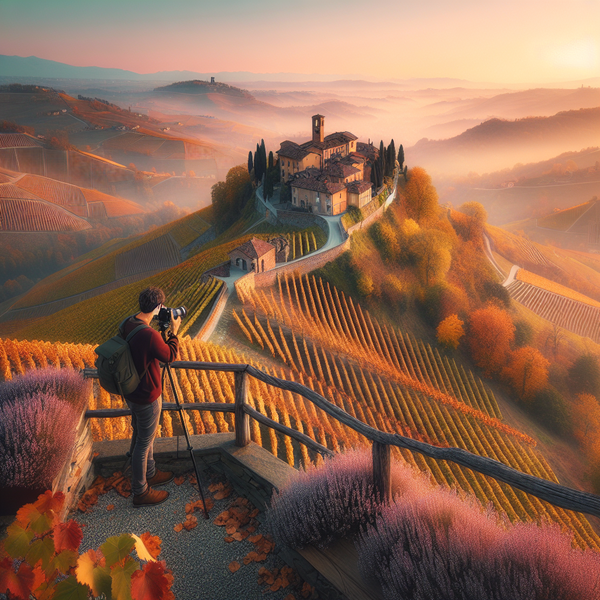
Officially listed among I Borghi più belli d’Italia, Neive manages to feel both perfectly polished and lived-in. The old village curls around a gentle hill crowned by the clock tower of San Michele. From Viale dei Caduti, the northern approach road, you can frame a shot of the entire borgo floating above the vineyards, especially striking in autumn when vines blaze red and yellow. Stop at Bottega dei Quattro Vini on Piazza Italia to taste local Barbaresco from nearby crus like Gallina and Serraboella—then climb to the viewpoint near the former Gancia distillery for another cinematic perspective.
Discover the best local experiences Explore tours and tastings
The UNESCO Wine Landscape Near Grinzane Cavour
The area around Grinzane Cavour Castle is part of the UNESCO-recognized “Vineyard Landscape of Piedmont: Langhe-Roero and Monferrato”. The castle, once home to statesman Camillo Benso Count of Cavour, now hosts a regional enoteca and annual truffle auction. Walk the short circular trail behind the castle, marked by brown signs, to see textbook vineyard rows aligned with Renaissance precision. Drones are allowed only outside the protected perimeter, so best to bring a handheld camera or smartphone with a wide-angle lens for panoramic shots. In late October, morning fog lingers, producing ethereal scenes that have become symbolic of the Langhe’s beauty.
Walks and Vantage Points Among the Barbaresco Hills
Barbaresco lies on the other side of the Tanaro River, and its views are smaller in scale but more intimate. The town’s medieval tower, recently reopened after restoration, provides a 360-degree viewing platform for just a few euros entrance. From the top, you can trace the Tanaro’s meandering line and follow the gentle folds leading to Neive and Treiso. For a lesser-known perspective, drive to the church of San Donato near Tre Stelle hamlet; the road edges along vine rows and finishes in a quiet clearing ideal for a picnic. Even locals come here at sunset for the copper light slanting through Nebbiolo vines.
Hidden Beauty of the Alta Langa
Beyond the famous Barolo and Barbaresco zones lies the Alta Langa, a highland of chestnut woods, hazelnut groves, and lonely ridges. Towns like Bossolasco and Murazzano sit above 700 meters altitude, offering cooler air and wild horizons that stretch to the Maritime Alps. The drive from Dogliani up SP56 twists through open vistas often empty of traffic. In July, lavender fields near Sale San Giovanni add a sudden shot of Provençal color to the Piedmontese palette. For lunch, the agriturismo Cascina Le Langhe outside Bossolasco serves tajarin pasta with sage from its garden, and from its terrace you’ll see the vineyards giving way to forest—a perfect transition between cultivated and wild Langhe.
Sunset Views Over Castiglione Falletto
For an unforgettable end-of-day panorama, head to the viewpoint on Via Alba at Castiglione Falletto. The small stone platform overlooks concentric rings of vineyards, with Serralunga’s tall tower glowing in the background. The location faces west, so sunsets here are vibrant and rarely crowded. Bring a small picnic or a glass from one of the nearby enotecas—the locals won’t mind if you stay until the last light. The ample parking just below the castle makes it an easy stop even on a day of multiple tastings.
Photography Hotspots Near Benevello and Treiso
If you’re into landscape photography, the roads linking Benevello, Treiso, and Mango offer some of the most seductive lines in all the Langhe. Each hairpin curve reveals a different depth of the Tanaro valley. The SP31, specifically the stretch between Treiso and Mango, has two road lay-bys frequently visited by photo workshops at dawn. You’ll catch the fog lying low over the vineyards, broken by cypress-like poplars and occasional bell towers. Just remember local etiquette: never walk into the vines without permission, and if you meet a grower on a tractor, a quick wave and a friendly “buongiorno” go a long way.
Practical Tips for Exploring the Scenic Langhe
To get the most from the Langhe’s scenic spots, travel between late September and November, when harvest and autumn colors coincide. Renting a small car in Alba is straightforward, but choose manual transmission if you’re comfortable—it handles the steep, narrow local roads more efficiently. Distances are short: Alba to Serralunga is only 15 kilometers, but the views along the way demand unhurried driving. Carry a refillable water bottle; small fountains in nearly every village provide cool spring water. If you prefer not to drive, guided e-bike tours along the La Morra–Barolo ridge offer a slower, equally scenic alternative.
Where the Landscape and Wine Meet: Sensory Harmony
In the Langhe, sight and taste are inseparable. The vineyard patterns you admire from La Morra or Neive are the same that define Barolo and Barbaresco’s aromas. Visit a winery like Marchesi di Barolo or Cantina del Glicine and ask to step into their vine rows; most hosts will gladly show you the soil differences that create terroir. There’s a poetic yet tangible satisfaction in sipping a glass of Nebbiolo while identifying the exact ridge from which it came. In the Langhe, every scenic viewpoint serves as both a photo opportunity and a geography lesson in how beauty becomes flavor.
Exploring the Langhe means reading a landscape of extraordinary precision, one terraced line at a time. Whether you stand beneath Serralunga’s medieval tower, watch mist rise from the Barbaresco hills, or drive a lonely Alta Langa ridge, the region reveals itself patiently. Its most scenic spots are not just places to see—they are coordinates of memory shaped by wine, labor, and light. Return after the harvest or at the first spring bud; either way, the Langhe’s beauty will still be quietly waiting, vine by vine.