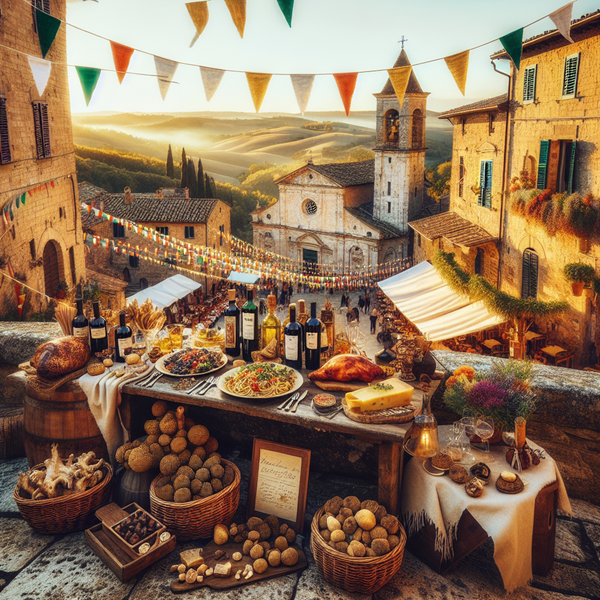
There’s no better way to understand Italian life than by spending a day at a village festival where locals gather to celebrate saints, harvests, and ancient crafts that never quite disappeared. These events, tucked into remote hills and often advertised only on handwritten posters at the bar, are where rural Italy reveals its truest rhythm — slow, generous, and fiercely proud of local identity.
Go to the section
ToggleHow Italian Village Festivals Keep Rural Traditions Alive
Every rural region in Italy has its own sagra — a traditional festival celebrating a local product or saint. In Piedmont’s Langhe region, you might stumble upon a Sagra del Tartufo Bianco in small towns like Monchiero or Roddi, where truffle hunters show off their finds under striped tents. In Basilicata’s hilltop town of Trivigno, the August Festa della Madonna del Carmine fills narrow lanes with brass music and homemade limoncello offered from doorways. These festivals rarely appear in mainstream guides but are carefully sustained by village committees.
What sets them apart is participation: villagers cook, decorate, and serve guests directly. There isn’t a corporate sponsor banner in sight, but rather handwritten menus and aunties serving up regional dishes like agnolotti del plin or pasta con i peperoni cruschi. If you’re lucky, someone will tell you which grandmother still makes her dough the old way.
Regional Hotspots for Hidden Italian Festivals
Some regions have a denser calendar of traditional events than others. In Abruzzo, the mountain town of Scanno hosts the Processione della Donna in Costume, where local women wear black shawls and golden jewelry dating back to the 18th century. In Umbria, tiny Cannara organizes a Sagra della Cipolla every early September celebrating the humble onion, drawing locals from Assisi and Perugia. You can taste caramelized onion focaccia for a few euros and join communal dances in the piazza.
In Sardinia’s Barbagia region, autumn brings the Cortes Apertas series: open-house weekends across towns like Orgosolo and Mamoiada, where families open their courtyards and bake pane carasau and sebadas before guests’ eyes. These aren’t tourist performances; they’re windows into daily life that otherwise remains private. If you drive between villages, you’ll see hand-painted signs showing where the next weekend’s celebration will be — a reliable indicator you’re on the right road.
When and How to Find Lesser-Known Village Festivals
Most rural Italian festivals follow the agricultural calendar, with a concentration between May and October. Spring brings asparagus and cherry festivals in Veneto’s hill villages like Marostica and Cerea; summer favors saintly processions and nighttime dining tables stretching across streets; autumn honors wine, truffles, and chestnuts from Piedmont to Tuscany.
Finding these festivals requires patience. Skip global event listings and instead look at municipal Facebook pages — search for “Pro Loco” plus the town name (e.g., “Pro Loco Montemerano”). These volunteer-run associations are the backbone of small-town life and post posters, menus, and timetables. In person, visit the local tabacchi or café: bartenders can tell you which valley has the best fireworks or where to find a porchetta roasting that weekend.
Weekend road trips in rural regions are ideal for catching spontaneous celebrations. Renting a small car from a regional hub like Perugia or Bari gives flexibility to stop in villages whose church bells echo from the next hill — a sure sign something’s happening nearby.
Practical Tips for Getting Invited and Blending In
Small festivals thrive on community, and visitors quickly become part of the scene if they show genuine interest. Arrive early — Italians often eat dinner late, but food stalls open by 7 p.m. Bring small cash for food tickets since few places accept cards. A reusable cup or plate shows respect for the environment; many Pro Loco committees appreciate visitors who reduce waste.
Be curious but discreet about taking photos, especially in religious processions. Ask “Posso?” before snapping shots of costumed participants. If you learn a few basic phrases like “Che buono!” or “Posso avere un bicchiere di vino rosso, per favore?”, you’ll earn sincere smiles. Sit family-style wherever seats are available — you’ll likely be served by someone whose cousin organized the event.
Some towns also host contests, like palio-style donkey races or pasta-making competitions. Local judges appreciate volunteers to help tally votes, so if you’re offered an apron, it’s an invitation worth accepting.
Unusual Festivals Where Authenticity Outshines Tourism
To go beyond the obvious, aim for celebrations still flying under radar. One gem is the Festa dei Ceri in Gubbio, Umbria — a pre-Medieval race where gigantic wooden candles are carried uphill by teams dressed in yellow, blue, and black. It’s not a reenactment; it’s faith, duty, and community rolled into a single, adrenalized sprint. In Calabria’s Bova, the Grecanica community revives ancient Greek rites through music and dance that echo between stone alleys.
In the Dolomites, the Desmontegada marks the cows’ return from alpine pastures. Villagers in Val di Fassa decorate cattle with garlands, and you can sample formaggio fresco directly from the farms. Far from being staged for visitors, these are annual reunions of farming families and mountain guides who celebrate another year of survival above 2000 meters.
Smaller still are the “feste paesane” celebrating saints or new wines. In the Marche’s Montefalcone Appennino, the early November Festa del Vino Cotto honors a lesser-known regional dessert wine. Attendees are handed clay cups filled from communal barrels, a practice banned in larger cities for hygiene reasons but still enjoyed safely in villages where everyone knows each other.
Why Authentic Village Festivals Matter to Rural Italy’s Future
Italy’s rural towns face steady depopulation, yet festivals offer a powerful glue holding generations together. The organization of a single sagra involves teenagers designing posters, bakers contributing bread, and elderly residents teaching dance steps. Tourist participation, when respectful, helps fund restoration of parish churches and community halls. For the visitor, it’s an exchange: you bring curiosity, and in return you witness living heritage preserved through laughter, recipes, and shared benches.
Even off-season, village leaders often keep contact with festival-goers through local associations. Don’t discard the flyers you pick up — next time you visit, the same number may reach you to a neighbor who remembers your curiosity for their special dish.
Final Thought: Traveling Where Memory Still Tastes Homemade
Seeking village festivals in rural Italy requires flexibility but rewards you with a sense of belonging no itinerary can guarantee. Trade famous squares for fields where accordion notes travel farther than Wi-Fi, and you’ll find the kind of authenticity travelers endlessly chase. The next time you pass a cluster of chairs under fairy lights and smell grilled sausages in the distance, park your car — you’ve just found Italy’s most welcoming invitation.