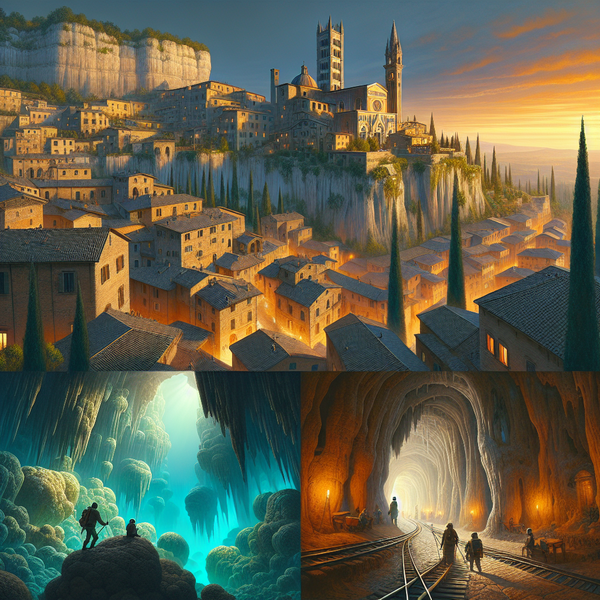
Italy is full of treasures above ground—cathedrals, piazzas, vineyards—but some of its most extraordinary stories are buried just below your feet. Beneath the sunlit towns and ancient stone walls lies another Italy: a labyrinth of rock-cut dwellings, medieval cisterns, and echoing dripstone caverns. Exploring these underground worlds reveals a side of Italian life shaped by necessity, devotion, and geology. These are not tourist gimmicks but living museums carved from volcanic tuff, limestone, and saltwater-karst—each one a testament to how Italians learned to live with, and within, their land.
Go to the section
ToggleOrvieto Underground: Tunnels beneath the Umbrian Cliff Town
From the main square of Orvieto, where the Gothic cathedral’s mosaic façade blazes in sunlight, few suspect that a honeycomb of more than 1,200 hand-dug caves lies below. This network dates back to Etruscan times, when residents carved wells and pigeonholes into the volcanic rock for water and food security. Guided tours leave from Via della Pace and last about an hour, exposing visitors to olive presses, cisterns, and rooms cut with precision centuries before modern tools existed. The experience is both fascinating and practical—it explains how a city perched on a cliff stayed self-sufficient through sieges and droughts.
In summer, temperatures underground stay consistently around 14°C (57°F), a welcome relief compared to the midday Umbrian heat above. Bring a light jacket and comfortable shoes with good grip—the tuff floors can be damp.
Sassì di Matera: Ancient dwellings in stone and shadow
Few places capture the layered depths of Italy’s underground history like Matera in Basilicata. Once considered a shameful symbol of poverty, the Sassi—rock-hewn dwellings stacked along a ravine—now stand as UNESCO-protected marvels. Many of the ancient houses were carved directly into calcareous limestone, expanding downward into hidden rooms and cisterns. The Casa Grotta di Vico Solitario, for instance, gives visitors a realistic glimpse into how entire families lived in these subterranean homes until the mid-20th century.
Most streets in the Sassi feel more like rooftops of the homes below, creating a vertical jigsaw of doorways and caves. For the most atmospheric visit, go just before sunset: light slants into the canyon, emphasizing every contour. Stay overnight in a renovated cave hotel like Le Grotte della Civita to experience the sensory calm only stone walls can give.
Naples Underground: The Subterranean Soul of a Lively City
Beneath Naples’ Spaccanapoli district, another world hums quietly below the chaos of scooters and espresso bars. Known as Napoli Sotterranea, this intricate maze of tunnels was originally quarried by the Greeks for building stone, then reused as aqueducts and air-raid shelters. You enter through Piazza San Gaetano, descending 40 meters by staircase into cool silence broken only by dripping water and distant echoes.
One of the most striking features is the network’s wartime graffiti—charcoal names and sketches that personalize what could otherwise feel purely historical. Don’t skip the ancient Roman aqueduct passageway; guides hand out candle-like lamps, turning the tour into something between archeology and adventure. To book ahead, use the official Napoli Sotterranea site, as daily walk-ins can fill quickly, especially on weekends.
Grotte di Frasassi: Italy’s Grand Underground Cathedral
In the Marche region, the Grotte di Frasassi near Genga form one of Europe’s largest karst systems. The initial chamber—the Ancona Abyss—is large enough to envelop Milan’s cathedral. Discovered accidentally by speleologists, these caverns now boast a well-maintained circuit of paths and gentle steps illuminated artfully to protect the fragile stalactites and stalagmites. Standard tours take about 75 minutes, but for those who want the thrill of exploration, the ‘Speleo-Adventure’ route (bookable on-site) involves crawling through narrow corridors wearing helmets and overalls.
Frasassi’s underground temperatures hover at a steady 14°C (57°F). Photography is permitted without flash, and the lighting makes the calcite formations glow like underwater coral. There’s a small café and parking area at the entrance of the Parco Naturale Regionale della Gola della Rossa e di Frasassi, reachable by shuttle from the ticket office in the nearby village of San Vittore di Genga.
Palermo’s Catacombe dei Cappuccini: Faces of the Past Beneath Sicily
Visiting Palermo’s Capuchin Catacombs is less about geology and more about Italy’s striking relationship with mortality. Beneath the Capuchin monastery on Piazza Cappuccini, corridors display thousands of mummified bodies—monks, nobles, children—carefully preserved between the 16th and early 20th centuries. The corridors are divided by social groups: priests, virgins, professionals. Though it can be unsettling, the atmosphere is curiously reverent rather than macabre.
Photography is strictly prohibited, partly to protect the fragile remains and partly to maintain respect. The site is open daily except for public holidays, and modest clothing is required. The catacombs are easily accessible by a 15-minute bus ride (line 327) from Palermo’s city center. Avoid high summer midday visits—the heat above and humidity below can be stifling.
Cupramontana’s Hidden Wine Cellars in Le Marche
Beneath the vineyards of Cupramontana, the air smells faintly of oak and limestone dust. Local winemakers have been aging Verdicchio wine in underground cellars carved directly into the sloping hillsides. Some, like the Migliori family’s cantina, allow appointments for tastings inside these vaulted spaces where humidity remains ideal year-round. Beyond the sensory pleasure, the visit reveals a centuries-old agricultural engineering practice: controlling temperature without electricity by using the natural insulation of stone.
Unlike show caves, these cellars require prior arrangement through the Marche tourism office or directly with producers. Bring a small torch and avoid perfume, which interferes with wine aromas. Many of these cellars connect to small tunnels once used as cool storage passages—reminders that Italian ingenuity often starts underground.
Chiusi Underground Labyrinths and the Etruscan Connection
Chiusi, in southern Tuscany, holds perhaps the most enigmatic underground network in central Italy. Known locally as Labirinto di Porsenna, these twisting corridors were likely Etruscan water channels. At the end lies a Roman-era cistern with smooth walls reflecting torchlight like polished marble. The entrance is through the Museo della Cattedrale near Piazza Duomo; guided visits run several times per day in both Italian and English.
What sets Chiusi apart is its continuity: villagers repurposed the tunnels over the centuries, using them for war shelters and, later, as cool basements. Standing here, you sense how civilizations literally built upon one another—layer after layer of stone and time. Combine this visit with the Etruscan tombs just outside town for a more complete archaeological picture.
Grotte di Castellana: Puglia’s Underground Landscape of Light
South of Bari, the Grotte di Castellana stretch for about three kilometers under karstic limestone. The ‘Grave,’ their opening chamber, drops 60 meters from the surface, letting a shaft of daylight pierce the darkness. Beyond it, guided tours lead past stalagmites shaped like curtains, columns, and even organ pipes. The final stop, the “White Grotto,” glows with pure calcite crystals reflecting any stray beam of flashlight.
To avoid crowds, arrive for the first tour at 10 a.m. or late in the afternoon. Helmets aren’t necessary for the standard route, but sturdy footwear helps. The caves maintain a constant 16°C (61°F), and English-language tours are offered several times a day. Nearby Alberobello, famous for its conical trulli houses, makes an ideal overnight pair with this subterranean spectacle.
Tips for Exploring Italy’s Underground Cities and Caves Responsibly
Most Italian underground attractions limit visitor numbers for preservation, so booking ahead is a smart move. Follow these guidelines to ensure a safe and respectful experience:
- Dress appropriately: Even in midsummer, underground sites remain cool and damp—light layers and closed shoes are best.
- Mind humidity: Bring a lens cloth for cameras; condensation forms quickly when descending from warm air to cool caves.
- Stay on marked paths: Foot traffic can damage fragile formations and centuries-old structures.
- Respect silence: Sound carries far in cavern systems—whispering keeps the atmosphere serene and prevents echo distortion.
Exploring Italy’s subterranean landscapes reveals how deeply the country’s culture and geology intertwine. Beneath the postcard views lies another Italy—one of resilience, craft, and quiet wonder still pulsing beneath the stone.