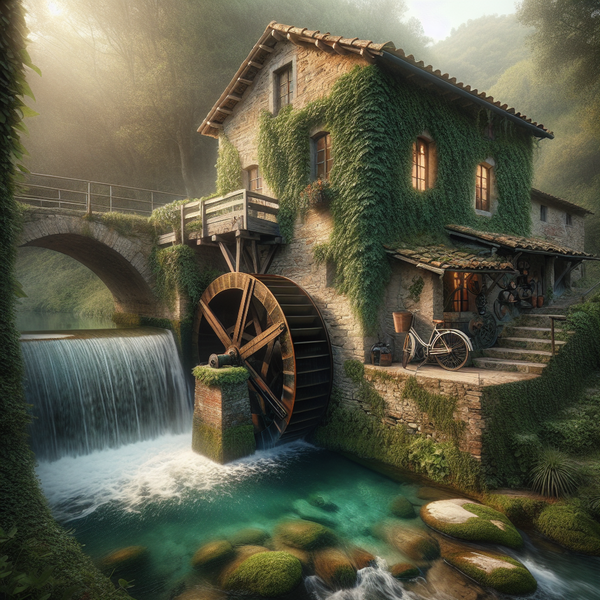
The rhythmic hum of turning wheels once drove much of Italy’s rural life, and today, historic water mills still dot the landscape — silent storytellers of centuries-old ingenuity. Beyond their rustic beauty, these mills remain extraordinary examples of early engineering that channeled nature’s power into community life. From alpine valleys to coastal hillsides, they remind visitors that Italy’s history is as much about water and craft as it is about marble and empire.
Go to the section
ToggleHistoric Water Mills in Tuscany: The Heartbeat of the Countryside
Tuscany’s hills have long been irrigated by networks of small rivers and streams, ideal for medieval milling. Near Lucca, the Mulino di Piezza in the Garfagnana valley still stands along the Serchio River. This mill’s wooden mechanisms, restored using traditional carpentry methods, show how families once ground chestnuts into flour — a regional staple still baked today as necci pancakes. Visitors can watch demonstrations between April and October, with local guides explaining how seasonal water flow dictated the rhythm of village life.
Closer to Siena, the Molino di Quercegrossa offers a different story. It once supported an entire farming hamlet and now operates as a small agriturismo. Staying overnight means waking to the sound of the stream that still powers the wheel, then sampling handmade pici pasta kneaded with flour milled on-site. The juxtaposition of function and hospitality makes this among Italy’s most engaging historic milling experiences.
The Alpine Ingenuity of South Tyrol’s Ancient Mills
In the mountain valleys of South Tyrol, the rhythm of water over stone becomes sharper and faster, mirroring the rugged peaks above. The Val di Funes Mill Trail (or Mühlenweg) connects several restored mills accessible via a marked path starting near the village of St. Peter. The most photogenic, the Romesmühle, has its undershot wheel still turning during summer demonstrations. Hikers often pair the visit with tastings of rye bread baked using flour from the same mill.
Another fascinating site is the Pfalzen Mill Museum near Brunico. This educational complex explains Alpine water rights — an essential topic given how every drop was once contested. Inside, interactive exhibits allow visitors to operate scale models, revealing the physics behind these centuries-old structures. Visiting early in the morning gives the best light for photography, as the sun filters through larch branches onto mossy spillways.
Hidden Treasures of Umbria: Water Mills Along the Clitunno and Nera Rivers
Umbria’s mills often feel secretive, shaded by poplars and half-hidden by ivy, yet their presence is integral to the region’s agrarian roots. The Mulino Spello, located just outside the medieval town of Spello, stands on the original Roman road via Flaminia. Its millrace still channels water diverted from the Topino River, and visitors can see old millstones carved from local Apennine limestone. Nearby cafés sell biscuits made with freshly ground farro, offering a direct taste of continuity from past to present.
Further south in the Valnerina, the Mulino di Sant’Anatolia di Narco forms part of the “Eco Museo della Valnerina,” a distributed museum highlighting pre-industrial technologies. Here, short interpretive walks link multiple mills, offering travellers a slow rhythm that matches the murmuring river. Guided tours in English are available on weekends from late spring through early autumn, and they emphasize biodiversity preservation alongside historical restoration.
Sardinia’s Coastal Mills: Harnessing Sea Breezes and Stream Currents
While the island of Sardinia is often associated with windmills, several water-powered mills remain preserved in the northwest. Near Bosa, the Mulino Sa Codina sits at the junction of freshwater and brackish tide. This rare positioning created a hybrid system where river current combined with tidal movement — a local adaptation to the island’s dry summers. The restored wheel is viewable daily, and artisans on site still produce coarse semolina used for traditional malloreddus pasta.
In the mountainous Barbagia region, tiny streams fed mills essential for processing barley, once the region’s main cereal. A cluster of these is preserved near Oliena, reachable via a marked trail that also connects vineyards. The Mulino Su Gologone was later integrated into a boutique hotel that preserves its original water channel right beside the restaurant terrace — an unusual opportunity to dine beside a working watercourse while tasting local bread made from freshly milled grains.
Northern Piedmont and the Rice Mill Legacy Along the Sesia River
Piedmont’s relationship with water mills differs from other regions: here, mills often processed rice rather than wheat. The Mulino San Giovanni di Costanzana, near Vercelli, is one of Italy’s few fully functioning historic rice mills still using hydraulic power. Its polished wooden machinery cleans and husks grains with gentle precision, preserving texture prized by chefs. Visitors can book guided tours through the Strada del Riso Vercellese association, often paired with tastings of Carnaroli risotto prepared in nearby trattorie.
Continuing north, the Mulino di Crodo near Lake Maggiore offers a picture-perfect contrast: granite wheels turning beneath Alpine waterfalls. The on-site workshop reveals how these mills not only ground cereals but also powered saws and wool carders, reflecting a self-sufficient mountain economy. Bring waterproof shoes — the short approach trail crosses several small channels that still feed the structure today.
Veneto’s River Mills: Industrial Heritage Along the Sile and Brenta
The Venetian mainland developed its water mills into early industry, supplying flour to the Republic’s merchants. The Mulino Cervara on the Sile River, now a protected natural reserve near Treviso, represents one of the most accessible examples. Visitors can wander wooden walkways above the wetlands while observing the perfectly balanced paddlewheel still rotating in slow rhythm. The interior museum demonstrates how sluices controlled by hand-carved levers regulated the water — an elegant marriage of craftsmanship and hydraulics.
Meanwhile, the Mulino di Dolo along the Brenta Canal tells a story of trade rather than farming. It was part of a network that processed and shipped flour to Venice itself via boat. Today, the stone building hosts exhibitions and occasional live milling days where visitors can purchase finely milled polenta flour, its golden color unique to the Venetian plains. Arrive on Saturday mornings for the weekly farmers’ market that fills the canal banks nearby.
Historic Water Mills in Lazio and Abruzzo: Rural Resilience and Revival
Outside Rome’s metropolitan area, the region of Lazio hides several restored mills along the Aniene River. The Mulino delle Mole near Tivoli displays the depth of Roman influence — remnants of ancient aqueduct engineering still visible near its modern wheel. The surrounding trails link the mill to Villa Gregoriana Park, making it an ideal pairing for travelers interested in ancient water management.
Further east, in Abruzzo, the Mulino di Capestrano along the Tirino River is part of a renewed eco-tourism effort that teaches traditional breadmaking. Its wheel, once abandoned, was reconstructed using local oak. The soft clatter of its gears accompanies workshop participants as they knead dough using spelt flour ground on-site. It’s a hands-on way to connect with rural Italy — not through nostalgia, but through genuine craft.
Planning a Water Mill Itinerary Across Italy
Exploring Italy’s water mills can easily fill a week or two depending on interest, and most can be reached by regional train or rental car. A practical itinerary begins in Florence, linking the Garfagnana mills with Umbria’s Clitunno valley via short scenic drives. Those seeking variety should add extensions north to South Tyrol or south toward Abruzzo. Remember that many historic mills operate seasonally, usually from April to October, when water flow and daylight enable demonstrations.
When planning visits, it helps to contact mills directly — many are family-run or community-managed foundations. Few charge more than a modest entrance fee, and several double as small museums or homestays. Packing light hiking shoes enables easy access to most sites, while carrying reusable water bottles maintains Italy’s new sustainability guidelines that limit single-use plastics even in rural areas.
Why Italy’s Water Mills Still Matter Today
These historic sites are not simply scenic relics; they illustrate how Italians once balanced productivity with nature. Modern interest has inspired a wave of restorations emphasizing renewable energy education. Projects from South Tyrol to Puglia now use surviving mill structures to teach micro-hydroelectric concepts alongside local history. Visiting them provides rare insight into a continuum of innovation — proof that centuries-old wheels still turn meaningfully today. So next time you hear water tumbling beneath a stone arch somewhere in rural Italy, pause: you may be hearing history still in motion.