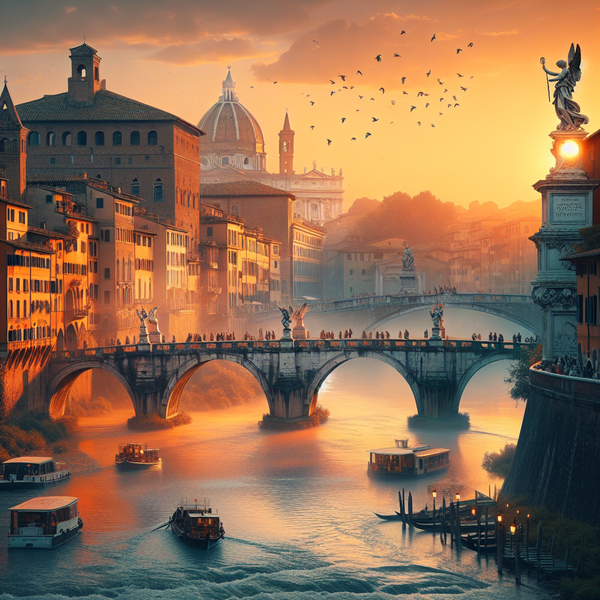
Few countries compress so much history into their bridges as Italy. Each span, from Roman aqueduct arches to medieval merchant crossings, carries centuries of engineering genius and civic life. To travel Italy through its historic bridges is to step across time — a journey grounded in stone rather than sentiment.
Go to the section
ToggleThe Engineering Grace of Florence’s Ponte Vecchio
The Ponte Vecchio is more than a postcard icon. Crossing the Arno River between Via Por Santa Maria and Via de’ Guicciardini, its lower deck still hums with the goldsmiths who replaced meat vendors in the 16th century. At dawn, the bridge’s shuttered shops glow in bronze light reflected off the Arno’s calm surface — one of the few moments locals linger before tourist crowds swell. Walk its length and notice the Vasari Corridor above: that elevated walkway once allowed the Medici to move privately between their palace and offices, a practical detail of Renaissance power hidden in plain sight.
Rialto Bridge: The Venetian Centerpiece of Commerce and Craft
Venice’s Rialto Bridge remains both the city’s spine and its showcase of resilience. The single stone arch, spanning the Grand Canal at its narrowest point, replaced a wooden version that kept collapsing under the weight of traders and goods. From the bridge’s midpoint, you can spot the morning vaporetti maneuvering beneath, a scene unchanged in rhythm even as technology modernized. Nearby, the Rialto Market fills with lagoon fish and purple artichokes from Sant’Erasmo Island — a vivid reminder that the bridge has always linked food, trade, and people as tightly as it connects districts.
Ponte Sant’Angelo: Rome’s Sacred Passage to the Tiber Banks
Ponte Sant’Angelo may be Rome’s most theatrical bridge. Commissioned by an emperor and later crowned with ten angels sculpted under Bernini’s direction, it leads directly to Castel Sant’Angelo — the former mausoleum turned papal fortress. The bridge’s travertine steps, worn concave by hundreds of years of pilgrims en route to St. Peter’s, serve as a subtle tribute to devotion through repetition. Cross at twilight, when street musicians set up at the midpoint arch; the way the Tiber reflects the fortress walls then makes the whole scene hum with centuries of layered faith and pageantry.
Verona’s Ponte Pietra: Roman Roots and Wartime Resilience
Ponte Pietra, or Stone Bridge, in Verona exemplifies continuity across eras. Originally a Roman structure connecting the ancient city with the hill of San Pietro, it bears distinct materials for each phase of reconstruction — white marble blocks by the Romans, alternating red brick arches from later medieval repairs, and postwar restorations blending both. Stand on Via Ponte Pietra at sunset, and you’ll see the Adige River’s strong current slicing between its arches, proof of an engineering feat adapted to both natural and political floods. The nearby Teatro Romano, visible across the bank, reinforces how bridges were integral not only for transport but also for urban planning.
Ponte di Tibeouta: The Silent Archways of Rimini
Rimini’s Ponte di Tiberio — often called Ponte d’Augusto e Tiberio — is a Roman masterpiece of stability. The five limestone arches over the Marecchia River have withstood earthquakes, floods, and even World War II bombings. The bridge still supports vehicles today, which surprises drivers used to Italy’s pedestrian-only monuments. Locals casually cross it for their morning coffee at Borgo San Giuliano, the pastel fisherman’s district known for murals celebrating Fellini’s films. The tactile experience of walking its deeply grooved stone pathway connects you quite literally to ancient footsteps in the same spot.
Ponte delle Torri in Spoleto: The Umbrian Giant Suspended in Silence
Stretching dramatically between the Rocca Albornoz fortress and Monteluco hill, the Ponte delle Torri is Umbria’s breathtaking hybrid of aqueduct and bridge. Measuring over two hundred meters long and supported by ten arches, it once carried water to the medieval city. The path along its top, though currently under preservation review, has long been a favorite viewpoint for watching the gradual shift of green valleys into dusk. Even locals tend to fall silent here; the height and geometry of the structure create a dizzying sense of proportion between human craft and nature’s scale.
Ponte Gobbo in Bobbio: The Devil’s Bridge of Emilia-Romagna
Ponte Gobbo, nicknamed the “Hunchback Bridge,” crosses the Trebbia River in the small town of Bobbio. Its irregular 11 arches don’t align — a quirk that feeds its legend involving a nocturnal pact with the devil. In practical terms, the irregularity allowed medieval builders to adapt to uneven river rocks. Visiting in early summer, when locals bathe in the river’s clear pools, reveals how the bridge still mediates between community myth and everyday leisure. The stones are polished smooth from centuries of current, so sturdy shoes are advisable if you climb down to the shore for photographs.
Ponte Vecchio of Bassano del Grappa: Venetian Timber and Alpine Tenacity
Few bridges embody local identity as completely as Bassano’s Ponte Vecchio. Designed by Andrea Palladio, its wooden structure spans the Brenta River and has been rebuilt numerous times following floods. The covered passageway resonates when walked upon — each step clattering against timber beams that the mountain carpenters still restore by hand. At its midsection, the Nardini Grappa bar serves tiny glasses to travelers pausing for a view of Monte Grappa — a living ritual rather than a tourist gimmick. Bassano’s citizens consider the bridge part of their civic psyche; during festivals, the town decorates it with flowers and flags as if dressing an elder relative.
Naples’ Ponte di Maddalena: The Hidden Gothic Marvel
Naples hides many wonders in plain sight, and the old Ponte di Maddalena is one of them. Standing near the modern Corso Garibaldi, it once marked the main route south from the historic center toward Portici. While much of it is now encased in later reclamations, fragments of the Gothic arch still protrude between newer constructions — a relic surviving the city’s turbulent expansions. For an authentic glimpse, approach from Via Marina at low tide, when the lower masonry becomes visible and locals fish with hand lines beneath its remnants. The bridge’s story teaches how Naples’ infrastructure evolves layer by layer without erasing its past.
Ponte della Maddalena in Tuscany: The Devil’s Mirror in the Serchio Valley
Near the town of Borgo a Mozzano, north of Lucca, the Ponte della Maddalena curves upward in a daring asymmetrical arc that seems to defy gravity. Its nickname — Ponte del Diavolo — stems from a legend similar to Bobbio’s, but here, the reflection on the Serchio River forms an almost perfect oval when the water is still. Reach it by car from Lucca in under 30 minutes; locals recommend going at dawn when mist wraps around the supports, making photographs subtly surreal. Though medieval in origin, it remains open to pedestrians and cyclists, offering one of Tuscany’s sharpest juxtapositions of mysticism and masonry.
Ponte Romano of Aosta: Alpine Testament to Roman Skill
Aosta’s Ponte Romano proves that solidity can be elegant. Built along the Via delle Gallie, its single arch of silvery stone still spans the Buthier Stream just outside the city’s Porta Praetoria. Although often overshadowed by nearby Roman ruins, it captures the essential balance of form and function typical of the empire’s northern provinces. The surrounding Alpine backdrop heightens the drama of its simple curve — an irresistible subject for winter photographers when frost highlights every chisel mark. Because the modern riverbed shifted slightly over centuries, the bridge today stands on dry land, a reminder that nature sometimes redrafts its own maps.
Ponte dell’Accademia: Venice’s Modern Heritage Link
Among centuries-old bridges, Venice’s Ponte dell’Accademia stands as a postscript demonstrating continuity in innovation. Though wooden, this 20th-century reconstruction follows the form of earlier steel and iron versions, connecting the Dorsoduro district to San Marco across the Grand Canal. Its broad steps accommodate both photographers and evening strollers observing the curve of the canal toward Santa Maria della Salute. Join the locals here at dusk; that’s when the bridge becomes a makeshift bleacher for the city’s most democratic view — accessible, familiar, and still graceful in wood and steel.
Traveling Between Italy’s Historic Bridges Efficiently
Italy’s spread of iconic bridges covers nearly the entire peninsula, making strategic routing essential. One ideal route begins in Verona, continues through Florence and Bologna (via Bobbio), then north to Bassano del Grappa, before finishing in Venice. For southern regions, starting in Rome and moving toward Naples, then crossing inland through Umbria and Tuscany toward Lucca, yields a complementary circuit rich in medieval crossings. Train travelers can rely on the efficient high-speed connections between major cities, while renting a small car offers flexibility to reach the river valleys where many lesser-known bridges rest quietly, untouched by mass tourism.
Why Italy’s Historic Bridges Endure
Beyond aesthetics, Italy’s bridges endure because they were designed as part of living systems. Their materials — limestone, brick, timber — were sourced locally, repaired cyclically, and integrated within civic routines. Even modern engineers study structures like Ponte Tiberio to understand seismic resilience achieved without modern reinforcement. For travelers, recognizing that continuity adds dimension: every step across a bridge here connects not only the banks but also the past and the living present — architecture as daily experience rather than background décor.