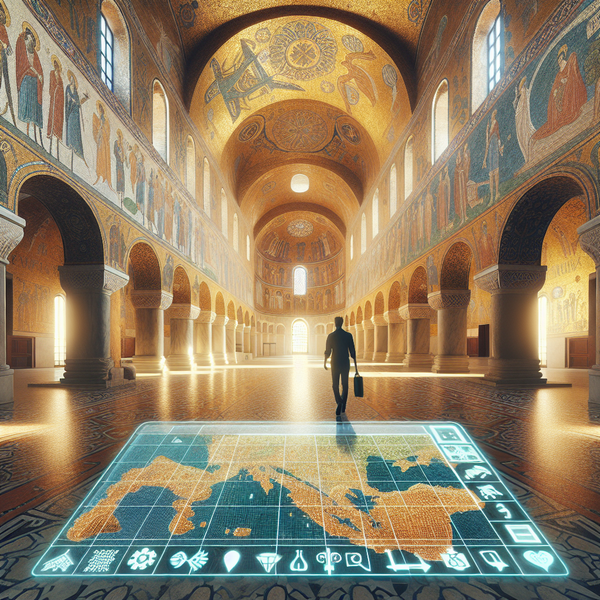
Ravenna sits quietly on the northeastern plain of Emilia-Romagna, far from the crowds of Venice or Florence, yet it once commanded an empire. Between the 5th and 6th centuries, this modest city became the capital of the Western Roman Empire, then of the Ostrogothic Kingdom, and later of the Byzantine Exarchate. Each era left its mark in the form of shimmering mosaics — glass, gold, and lapis tesserae — that cover church apses and baptistery domes. Standing beneath them today, you’re not just sightseeing; you’re in conversation with more than a millennium of artistic devotion and political power.
Go to the section
ToggleBasilica di San Vitale: The Jewel of Ravenna’s Byzantine Heritage
The Basilica di San Vitale is where Ravenna’s Byzantine mosaics reach their peak. Built under the Emperor Justinian’s rule, this octagonal church blends Roman spatial ingenuity with Eastern mysticism. The interior bursts into color the moment you step inside. The central apse mosaic, featuring Emperor Justinian and Empress Theodora, is pure political theater rendered in glass and gold. Stand by the presbytery arch and notice the sheep and rivers arranged in geometric precision — theological metaphors presented as art. The church opens daily from early morning until early evening, but visiting at midday helps you catch the mosaics in full natural light filtering through alabaster windows.
Another small but unforgettable detail lies right under your feet: the original marble floors, slightly uneven from age. They tilt gently as if to remind you that centuries have passed, yet the human hand that placed each tile remains present.
Mausoleum of Galla Placidia: Night Sky in Tesserae
Just across the courtyard from San Vitale stands the Mausoleum of Galla Placidia, one of the most intimate mosaic spaces in Europe. Built as an oratory rather than an actual tomb, its cross-shaped interior glows with deep ultramarines and gold stars. The famous ceiling dome — a dark blue sky scattered with golden constellations — looks almost modern in its abstraction. If you linger near the entrance, the dim light amplifies the illusion that you’re standing beneath an infinite cosmos. The small size of the building allows you to study each detail easily, such as the apostles rendered with faint Greek influences in their faces and garments.
Because this site limits entry for preservation, timed tickets often sell out in high season. Buy the combined Ravenna UNESCO Pass online in advance and plan to visit early in the day before bus tours arrive.
Basilica di Sant’Apollinare Nuovo: Processions of Saints and Icons of Everyday Life
The Basilica di Sant’Apollinare Nuovo lines Via di Roma, an easy 10-minute walk from San Vitale. Here, three horizontal registers of mosaics trace Ravenna’s shifting faith — first Arian under Theodoric, then Orthodox after the Byzantine reconquest. Along the nave walls, processions of saints, martyrs, and virgins march toward the enthroned Christ. Unlike the static figures of earlier mosaics, these have personality: gestures vary, robes flutter, feet lift as if mid-step. Look lower, and you’ll find scenes from daily life in Ravenna’s ancient harbor of Classe, with ships docked beside warehouses and courtyards. The apse, rebuilt later, still harmonizes surprisingly well with the 6th-century panels.
Morning visits are best here because the sun enters through the south windows, lighting up the women’s white robes in the south procession. Photography is allowed without flash, so bring a lens that handles low light to capture the detail of the gold backgrounds.
Battistero Neoniano (Orthodox Baptistery): The Earliest Surviving Mosaic Dome
The Battistero Neoniano, or Orthodox Baptistery, hides behind Ravenna’s cathedral and predates most other Byzantine works in the city. Its octagonal interior encapsulates the baptism of Christ in shimmering tesserae. Christ stands waist-deep in Jordan’s turquoise water as John pours baptismal waters from a seashell. Around the dome, twelve apostles move in a hypnotic circle that seems to rotate when you shift your gaze upward. What separates these mosaics from later Byzantine ones is their gentler modeling — still Roman in softness, yet hinted with Eastern stylization. This is where you see the crossroads between old empire and newborn Byzantium.
Because the space is small, visit either just after opening or near closing time; groups pass through quickly, leaving you precious moments alone to absorb the quiet glow.
Basilica di Sant’Apollinare in Classe: Mosaics Set Amid Ancient Silence
About eight kilometers south of city center lies the Basilica di Sant’Apollinare in Classe. You can reach it by bike following the dedicated path from Piazza del Popolo or by local bus Line 4 heading toward Classe. Standing amid open fields and ruins of the Roman port, this basilica is serene. Inside, a vast apse mosaic shows Saint Apollinaris with raised arms among green meadows dotted with white sheep — a symbolic paradise framed by palms and stars. The colors here are cooler and lighter than in San Vitale, reflecting the open countryside light that filters through broad windows. If you have binoculars, use them to study the small medallions of the Evangelists that crown the arch. They reveal exquisite micro-detail invisible to the naked eye.
Attached to the church, a modest museum displays archaeological fragments that help frame the site’s context as once the center of maritime Ravenna. Plan an hour here, including time to sit in the garden outside the apse wall, listening to cicadas hum their own Byzantine rhythm in summer.
Arian Baptistery: Theostheric Faith Preserved in Mosaic
The Arian Baptistery, built during Theodoric’s reign, offers an intriguing contrast to the Orthodox Baptistery. Though smaller, it mirrors similar themes, again showing the baptism of Christ, yet with crucial doctrinal differences. Here, Christ appears younger, almost adolescent, and the dove of the Holy Spirit seems less dominant. The simplicity of lines and limited palette convey Theodoric’s preference for direct clarity over Byzantine luxury. If you visit both baptisteries back to back, you’ll grasp how theology literally took shape in glass tiles. Entry is covered by the same UNESCO combination ticket, so plan them in tandem to avoid returning twice.
Archiepiscopal Chapel (Cappella di Sant’Andrea): Private Faith Behind the Cathedral
This small chapel within the Archbishop’s Museum is Ravenna’s only surviving private oratory of a Byzantine bishop. Dedicated to Saint Andrew, its mosaics immerse you in military and spiritual imagery. The ceiling vault displays a living Christ trampling a lion and serpent — vivid metaphors of triumph — framed by peacocks and vines. Because photography is forbidden inside, most travelers miss its artistry, but its intimacy makes it memorable. The museum ticket also grants access to ivory panels, including the celebrated throne of Maximianus, carved with figures so detailed they rival mosaic precision.
After your visit, have an espresso at the small café just opposite the museum’s exit on Piazza Arcivescovado. It’s a good spot to jot down impressions while the details are still bright in your mind’s eye.
Planning Your Byzantine Mosaic Trail in Ravenna
Seeing all of Ravenna’s Byzantine mosaics comfortably takes two full days. Start at San Vitale and Galla Placidia early on your first morning, continue to Sant’Apollinare Nuovo after lunch, and finish at the Orthodox Baptistery before dinner in Via Cavour. The second day suits an excursion to Classe and a relaxed visit to the Arian Baptistery and Archiepiscopal Chapel. Purchase the Ravenna Mosaics Pass (valid for multiple UNESCO sites over several days) at any participating ticket office. Combined admission streamlines your route and saves you time standing in queues.
For longer stays, consider basing yourself in a boutique hotel near Piazza del Popolo, within easy walking distance of all major mosaics. Evening strolls reveal another dimension of the city: illuminated church domes, faint echoes of choir rehearsals, and mosaic reflections in wet cobblestones after a summer shower.
Beyond the UNESCO Sites: Modern Mosaic Workshops and Hidden Corners
Ravenna’s commitment to mosaic art didn’t end in antiquity. Contemporary ateliers along Via d’Alighieri, such as the Scuola Mosaicisti, teach time-honored methods using classic glass tesserae from Venetian furnaces. Visitors can book short workshops to make their own small panel using Byzantine techniques. Another excellent stop is the TAMO – Tutta l’Avventura del Mosaico museum, where multimedia exhibits explain how artisans cut, set, and polished pieces to create depth and shine. Spending an hour here deepens your appreciation for the craftsmanship behind what you saw in the churches.
Conclude at the city’s quiet public gardens behind the Biblioteca Classense. Sit near the pond and notice local students sketching mosaic motifs in notebooks — proof that Ravenna’s artistry continues to inspire. When you finally leave, traces of gold and cobalt blue might linger in your memory, light captured in glass that has outlasted empires.