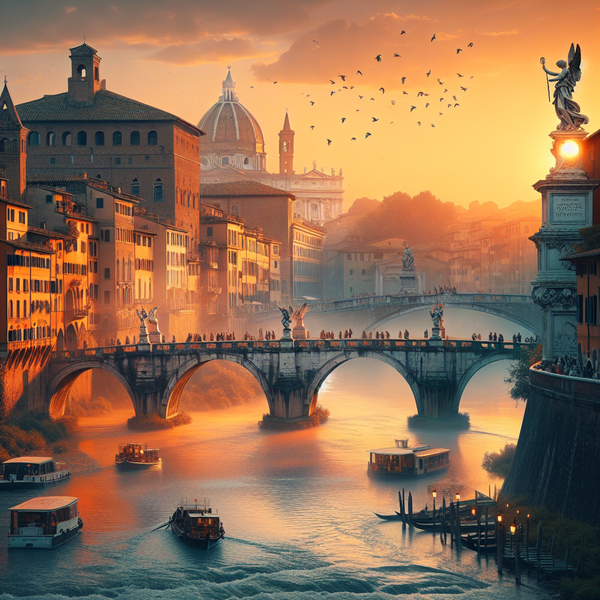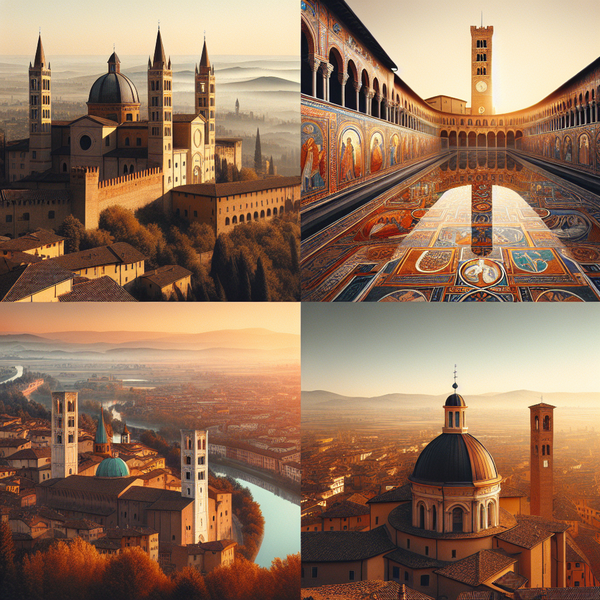
Florence may hold the crown of Renaissance fame, but Italy’s artistic heart beats well beyond its Arno banks. Across the peninsula lie smaller, often-overlooked art cities—places where frescoes illuminate quiet chapels, where locals still greet you by name, and where masterpieces coexist with everyday life. Cities like Urbino, Ravenna, Ferrara, and Mantua reveal a genuine depth of culture far removed from museum queues and souvenir stands. Traveling through them offers not only breathtaking art but also a glimpse into the quiet confidence of Italy’s historical backbone.
Go to the section
ToggleUrbino: The Intimate Renaissance Capital of the Marche
Perched atop twin hills in the Marche region, Urbino feels almost suspended in time. Its compact historic center—encircled by 16th-century walls—invites slow exploration on foot. The highlight is the Palazzo Ducale, home to the Galleria Nazionale delle Marche, where Piero della Francesca’s Flagellation of Christ still hangs mere meters from its original intended setting. The palace’s symmetrical courtyards and double loggia exemplify the humanist ideals championed by Duke Federico da Montefeltro, whose studiolo (private study) with illusionistic wood inlay remains one of the most evocative small spaces of the Italian Renaissance.
Urbino’s rhythm revolves around its university, one of Italy’s oldest, ensuring a youthful presence among cobbled alleys. Cafés like Caffè Basili near Piazza della Repubblica serve espresso to both students and visiting art lovers, while trattorie tucked behind Via Raffaello offer house-made passatelli in brodo and locally produced Verdicchio wine. For overnight stays, heritage lodgings within walking distance of Palazzo Ducale, such as Albergo Italia, give direct access to dusk views over Montefeltro’s misty hills.
Ravenna: Mosaics That Capture the Light of Byzantium
Heading east, Ravenna dazzles with its mosaic-laden basilicas more completely preserved than anywhere else in Europe. UNESCO recognizes eight monuments here—all within easy walking range. The Basilica di San Vitale and Mausoleo di Galla Placidia overflow with gold and cobalt tesserae that seem to shimmer from within. Standing beneath Emperor Justinian’s portrait in San Vitale, you sense the tangible connection between this Adriatic city and distant Constantinople. Guides at the site often use small mirrors so visitors can admire the domes without craning upward—a surprisingly practical detail locals swear by.
Ravenna’s compact layout allows you to explore at a languid pace. Rent a bicycle from one of the rental points near Piazza del Popolo, then cycle to the Classis Museum on the southern edge, set in a converted sugar factory. The museum’s multimedia displays contextualize how an imperial port evolved into a quiet town surrounded by pine forests. To linger, book a night at the family-run Hotel Diana, a short stroll from San Vitale, where breakfast may feature ciambella romagnola—a dense ring cake flavored with anise.
Ferrara: A Renaissance City Planned in Perfect Geometry
Only an hour’s train ride from Bologna, Ferrara stands as one of the rare examples of Renaissance urban planning executed on a real-world scale. The Castello Estense dominates the city center with its red-brick towers and surrounding moat still filled with water. Within its walls, frescoed ducal apartments reveal the ambition of the Este family, whose court attracted luminaries like Giorgione and Ariosto. The 15th-century Quadrivio degli Angeli—an intersection of marble-clad palazzi—symbolizes how art, architecture, and civic expansion merged in this progressive courtly hub.
Cycling remains Ferrara’s unofficial mode of transport; bike lanes trace the entire circuit of its medieval ramparts. Renting from Al Corridoio Bici near Via San Romano costs little more than a coffee per hour, and it’s the smoothest way to spot the contrast between gothic cathedral façades and tree-lined boulevards. Ferrara’s culinary claim to fame, cappellacci di zucca—pumpkin-filled pasta served with butter and sage—makes a satisfying end to a day spent tracing Renaissance geometry.
Mantua: The Court of the Gonzaga and the Birthplace of Perspective
In Lombardy’s southern plain, Mantua (Mantova in Italian) arises amid three artificial lakes formed by the River Mincio. It’s a place of orchestration—both urban and artistic. The enormous Palazzo Ducale spans over 500 rooms, including Andrea Mantegna’s Camera degli Sposi, a fresco cycle whose painted oculus pioneered illusionistic perspective. Booking guided entry online is essential, as daily visitor numbers remain limited to preserve humidity levels. The nearby Palazzo Te, designed by Giulio Romano, shocks with mythological frescoes that seem to tumble from the walls, revealing the Gonzaga taste for the theatrical and the surreal.
Evenings in Mantua often center on Piazza delle Erbe, where locals sip Aperol spritzes beneath arches that once housed merchants. A glass of Lambrusco Mantovano, slightly fizzy and dry, perfectly complements simple regional dishes like tortelli di zucca or risotto alla pilota. Many visitors stay at restored Renaissance residences such as Casa Poli; these boutique sleeps blend period furniture with eco-friendly features—a nod to Mantua’s UNESCO World Heritage stewardship that emphasizes sustainable tourism.
Padua and Vicenza: Northern Italy’s Quiet Giants of Art and Architecture
Between Venice and Verona, Padua and Vicenza deliver high culture minus the crowds. Padua’s revered Scrovegni Chapel contains Giotto’s fresco cycle of the Life of the Virgin, considered a cornerstone of Western art; access is strictly timed in 15-minute slots to protect the climate system. Visitors check in first at the adjacent Eremitani Civic Museum before being ushered into the temperature-controlled antechamber. Being punctual matters here—missing your slot means no refund or reentry. Afterward, traversing Prato della Valle’s elliptical square, one of Europe’s largest, underscores Padua’s civic ambition that extended well beyond religious patronage.
Less than an hour’s drive west, Vicenza unfolds as an open-air textbook of Palladian architecture. The Teatro Olimpico, completed posthumously from Palladio’s design, features trompe-l’œil stage streets carved entirely from wood. Its acoustics remain so precise that classical performances require no amplification. The city’s pedestrian streets radiate around Piazza dei Signori, where locals enjoy a morning macchiato at Caffè Garibaldi while admiring the clocktower of the Basilica Palladiana. Staying overnight gives access to intimate evening walks when the marble glows soft pink under lamplight.
Parma: From Duomo Frescoes to Culinary Mastery
Parma blends art and gastronomy more naturally than perhaps any other Italian city of its size. Its Cathedral of Santa Maria Assunta hides Correggio’s visionary dome frescoes, whose swirling saints seem to float in infinite space. Right next door, the octagonal Baptistery constructed in pink Verona marble demonstrates the shift from Romanesque to Gothic architecture in tangible stone. Every surface invites slow looking—notice the sculpted zodiac signs at eye level near the entrance.
Outside of art, Parma’s claim as the home of Parmigiano Reggiano and Prosciutto di Parma almost equals the reverence given to Correggio. Joining a guided half-day food tour departing from Piazza Garibaldi offers insight into centuries-old production methods and includes ample tastings straight from aging cellars. Even short visits benefit from seeing both cathedral and cheese wheel: both embody patience, layering, and perfectionism—a Parma sensibility that values quiet excellence over spectacle.
Lecce: The Baroque Jewel of Southern Italy
Further south, Lecce in Puglia surprises many first-time visitors with its cohesive Baroque cityscape carved entirely from local limestone. Walking along Via Libertini at sunrise reveals façades that seem to glow. The Basilica di Santa Croce epitomizes the style’s exuberance: fruit clusters, cherubs, and columns knotted in spirals create visual abundance crafted by 17th-century stonecutters whose workshops still operate nearby. Visiting one, such as the Niccolò Ferramosca studio around Via Idomeneo, shows how skilled crafts endure in this lesser-visited region.
Lecce’s small museums—particularly the MUST Museum of Contemporary Art—link this Baroque lineage to modern creativity. Many galleries stay open until late evening, catering to a lively local crowd rather than tourists. Sample a pasticciotto pastry stuffed with pastry cream from Pasticceria Natale on Via Trinchese, preferably with a cold almond coffee known as caffè leccese, a ritual perfected in the hot southern Mediterranean light.
Planning Your Own Circuit of Italy’s Art Cities Beyond Florence
Designing a route through Italy’s lesser-known art cities rewards curiosity and pacing. One practical approach is to begin in Bologna, whose central rail hub links directly to Ferrara, Ravenna, and Parma within an hour’s ride each. From there, trains reach Mantua via Modena or Verona, and coaches connect the Marche to Urbino. For southern extensions like Lecce, high-speed trains from northern cities reduce the journey to half a day—providing a satisfying arc from Renaissance to Baroque expression within a single itinerary.
Consider visiting shoulder seasons—April to early June or September to mid-October—when light conditions favor both photography and comfortable sightseeing. Many museums close for midday breaks, so double-check timetables at municipal websites, which Italian cities maintain consistently well in English. With thoughtful timing, you can step into cathedrals when they’re empty, enjoy lunch in family trattorias before the crowds, and rediscover an Italy centered not on monuments alone but on the living rhythm of its art-filled towns.
Why Exploring Beyond Florence Deepens Your Understanding of Italian Art
Each of these cities represents a chapter in the evolution of Italian aesthetics. Urbino perfects the ideals of perspective; Ravenna preserves the radiance of the Byzantine mosaic; Ferrara and Mantua codify civic planning and courtly grandeur; Parma refines both pictorial and culinary composition; Lecce crowns the southern baroque flourish. Visiting them collectively provides a comprehensive narrative missing when travel is confined to the well-beaten triangle of Florence, Rome, and Venice.
To see Italy beyond Florence is not to reject its icons but to appreciate the quiet continuities that hold the country’s beauty together. Here, art never fully detached from daily life—it still shapes how people live, build, and eat. That connection is what truly makes Italy, in every sense of the word, a living masterpiece.