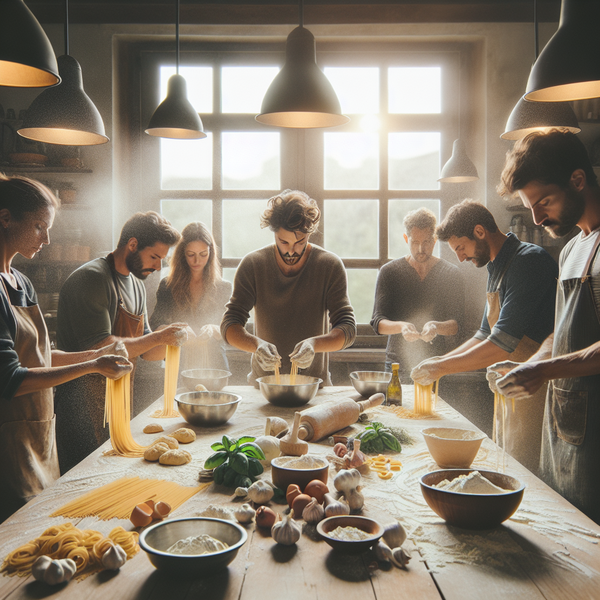
Learning to make fresh pasta in Italy isn’t just a cooking lesson — it’s a doorway into centuries of regional tradition and heartfelt hospitality. Whether you’re kneading semolina flour in a farmhouse kitchen or shaping tortellini with a Bologna nonna, these Italian cooking classes offer the kind of immersion that changes how you cook forever. Each of the following experiences delivers something verifiable: small group settings, regional ingredients, and genuine connection to local food culture.
Go to the section
TogglePasta-Making Classes in Bologna: The Heart of Emilia-Romagna’s Culinary Tradition
Bologna’s nickname, la grassa (the fat one), reflects its devotion to rich, handmade pastas. At La Vecchia Scuola Bolognese, on Via Malvasia 48, students spend three hours mastering the city’s classics — tagliatelle al ragù and delicate tortellini in brodo. Each rolling pin at this school is cut from beech wood, and the glass-walled kitchen lets you watch dough stretched into near transparency, a true local hallmark. Classes are taught by Alessandra Spisni, a well-known teacher who also trains professional chefs. Students leave not only with recipes, but with the tactile memory of how real sfoglia should feel beneath the hands.
For travelers looking for a slower, countryside rhythm, Casa Artusi in Forlimpopoli—about an hour’s drive from Bologna—offers half-day pasta workshops focused on homemade egg dough. Recipes follow Pellegrino Artusi’s 19th-century cookbook, and the school’s attached library holds over 45,000 culinary volumes. Participants finish with a communal lunch served in the on-site trattoria, making the experience both educational and delightfully edible.
Florence and Tuscany: Rustic Pasta Lessons in Vineyards and Farmhouses
Tuscany’s cooking traditions favor simplicity and strong local ingredients over ornate sauces. Cooking with Carlotta, hosted in a rustic farmhouse outside San Casciano in Val di Pesa, brings guests directly into the Tuscan countryside. Ingredients come from the farm’s own olive groves and kitchen garden: bright green basil, 00 flour, and eggs from free-range hens. Carlotta, a Florence-born chef, limits her classes to eight people, ensuring hands-on practice and personalized tips — for instance, how to adjust flour-to-egg ratios based on humidity, a detail she insists makes or breaks good pappardelle.
Within Florence itself, Desinare — a refined cooking atelier located in Via dei Serragli — draws locals and travelers alike. Students make ravioli stuffed with ricotta and spinach, and then plate their creations using elegant Tuscan ceramics. The class is ideal for travelers staying in the Oltrarno district, as it’s walking distance from the Santo Spirito market where the morning begins with ingredient shopping.
Rome: Pasta Workshops in the Capital’s Neighborhood Kitchens
In Rome, pasta-making is as lively and expressive as the city itself. Grano & Farina Cooking School in Trastevere offers detailed, technique-driven classes that attract both tourists and local foodies. Co-founders Chef Pino and Chef Julia keep groups intentionally small — usually around six students — to ensure everyone rolls out their own silky strands of tonnarelli or hand-cuts fettuccine. Their Roman pasta workshop also includes a short session on sauces: cacio e pepe, amatriciana, and carbonara, each demonstrated with authentic DOP ingredients like Pecorino Romano and guanciale.
For a more residential experience, Latteria Studio in the Monteverde neighborhood offers half-day pasta-making workshops run by British-born food stylist Rachel Roddy and Roman chefs. You’ll learn how to use a chitarra (a stringed wooden frame) to cut square spaghetti — a traditional Abruzzese method that has found a home in Rome’s modern kitchens. The experience wraps up with an aperitivo around the communal table, where each participant enjoys their freshly made pasta paired with local wine.
Naples and Campania: Fresh Pasta by the Sea with Local Families
Southern Italian cooking places more emphasis on semolina and water doughs rather than the egg-based versions of the north. In Naples, Cesarine offers intimate pasta workshops in the homes of vetted local hosts. One notable experience unfolds in the hilly Vomero neighborhood, where Signora Anna teaches guests how to craft orecchiette using only semolina rimacinata and water at room temperature. After shaping, you cook your pasta with her homemade San Marzano tomato sauce, sourced from her own rooftop garden. Guests also learn storage tips — like how to air-dry orecchiette using cotton sheets rather than nonstick trays, maintaining their rough, sauce-hugging texture.
Farther down the coast in Sorrento, Mamma Agata’s Cooking School sits on a lemon terrace that overlooks the Tyrrhenian Sea. The full-day course begins at 10 a.m. with homemade limoncello tasting, then moves into rolling out fettuccine and making ravioli filled with fresh ricotta from nearby Agerola. The school’s kitchen features a traditional wood-fired oven; students bake their fresh pasta gratin right after shaping it. The relaxed, family-run atmosphere makes it easy to imagine living as a local chef even if only for a single afternoon.
Piedmont and Northern Italy: Refined Techniques for Serious Pasta Lovers
In Piedmont, pasta often meets high gastronomy. Alba’s Langhe Cooking Experience specializes in traditional tajarin — ultra-thin egg pasta rich with local yolks. The ratio here is famously decadent: around 40 yolks per kilogram of flour. The class begins with a demonstration of how to fold yolk-rich dough without heat damage, then moves to wine pairing using nearby Barolo or Barbaresco. Classes generally include a tour of a local truffle market when in season, connecting participants to the full cycle of regional cuisine.
If you prefer a more technical class, Turin’s Il Melograno Cooking School offers multi-day courses that teach both pasta shaping and sauce emulsification. The facility provides digital recipe files and time-stamped video replays, useful for travelers who want to repeat the recipes at home. The school is located near Piazza Vittorio Veneto, allowing students to stroll along the Po River afterwards — a fine digestif walk after tasting a buttery plate of agnolotti del plin.
Home-Hosted Pasta Classes and Agriturismi: Deep Connection in the Italian Countryside
Outside the larger cities, some of Italy’s most memorable pasta-making lessons happen in agriturismo kitchens. In Puglia’s Itria Valley, Masseria Montenapoleone offers a class where guests hand-roll cavatelli using local Senatore Cappelli grain, an ancient wheat variety known for its nutty flavor. Participants grind flour on-site using a small stone mill before kneading, connecting directly with the raw ingredient cycle. The setting — a refurbished 17th-century farmhouse — reinforces how rural ingredients still shape modern Italian cuisine.
In Umbria, Agriturismo Poggio della Volara near Orvieto hosts a hands-on class that concludes with a sunset dinner overlooking the volcanic hills. Students prepare strangozzi with black truffle shavings and olive oil from the estate’s own press. Owners Marco and Silvia translate each local idiom behind the recipes, such as the phrase “fare la sfoglia come una volta” — to make pasta as it used to be done. It’s a reminder that in Italy, language, culture, and food remain intertwined.
Practical Tips for Booking the Best Italian Pasta Classes
Most high-quality Italian cooking classes require advance booking, particularly during late spring and autumn when culinary tourism peaks. Always verify what’s included — some workshops provide wine pairings and transportation, while others focus solely on technique. If you’re traveling by train, remember Italy’s regional trains can reach even small towns like San Casciano or Forlimpopoli within two hours of major cities. Bring closed shoes (many kitchens enforce this for safety) and avoid heavy perfumes or jewelry, as prolonged kneading requires free movement.
Language is rarely a barrier in reputable classes; most instructors speak English fluently, though it’s worth confirming beforehand. You’ll also find that many schools sell pasta tools such as wooden gnocchi boards or brass pasta cutters. Purchasing these at the end of your class not only supports local artisans but gives you the correct equipment to replicate your lesson at home.
Why Taking an Italian Pasta Making Class Is Worth the Journey
Investing a morning or day in an Italian cooking class transforms your perception of the country’s cuisine. Beyond the delicious results, the act of rolling, cutting, and tasting connects travelers with everyday Italian life more deeply than museums or tours ever could. You learn that flour texture changes by region, that egg color signals breed and diet, and that hospitality often begins with sharing dough and stories at the same table. The best pasta classes become cultural exchanges — kneaded into memory, flavored with patience, and taken home as a proud skill rather than a souvenir.