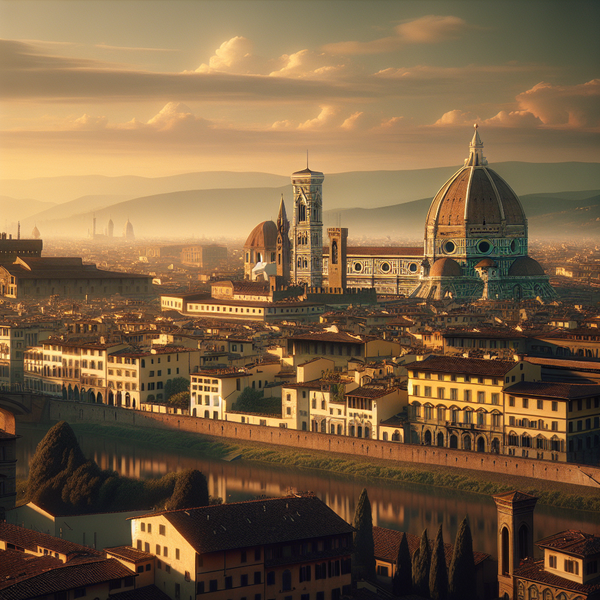
It’s tempting to think Florence begins and ends with the Duomo — that glimmering dome visible from almost every terrace. Yet step just a few streets away, and the city unfolds into a network of sanctuaries where Florentines still light candles quietly after work, and frescoes glow faintly under centuries of candle smoke. The real soul of the city lies here: in the chapels and cloisters that the average tour group never reaches. Pop into one of these churches mid-morning, when the sound of the organ mixes with the smell of incense and wax — you’ll feel Florence breathe.
Go to the section
ToggleSanta Croce: The Church of the Florentine Spirit
While the Duomo towers over Florence, Santa Croce is its most human church — dedicated to the city’s thinkers, artists, and rebels. Located on Piazza Santa Croce, less than a ten-minute walk from Piazza della Signoria, this Franciscan basilica holds the tombs of Galileo, Machiavelli, and Michelangelo. The nave’s cool, stone interior is softened by Giotto’s unusually gentle frescoes that narrate the life of St. Francis, completed in the early 14th century. Visitors can explore the Pazzi Chapel, a harmonious Brunelleschi design featuring a perfectly proportioned dome — a quiet reprieve from the crowds outside.
For a meaningful visit, arrive early in the morning. The church opens at 9:30 AM, and between then and 10 AM, you’ll often have the cloister garden almost to yourself, its cypress trees whispering above the stone arcades. The €8 entrance fee includes access to the museum, where you can see restored fresco fragments saved from the 1966 flood — a reminder that preservation in Florence is never abstract, but urgent and ongoing.
Santa Maria Novella: A Gateway into Renaissance Harmony
Facing the main railway station, Santa Maria Novella is often the first church travelers see but rarely explore properly. The Dominican friars who commissioned it were intellectual rivals to the Franciscans of Santa Croce, and you can sense that scholarly ambition in every architectural line. The marble façade, designed by Leon Battista Alberti, is a geometry lesson come to life — circles balancing squares in black and white stone. Inside, Masaccio’s fresco of the Holy Trinity marks a turning point in perspective; look closely at the receding architectural illusion painted onto the wall, a trick so convincing it reshaped Renaissance art.
Don’t miss the Spanish Chapel behind the sacristy. Its fresco cycle, painted by Andrea di Bonaiuto, describes the Dominican world view — theology, knowledge, and virtue woven into a visual map of medieval thought. It’s best appreciated mid-afternoon when sunlight filters gently through the upper windows, softening the colors on plaster that’s endured for more than six centuries. With an entry fee of around €7.50, Santa Maria Novella rewards those who linger longer than a photo stop.
San Miniato al Monte: A View and a Vision Above the City
Climbing to San Miniato al Monte from Piazzale Michelangelo isn’t just exercise — it’s a short pilgrimage with a payoff even Florentines still savor. The Romanesque basilica stands on one of the city’s highest points, its green-and-white marble façade echoing the Duomo far below. Inside, you’ll step onto a raised choir above the crypt, an architectural feature that enhances the sense of ascending toward heaven. The interior mosaics shimmer in dim light, their gold tesserae reflecting sunlight filtered through thin alabaster windows.
If you time your visit for evening vespers (around 5:30 PM), you’ll hear the Olivetan monks chanting Gregorian hymns — an unamplified sound that seems to suspend the church in another century. Outside, the terrace offers one of Florence’s best panoramas, especially around sunset when the river and rooftops glow bronze. There’s no entrance fee, though leaving a small donation at the exit box is customary and appreciated.
Santo Spirito: The Heartbeat of the Oltrarno
Across the Arno River, inside the bohemian Oltrarno quarter, stands Santo Spirito — Brunelleschi’s late masterpiece. Unlike the Duomo’s grand domes, this church feels intimate and mathematical, a crescendo of perfect proportions. Its austere cream façade hides a luminous interior where light falls softly on columned aisles and delicate stucco. The neighborhood around the piazza is one of Florence’s most lived-in: you’ll likely see locals sitting on the church steps with gelato in hand as children kick footballs nearby.
Inside, the naïve simplicity gives way to surprise: tucked in a small side chapel is a youthful wooden crucifix believed to have been sculpted by Michelangelo during his apprenticeship under the monks here. Unlike the monumental figures he later carved, this Christ is tender and human-sized, echoing the church’s character. If you arrive between 10 AM and noon, you’ll usually find the doors open and the church quiet. Entry is free, though the adjoining convent museum, accessible from Via Santo Spirito, charges a modest fee.
Ognissanti: Artistic Quiet Along the Arno
Ognissanti, just west of Ponte Vespucci, often goes unnoticed even though some of Florence’s greatest Renaissance artists lived nearby. The building was home to the Humiliati order before passing to the Franciscans, and its frescoes reflect those layered histories. Here you can stand in front of Ghirlandaio’s Last Supper — a precursor to Leonardo’s in Milan — perfectly preserved in the refectory. Sandro Botticelli, who painted his own fresco of Saint Augustine in the nave, lies buried just steps from the main altar. That grave alone makes this church a quiet magnet for art lovers who prefer contemplation to crowds.
Entrance is free, and the parish maintains regular visiting hours (mornings 9 AM–12:30 PM, afternoons 3:30–6:30 PM). Visit around opening time, and you may catch a priest rearranging flowers below the frescoes, a still-life scene that reminds you these masterpieces still belong to a living community.
Santa Trinita: Mannerist Mastery in the City Center
Set back from Via de’ Tornabuoni’s designer boutiques, the understated façade of Santa Trinita hides one of Florence’s most refined chapels. The Sassetti Chapel, decorated by Ghirlandaio, portrays contemporary Florence in the background of sacred stories — a charming Renaissance habit of blending everyday life with the divine. Look at the fresco of the Nativity: the Arno bridges appear exactly as they did five centuries ago. This church invites detail-watching; even the capitals on its columns, carved in quiet elegance, embody the restrained beauty of late Gothic architecture merging into the Renaissance.
Admission is free, and the church stays open most mornings until lunchtime. Pause in the square outside afterward for a macchiato at Caffè Giacosa, once frequented by Florentine nobles; it’s as close as you’ll come to caffeinating through history without leaving your seat.
Badia Fiorentina: Where Florence’s Monks Still Sing
A few steps from the Bargello Museum, you might hear voices rising in polyphonic harmony: the monks of Badia Fiorentina. Founded in the 10th century, this abbey remains active, the tower bell striking the quarter hours across the old city. Many pass its modest doorway without realizing that within lies a Filippino Lippi masterpiece — the Apparition of the Virgin to Saint Bernard — whose delicate play of light could hold your gaze for ten minutes or more. Services here are open to the public, and attending mass at 6 PM offers a glimpse of daily spiritual rhythm far removed from sightseeing.
The Benedictine community maintains the church’s stillness with admirable warmth. Visitors are welcome to stay after the service and speak quietly with the monks, some of whom share anecdotes about the church’s role during the Medici era. There’s no entrance fee, though donations support restoration projects like the ongoing conservation of the cloister frescoes.
The Brancacci Chapel at Santa Maria del Carmine
If Florence’s art is a book, the Brancacci Chapel is its first chapter. Tucked inside Santa Maria del Carmine, across the river in the Oltrarno, the fresco cycle by Masaccio and Masolino changed Western painting forever. Here, perspective deepens, light becomes moral, and human emotion takes center stage. The fresco of Adam and Eve Expelled from Paradise captures anguish with staggering realism — something that shocked 15th-century viewers and continues to move modern eyes. Restoration work after the 1980s fire returned its colors to luminous clarity, making this chapel an essential stop for anyone exploring beyond the Duomo.
To visit, reserve a timed entry ticket (€8) through the official site or at the entrance kiosk; slots are limited to preserve humidity levels. The complex opens from 10 AM–5 PM (closed Tuesday). Nearby cafés on Piazza del Carmine make ideal post-visit spots for reflecting over espresso and homemade biscotti.
Why Exploring Florence’s Lesser-Known Churches Matters
Visiting these churches goes beyond checking boxes on a sightseeing list — it connects you to the everyday rhythm of the city. Each sanctuary tells a story of community resilience: flood recovery in Santa Croce, artistic innovation in the Brancacci Chapel, silent continuity at Badia Fiorentina. Many are free or charge minimal fees, making them accessible windows into Florence’s ongoing dialogue between past and present. Bring small change for candle offerings, dress modestly, and step softly; reverence here isn’t just ritual but shared respect for spaces that still belong to their neighborhoods.
The reward for going beyond the Duomo isn’t just quieter aisles or better photographs. It’s that subtle realization, somewhere between incense and sunlight, that Florence’s beauty always lives where devotion and art continue to meet — usually just around the next corner.