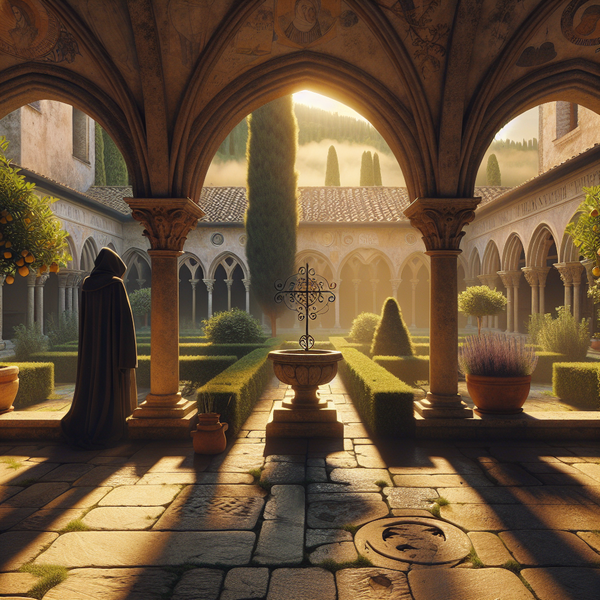
Some of Italy’s richest cultural treasures lie behind quiet walls where time slows and footsteps echo off centuries-old stone. Cloisters and monasteries across the peninsula preserve not only religious art but also the architecture and rhythms of a slower, contemplative Italy. For travelers seeking beauty far from crowds, these sanctuaries offer the chance to wander between marble columns, smell herbs growing in monastic gardens, and glimpse frescoes painted for the eyes of monks rather than tourists.
Go to the section
ToggleThe Sacred Geometry of the Cloisters of Florence
Florence hides several cloisters that rival its museums for serenity and craftsmanship. At Santa Maria Novella, the Green Cloister (Chiostro Verde) is named for the earthy-green pigment in early Renaissance frescoes by Paolo Uccello — a palette that turns soft gold in the afternoon light. Arrive before 9 a.m., when tour groups have not yet spilled from nearby Piazza Santa Maria Novella, to hear only the splash of the well at its center. A short walk away, the Cloisters of Santa Croce quietly shelter the Pazzi Chapel, Brunelleschi’s masterpiece of perspective and proportion. The entrance ticket includes access to the two adjoining cloisters, where monks once dried laundry on strings beneath the loggias. Bring coins: the small bookshop often sells postcards featuring details not seen in guidebooks.
Monasteries in the Hills of Tuscany: From Monte Oliveto Maggiore to Camaldoli
South of Siena, the Abbazia di Monte Oliveto Maggiore rises from a grove of umbrella pines near Asciano. You cross a drawbridge to enter, signaling its semi-monastic seclusion even today. Inside, the cloister’s Renaissance fresco cycle by Luca Signorelli and Sodoma narrates the life of Saint Benedict — 35 panels painted with humor and humanity. The monks still sing Gregorian prayer in the church each evening around 6:15 p.m.; visitors may listen quietly from the back pews. Their shop sells the monastery’s bitter herbal liqueur, made with locally gathered botanicals since medieval times.
Deeper into the Apennines, Camaldoli Monastery offers a contrasting experience: dense forest, austere hermitages, and the scent of pine resin. Founded by Saint Romuald, its eremo (hermit colony) is reachable by a winding road from the main monastery below. The monks here maintain an ancient pharmacy where you can still buy eucalyptus balm following the original recipe. Between the two communities, the air feels charged with monastic discipline and cedar smoke. Staying overnight is possible in simple guest rooms — reserve directly by phone, as online booking is minimal.
Benedictine Heritage in Lazio and Umbria
Central Italy formed the heart of the Benedictine world, and nowhere is this clearer than at Montecassino Abbey, perched high above the town of Cassino. Destroyed and rebuilt multiple times, its current cloisters gleam with travertine and arcaded symmetry that reveal the order’s enduring devotion to balance. Photographers favor the balcony overlooking the Liri Valley, best lit before 10 a.m. To reach Montecassino from Rome, take the regional train to Cassino (about 90 minutes) and a short taxi ride uphill. A quiet alternative is Abbazia di Farfa near Rieti, where Benedictine brothers sell honey and herbal soaps in a cobbled village frozen in the 9th century. The cloister there is intimate: carved capitals show leaves and lions half-worn by time but still dignified in their simplicity.
In Umbria, the Abbey of San Pietro in Assisi offers a hidden cloister often overlooked by pilgrims heading to the Basilica of Saint Francis. Entry is free, and you’ll likely share the space only with a local or two sketching the medieval arcades. Umbria’s foggy mornings make the pink Subasio limestone glow softly — a natural light show best seen from the second-floor loggia. Cafés on nearby Via Borgo San Pietro serve the monks’ own herbal tea blend; buy a packet to bring home the scent of the place.
Hidden Cloisters of the South: Campania, Puglia, and Sicily
In southern Italy, Mediterranean light transforms cloisters into open-air galleries of shadow and sun. In Campania, the Charterhouse of San Martino perches above Naples in the Vomero district. Take the funicular to Morghen stop; from there it’s a short uphill walk rewarded by panoramic views of the Bay of Naples. The Chiostro dei Procuratori, paved with alternating black and white marble, feels suspended between city and sky. Don’t miss the smaller cloister with Vesuvius framed like a painting through its arches. Local tip: go late afternoon, then watch sunset from the adjoining terrace before descending to the historic center for dinner.
Across the peninsula in Puglia, Lecce’s Monastero delle Benedettine di San Giovanni Evangelista opens its delicate Baroque cloister by guided appointment only — usually Saturday mornings. The lace-like capitals reflect Salento’s limestone artistry, and the nuns’ signature almond pastries (pasta di mandorla) can be purchased at the reception desk. Meanwhile in Sicily, Monreale Abbey, just outside Palermo, hosts one of Italy’s most celebrated cloisters: 228 double columns capped with mosaicked arches. Each pair carries different motifs — peacocks, palm leaves, twisted spirals — making it a field lesson in Norman Arab art. Visit around lunchtime when tour buses depart, and you’ll have entire arcades to yourself.
Veneto and Lombardy: Cloisters That Blend Art and Silence
Northern Italy’s monastic elegance is more sober but no less inspiring. In Venice, the Church of San Francesco della Vigna hides a peaceful cloister where vines still grow against brick walls planned by Jacopo Sansovino. Bring a small donation to the friars and they’ll let you visit the adjoining garden where seabirds nest among cypresses. A vaporetto stop at Celestia keeps this corner relatively quiet even in summer. Nearby on the mainland, the Cloisters of San Giorgio Maggiore combine Palladian geometry with lagoon breezes — one of the few spaces in Venice where you can actually hear your own footsteps.
In Milan, the Chiostri di Sant’Eustorgio form a hidden square behind the basilica famous for the relics of the Magi. The Dominican friars tend roses and olive trees there; on spring weekends they host small concerts to fund restoration work. Just outside the city, Certosa di Pavia remains one of Italy’s grandest monastic complexes, commissioned by the Visconti dukes. Its cloisters are ringed by monks’ cells, each with its own garden plot — you can peek inside a restored one furnished with a bed, writing desk, and stove. Take the regional train from Milan Porta Garibaldi to Pavia and then a taxi; expect to spend at least two hours exploring the frescos and marble detailing alone.
Practical Tips for Visiting Cloisters and Monasteries in Italy
Before entering any cloister or monastery, check opening times — they often close for midday prayers between noon and 3 p.m. Dress modestly: shoulders covered, skirts or shorts to the knee. Photography is occasionally restricted during services; look for signs in Italian reading “silenzio” or “vietato fotografare.”
Consider visiting on weekdays. Monday is often rest day after Sunday services, making Tuesday and Wednesday mornings ideal. Many monasteries sell local products — honey, herbal balms, wine, or ceramics — directly supporting the communities. Small cash bills are appreciated, as card readers may not function in ancient walls. In some cloisters like Monte Oliveto or Camaldoli, guests can book a night of simple lodging; meals are communal and vegetarian, generally included in a modest fee.
For travelers interested in quiet immersion rather than sightseeing loops, Italy’s cloisters offer an itinerary through both the country’s history and its living spiritual traditions. You walk where monks once copied manuscripts or tended apothecary herbs, yet the atmosphere remains strikingly current — a refuge from the pace of modern travel. Step inside one, breathe the cool stone air, and you’ll understand why silence has been Italy’s most eloquent art form for centuries.