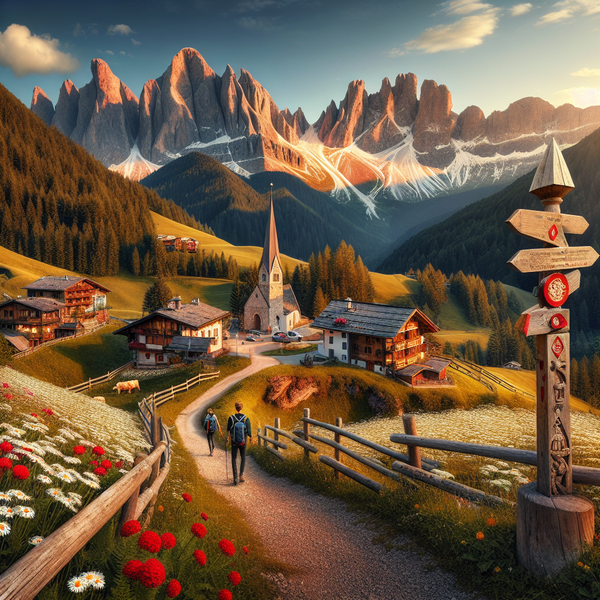
There are few landscapes in Europe as sculptural as the Dolomites. Their pale limestone towers, streaked pink at sunset, rise above valleys dotted with chalets and onion-domed churches. Yet the region’s real heart lies within its mountain villages — small, meticulously kept communities where woodcarvers, cheesemakers, and mountaineers still shape daily life. Exploring them isn’t about checking sights off a list; it’s about understanding how these settlements balance ancient Ladin traditions with modern alpine hospitality.
Go to the section
ToggleOrtisei in Val Gardena: The Artistic Soul of the Dolomites
Ortisei (Urtijëi in Ladin) is one of those places where craftsmanship is not a token tourist attraction but a living, breathing art form. Nearly every wooden sign, crucifix, or nativity figure you see in the Dolomites has roots in this valley. The village sits at 1,236 meters, with ski lifts rising right from the pedestrian center to the Seceda and Alpe di Siusi plateaus. In winter, it links directly into the Sella Ronda circuit, while summer brings a labyrinth of well-marked hiking routes like trail no. 6 to the Furnes cable car station — a gentle climb dense with wildflowers until mid-July.
Ortisei’s old center is unexpectedly cosmopolitan for such a small alpine town. You can browse at Galleria ART52, where local sculptors exhibit their work, or sip a glass of Lagrein at Café Demetz overlooking pastel façades and flower boxes. To see living heritage, step into the Museum Gherdëina, where exhibits about the Ladin language and wooden toys offer essential context for the region’s culture. For accommodation, smaller family-run guesthouses like Garni Irma give you quiet views above the bustle, but are still only a 10-minute walk from the main piazza.
San Candido: Balancing Tradition and Adventure Near Austria
San Candido (Innichen) lies just minutes from the Austrian border, in South Tyrol’s Alta Pusteria valley. Its tidy streets reveal the town’s Austro-Hungarian lineage: onion-domed churches, tidy pastel façades, and efficient public transport that runs like clockwork. The Baroque Collegiate Church of San Candido, built on the site of a Carolingian foundation, is considered one of the best-preserved Romanesque buildings in the Eastern Alps. Inside, 12th-century frescoes depict scenes from the Old Testament — unusually vivid for this altitude and climate.
This is a base that suits both relaxed walkers and fit mountain bikers. The paved Drau cycle path begins here, descending all the way into Lienz, Austria. It’s a 44-kilometer ride but almost entirely downhill, with clear signage and regular cafés offering strudel stops en route. Winter adds the cross-country skiing network connecting San Candido with Dobbiaco and Sesto, totalling over 200 kilometers of groomed trails managed by the Drei Zinnen Dolomites area. When you want to unwind, stop at Acquafun, the town’s public spa center, where saunas use mountain herbs gathered locally in summer.
Canazei and the High Peaks of Val di Fassa
Cradled beneath the fierce ridgelines of the Marmolada and Pordoi Pass, Canazei blends mountaineering tradition with unapologetic alpine glamour. You’ll hear a mix of Italian, German, and Ladin spoken in the same café, often by the same waiter. The town’s lifts connect directly to the Dolomiti Superski network in winter and to panoramic hiking routes in summer. Particularly recommended is the gondola ride from Campitello up to Col Rodella — the summit terrace gives a near-cinematic perspective over the Sassolungo group.
The Ladin Museum in neighboring Vigo di Fassa adds context to this linguistic and cultural crossroads. After a day in the heights, locals and visitors often gather in mountain huts like Rifugio Friedrich August for dumplings in melted butter, followed by grappa infused with mountain pine. For a slow morning, take a stroll along the Avisio River path that cuts through Canazei — a gentle 4-kilometer loop suitable even for strollers and lightweight wheelchairs.
Corvara in Alta Badia: Where Gourmet Culture Meets Alpine Silence
Corvara sits at 1,568 meters, in the heart of Alta Badia — a region whose culinary reputation now rivals the French Alps. In fact, a cluster of Michelin-starred restaurants operates within a 15-kilometer radius: La Stüa de Michil and St. Hubertus among them. Despite this prestige, Corvara’s rhythm is still dictated by the mountains. Locals start early for hikes to Pralongià Plateau, where cows graze amid edelweiss fields, or for the more demanding ascent to Sassongher.
In winter, Corvara becomes one of the most strategic points of the Sella Ronda ski tour. Hotels like Posta Zirm have ski-in/ski-out access, while smaller chalets such as Ciasa de Munt focus on sustainability — using alpine larch and solar systems for heating. During shoulder seasons, you can enjoy quiet mornings with the Dolomites nearly to yourself. The Alta Badia Tourist Office lends free trekking maps and can organize guided hikes along the Armentara meadows, where orchids bloom between late June and mid-July.
Santa Maddalena: The Postcard Gem of Val di Funes
If you’ve ever seen a photo of the Dolomites that looks too perfect to be real — a small church before a jagged wall of peaks — that’s Santa Maddalena. The village is tiny, but it guards one of the most iconic viewpoints in South Tyrol. To reach the classic panorama, start from the parish church and follow the signposted path towards the Geisler Alm trail; after about 20 minutes of gentle climbing, you’ll find the small wooden fence where photographers gather before sunset. Go early in the morning to catch the peaks reflected in dew on the meadows — there’s usually no one else around.
Though Santa Maddalena has only a handful of inns, most stay in nearby Funes and walk up to the village. Gasthof Mesnerwirt, run by the same family for generations, serves homemade Schlutzkrapfen (spinach-filled pasta) with brown butter — a simple but utterly local dish. Active travelers can continue from the viewpoint to the Odle Mountain Group trails (numbers 6 and 36), reaching the Geisler Alm hut in about 90 minutes. The path is well maintained even in early autumn when larches turn gold.
Sottoguda: Gateway to the Serrai Gorge
Sottoguda, a fraction of Rocca Pietore, once ranked among Italy’s official “Borghi più belli,” and for good reason. The hamlet sits at the entrance of the Serrai di Sottoguda gorge, where a narrow path winds between 50-meter cliffs carved by centuries of glacial runoff. In winter, the frozen waterfalls attract ice climbers from across Europe, while in summer it’s a cool refuge from midday heat. The route is about 2 kilometers each way, easily done in an hour, and you’ll still want to stop every few minutes for photos of the cascading rock walls.
Despite its small size, Sottoguda remains deeply artisanal. Many residents still work as blacksmiths, shaping bells, gates, and decorative iron ornaments using traditional forging methods. Visitors can watch them at work in open workshops along the main street Via Sorarù. The village was damaged in recent storms but has rebuilt carefully, preserving its 17th-century barns and slate-roofed houses that lean into each other with alpine practicality. Simple B&Bs like Hotel Garnì Ai Serrai offer affordable stays right by the gorge entrance.
Alleghe: Lakeside Tranquility Under Mount Civetta
Few Dolomite villages combine water and summit views as elegantly as Alleghe. The town sits beside its namesake lake, created naturally by a landslide in the 18th century. You can circumnavigate the lake in about an hour along a flat 5-kilometer path — a perfect evening stroll after a day of hiking. Across the water, the vertical Civetta massif rises more than 3,000 meters, its north face lit crimson by the setting sun. Local legend calls this glow the “enrosadira,” a word you’ll soon hear in every corner of the Dolomites.
Alleghe doubles as a practical base for accessing the Civetta ski area, which offers 72 kilometers of slopes connected by modern lifts. In summer, take the gondola to Piani di Pezzè, then continue on foot toward Rifugio Coldai for an easy half-day excursion — the hut’s terrace serves polenta with melted cheese from nearby Malga Pioda. Evening entertainment stays low-key here: a lakeside aperitivo at Bar Alleghe Beach followed by a simple pizza with locals watching a Serie A match inside.
Practical Tips for Exploring Dolomite Villages
Public transport in the Dolomites is surprisingly reliable, but a car offers more flexibility when hopping between valleys. If driving, remember that parking in historic centers like Ortisei or San Candido is often regulated by disc zones; free lots typically sit just outside the core. Buses operated by SAD and DolomitiBus connect most major valleys — multi-day passes sold at tourist offices can save considerable cost if you’re staying for a week.
For scenic continuity, plan your route north to south or vice versa rather than zigzagging. A logical itinerary could begin in San Candido, pass through Ortisei and Corvara, then end in Alleghe. This direction takes advantage of descending altitude and better late-afternoon light for photography. Always check the mountain weather forecasts posted at valley stations; thunderstorms often roll in after 3 p.m. in July and August. And don’t underestimate local hospitality — carry some cash for mountain huts, as card terminals still can’t be relied upon above 2,000 meters.
The Dolomites’ mountain villages are not frozen relics but living communities that adapt year after year. By traveling with patience and curiosity, you’ll find that their greatest beauty lies not only in the sharp ridgelines but in the quiet continuity of everyday life — wood smoke, church bells, and meadows where cows still wear handmade bells from an ironsmith in Sottoguda.