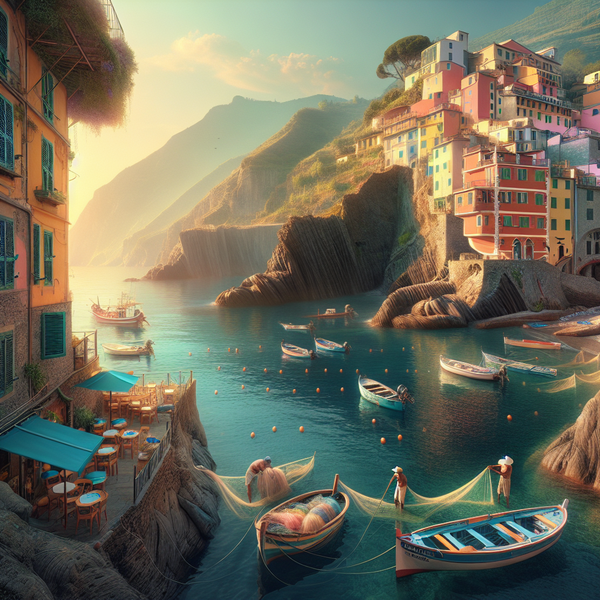
Few travel experiences stir the senses like stepping into an Italian fishing village just as the boats return to harbor. Nets glisten with seawater, pastel homes tumble toward the quay, and the scent of grilled calamari mingles with diesel and salt air. Italy’s coasts have dozens of these timeless enclaves, each guarding a centuries-old rhythm between land and sea — and each with its own palette of colors that seem designed for painters, not fishermen.
Go to the section
ToggleRiomaggiore and Manarola: The Jewel Tones of Cinque Terre
The Cinque Terre villages may be photographed relentlessly, but they still belong to the sea. Riomaggiore’s narrow Via Colombo slopes directly to the harbor, where small gozzi boats rest under pink facades patched with salt. Few visitors realize that locals repaint these facades every few years to combat marine corrosion and keep the colors alive — a kind of quiet civic ritual.
In neighboring Manarola, the pastel terraces are not decorative fantasy but reflect a functional code: fishermen once recognized their house from sea by color. Walk the footpath below the terraced vineyards to Nessun Dorma wine bar before sunset; it overlooks the bay and serves Ligurian crostini with anchovies cured in local lemon juice. For a less crowded view, take the uphill route to the cemetery — it’s one of the best vantage points for photographers chasing the famed afterglow on housefronts.
Camogli: The Ligurian Gem Hidden in Plain Sight
Just 25 minutes by local train from Genoa, Camogli feels untouched by the cruise-circuit crowds that dominate Portofino. The beachfront promenade here is lined with tall, ochre and coral houses painted with trompe‑l’œil window frames — a tradition dating back to the 19th century, when fishermen decorated façades to rival noble palazzi at half the cost. Stop at Revello bakery for their signature torta di riso, a savory rice pie that locals eat for breakfast or with aperitivo.
Fishing remains visible in daily life. Around 8 a.m., you can watch the wooden trawlers unload at the small pier near the railway tunnel, a rare sight in modern Liguria. For an atmospheric overnight stay, book a sea-facing room at Cenobio dei Dogi, which sits directly above the rocks once used to dry nets.
Porticello and Cefalù: Sicilian Fishing Villages with Living Traditions
Sicily’s northern coast hosts quieter fishing communities than its better-known resort towns. Porticello, about 30 minutes east of Palermo, still stages the annual Festa di San Giuseppe, where fishermen decorate their boats with palm leaves and process through the water — a spectacle best witnessed from the pier at dusk. If you visit in June, the sardine season peaks, and many waterfront trattorie like Trizzano serve them grilled within hours of catch.
A few kilometers along the coast, Cefalù charms travelers with its mix of Norman architecture and working fishing port. The medieval washhouse at Via Vittorio Emanuele, once used by fishermen’s families, still channels spring water under stone arches. Early mornings, you’ll see retirees repairing nets along the old seafront below the Cathedral’s twin towers. For swimmers, the beach beneath Porta Pescara offers clear shallows even in August, though locals recommend arriving before 9 a.m. for space.
Burano: The Venetian Lagoon’s Painted Labyrinth
Burano feels like Venice viewed through a kaleidoscope. Only 40 minutes by vaporetto from Fondamenta Nove, the island’s canals reflect rows of vividly colored homes, each painted differently to mark property lines — essential centuries ago when fog hid everything beyond an arm’s length. Current residents must request municipal approval for repainting, ensuring no two adjacent houses repeat a hue.
Between photographing candy-colored reflections, step into Martina Vidal’s lace workshop to see locals hand‑knotting lace using bobbins, a craft alive since the 1500s. Skip weekend lunchtime rushes by arriving midweek around 10 a.m.; enjoy espresso at Pasticceria Rosa Salva before exploring side canals where laundry ropes cut diagonally across the view. For lunch, try Trattoria al Gatto Nero, where chef Ruggero serves risotto di go — a silky rice dish using lagoon goby fish found nowhere else.
Marina di Pisciotta and Acciaroli: Campania’s Unspoiled Coast
South of the Amalfi frenzy, Cilento’s fishing towns keep a slower rhythm. Marina di Pisciotta lies two hours by car from Salerno, its harbor ringed by stone houses weathered to lavender-grey and coral-pink. Residents speak of the “alice di Menaica” — anchovies caught at night with traditional nets handed down from ancient Greek settlers. You can taste them pressed in salt and served on lemon leaves at Osteria del Mare; they carry a Slow Food designation protecting both the fish and the fishermen’s craft.
Further south, Acciaroli is famously linked to Ernest Hemingway, who visited in the 1950s, though locals today are prouder of their centenarian population. Scientists attribute longevity partly to the diet: anchovies, wild rosemary, and olive oil from nearby Pisciotta groves. Morning boats still leave from the concrete pier beside Piazza della Repubblica; standing beside them as they inch out of the harbor at dawn gives you a rare glimpse of pre-tourism Italy.
Marzamemi: Baroque Meets Fishing Heritage in Eastern Sicily
Among Sicily’s eastern coast villages, Marzamemi blends seaside warmth with architectural grace. Its heart is Piazza Regina Margherita, framed by fishermen’s stone warehouses known as tonnare — once tuna processing plants under the Prince of Villadorata. The ocher stone glows honey‑colored at sunset; travelers often pair a visit with nearby Noto’s Baroque streets.
Today, small-craft fishermen still moor beside boutique wine bars. Order a plate of bottarga — cured tuna roe — and a glass of Nero d’Avola while seated on the low wall near La Balata. Repainting restrictions preserve the village’s natural hues: faded sand tones and muted turquoise shutters keep harmony with the limestone.
Bosa: Sardinia’s Colorful Riverfront Haven
Few expect pastel perfection inland from the sea, but Bosa sits on the Temo River’s lower reach, where fishing boats float under a medieval hilltop castle. The town’s houses are painted fruit‑sherbet colors: mango, coral, lavender, and teal — a tradition revived after the 1990s to boost local morale and tourism without sacrificing authenticity. For a perfect sunrise photograph, climb to Castello Malaspina before 8 a.m.; the light hits the façades at a diagonal golden angle.
Despite its river position, Bosa’s economy still relies on fishing for species like mullet and eel. Visit the riverside Trattoria da Chelo for spaghetti alla bottarga, made from local cured roe. Pair it with Malvasia di Bosa wine, whose subtle sweetness balances the briny sauce.
Practical Tips for Visiting Italy’s Fishing Villages
Each Italian region guards its coastal treasures differently. Planning around local rhythms keeps your experience authentic:
- Transport: Train lines run directly to Camogli, Riomaggiore, and Cefalù. For others like Marzamemi or Acciaroli, renting a compact car from provincial towns such as Salerno or Noto gives flexibility.
- Season: Late April to early June offers mild weather and active fishing without high-season prices. By mid-August, parking in Liguria’s villages can require permits from local comune offices.
- Etiquette: Always ask before photographing fishermen or their catch — it is considered respectful and often rewarded with a story or a taste of the day’s haul.
- Dining hours: Coastal trattorie often follow fishermen’s schedules. In smaller villages, kitchens close after 2:30 p.m. for lunch, reopening after 7:30 p.m.
Whichever shoreline calls your name, Italy’s colorful fishing villages share something deeper than pretty façades: a lived connection between generations who look to the same sea for purpose and sustenance. Visit with patience, and you’ll find moments of real life — a conversation on a quay, a net flickering under morning sun — that stay long after the paint colors fade.