When most travelers think of Byzantine mosaics in Italy, Ravenna comes instantly to mind. Yet, the glittering heritage of gold-backed tesserae and vivid saints extends far beyond Emilia-Romagna. Across Sicily, Venice, Rome, and even Apulia, lesser-visited churches and chapels preserve the shimmer of Byzantium — often with fewer tour groups and more context. Exploring these mosaics is not just a visual delight; it’s a lesson in how Eastern and Western Christianity intertwined through trade, conquest, and art.
Go to the section
ToggleByzantine Mosaics in Venice: Palermo’s Sister in Splendor
Venice inherited a strong Byzantine identity long before the Renaissance. Step inside St. Mark’s Basilica on Piazza San Marco, and gold light washes over every surface. Nearly 8,000 square meters of mosaics cover domes and walls; though many were restored through the centuries, much of the twinkle remains true to Byzantine style. The earliest scenes depicting Genesis and the life of Christ were made by craftsmen from Constantinople, and keen eyes will notice Greek inscriptions still preserved above the narthex.
To avoid the midday crowds, book a timed entry ticket for an early morning slot (as early as 8:30 a.m.). The Basilica’s museum upstairs offers a rare perspective: from its balcony, you can admire both the interior mosaics and the piazza’s flow of life below. Do not miss the original bronze horses from the Hippodrome of Constantinople preserved here — they are physical proof of Venice’s Byzantine connections.
Sicily’s Byzantine Marvels: Cefalù, Monreale, and Palermo
Sicily holds perhaps the greatest Byzantine legacy outside the Adriatic coast. In Cefalù Cathedral, built under Norman rule, the apse mosaic of Christ Pantocrator dominates the space. The golden tesserae sparkle against the mountain light filtering through the narrow nave, and this Christ’s expression — softer than Ravenna’s stern icons — reflects the island’s fusion of Greek, Arab, and Latin artistry.
Just outside Palermo, Monreale Cathedral astonishes visitors with more than 6,000 square meters of mosaics narrating the entire Bible in shimmering detail. The artisans who completed Monreale came from both Byzantium and local Sicilian workshops. For travelers, the easiest route is a 30-minute bus ride (AST line) from Palermo’s Piazza Indipendenza; arrive before 10 a.m. to photograph the gold walls without glare from the upper windows. In downtown Palermo, the Palatine Chapel within the Norman Palace blends Arabic muqarnas ceilings with Byzantine mosaics — nowhere else in Europe can you stand where three medieval cultures coexisted in one room.
Byzantine Fragments in Rome’s Early Christian Basilicas
Rome may be Rome — endlessly layered — but it also preserves multiple outposts of Byzantine mosaic work. Start with Santa Prassede near Santa Maria Maggiore; the Chapel of St. Zeno here holds perhaps the most perfectly preserved Byzantine mosaic cycle in the city. The gold background, glass cubes, and Greek facial types mirror those in Ravenna. This small space, lit by a single modern bulb, often overwhelms first-time visitors with its intimacy. The apse mosaic in Santa Pudenziana, only a five-minute walk away, is older still and gives a glimpse of the transition between pale Christian fresco and Byzantine style.
An often-overlooked site is Sant’Agnese fuori le mura on Via Nomentana, a few kilometers outside the Aurelian Walls. Its 7th-century mosaic of the young martyr flanked by popes rests largely unrestored. Bus 60 or 82 will drop you near the gate, and weekday mornings are usually silent enough to hear the birds in the catacombs area below.
Mosaics of Apulia: Nestorians and Hidden Chapels
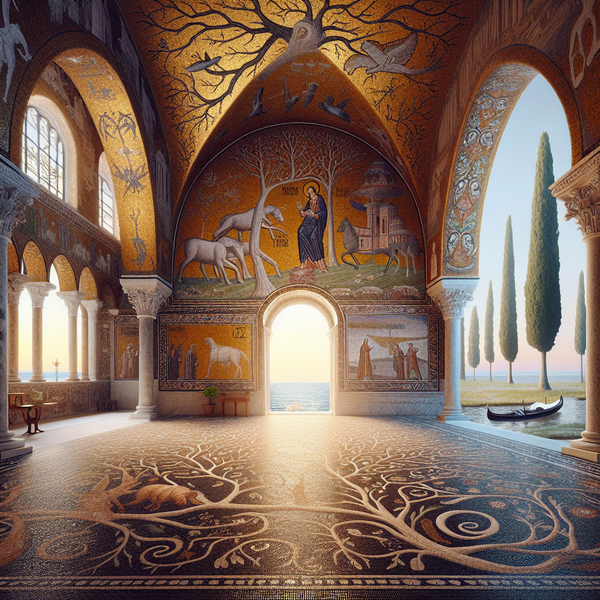
Few travelers realize that Otranto, at Italy’s heel, houses one of Europe’s most astonishing mosaic floors. The 12th-century Cathedral of Santa Maria Annunziata depicts the Tree of Life, zodiac signs, and mythological creatures all rendered in bright tesserae. Unlike the gold walls of Ravenna or Monreale, these stones lie beneath your feet, stretching from nave to presbytery. Their layout blends Western Romanesque geometry and Byzantine motifs, suggesting an artistic dialogue across the Adriatic Sea. You’ll need clean, rubber-soled shoes — attendants may request that visitors avoid high heels to preserve the fragile floor.
In Trani’s cathedral, dedicated to St. Nicholas the Pilgrim, mosaic fragments survive in the crypt, lit by small lamps. Although most of the wall surfaces were lost, what remains shows unmistakable Byzantine geometric borders. If you’re driving between Bari and Lecce, stop in Conversano to see the small but moving mosaics in the crypt of San Cataldo — their stylized sheep and vines echo Eastern iconography far from Constantinople’s reach.
Byzantine Echoes in Umbria and Marche
Central Italy may seem all about Frescos, but look carefully inside its Romanesque churches. In Spoleto’s Duomo, a dazzling apse mosaic of Christ Enthroned gleams above Filippo Lippi’s later frescoes. The Byzantine influence here is evident in the frontality and symmetrical folds of Christ’s robe. Visit in the late afternoon when the western light enhances the gold’s radiance. From Spoleto, it’s an easy local train hop (around 25 minutes) to Foligno, where the Oratory of the Nunziatella preserves small but intricate mosaic medallions thought to be designed by Venetian craftsmen.
Travel north through the Marche to San Ciriaco Cathedral in Ancona, poised high on a hill above the port. Its crypt mosaics, though fragmentary, date to the city’s Byzantine urban period when it traded directly with the Eastern Empire. The small local archaeological museum nearby exhibits a few recovered tesserae and Byzantine coins, giving context often missing from more famous sites.
Offbeat Byzantine Treasures in the North: Grado and Torcello
If you’re exploring beyond Venice into the lagoon, the small island of Torcello is a revelation. The Cathedral of Santa Maria Assunta houses two monumental mosaics: the Virgin Hodegetria above the altar and a six-band Last Judgment on the west wall. Completed by Byzantine teams who fled Constantinople’s turmoil, these mosaics rank among Italy’s most powerful spiritual artworks. Visit early or late in the day for the most tranquil light filtering through the nave windows. There is a modest entrance fee (€5 at the time of writing), and photography is limited to hand-held devices without flash.
North of Venice, in Grado, the Basilica of Sant’Eufemia and its nearby baptistery glisten with early Christian mosaics laid when the area was part of the Byzantine Exarchate. The sea’s proximity affects the microclimate inside these churches, sometimes leaving a thin film of salt on the marble floor. Local caretakers wipe the surfaces daily — a striking reminder that these works are still living artifacts exposed to coastal reality.
Practical Tips for Visiting Italy’s Byzantine Mosaics
To explore Byzantine mosaics beyond Ravenna efficiently, consider these planning points:
- Travel connections: Regional trains easily link Palermo–Cefalù–Monreale and Venice–Grado. Many rural sites in Apulia, like Otranto, are best reached by rental car.
- Lighting conditions: Most mosaics gleam best in natural light. Visit churches either early morning or mid-afternoon depending on the window orientation. Carry a €1 coin for light boxes in smaller chapels.
- Dress and respect: Shoulders and knees must be covered in active churches. Some Sicilian cathedrals require silence due to ongoing services.
Remember that mosaic conservation in Italy is ongoing. Restoration scaffolds can temporarily obscure apse domes — though they often reveal unique viewing platforms for those who ask politely. Local guides in Palermo or Venice frequently hold art history backgrounds from their universities; seeking out these experts transforms decoration into narrative.
Connecting Italy’s Mosaics to the Byzantine Legacy
Beyond their visual beauty, these mosaics trace the shifting borders of faith and empire. From Torcello’s island isolation to Palermo’s fusion of Arab and Greek artisanship, every gold cube testifies to centuries of exchange. Visiting them today offers an unbroken thread back to Constantinople, preserved through the patience of Italian restorers and the curiosity of travelers who venture beyond Ravenna’s borders. Whether you study their construction, photograph their detail, or simply sit under their glow for a few minutes, each mosaic tells a fragment of Italy’s connection to Byzantium — a story as luminous as the art itself.