Italy’s coastline is not just a string of sun-kissed beaches and rugged cliffs — it hides a quieter beauty in its coastal lagoons, those delicate stretches where saltwater meets fresh. These are places where flamingos outnumber tourists, where fishermen tend their nets beside glassy inlets, and where the scent of sea salt mixes with wild herbs. Visiting Italy’s coastal lagoons offers a different rhythm of travel: less spectacle, more serenity, and a view into the country’s most intimate landscapes.
Go to the section
ToggleThe Venetian Lagoon: History, Ecology, and Unfiltered Light
The Venetian Lagoon is Italy’s largest and most iconic, stretching over 550 square kilometers and dotted with more than 100 islands. Most visitors see only central Venice, yet the lagoon’s true magic lies beyond the Grand Canal. Take a vaporetto from Fondamente Nove to Burano, and you’ll glide past marsh islands like Sant’Erasmo, the so-called “vegetable garden of Venice,” where farmers still deliver produce by boat. The light here — especially in early morning — has an uncanny quality that painters from Canaletto to Turner tried to capture.
For an eco-minded experience, visit Torcello, home to just a handful of residents but the haunting Byzantine mosaics of Santa Maria Assunta. The island pathways are often quiet even in peak season, and the nearby channels shimmer with egrets and herons. To explore responsibly, hire a small traditional bragozzo boat operated by locals rather than a motor launch, reducing both noise and ecological impact. The lagoon waters are shallow, often under two meters, so navigation depends on tide markers called bricole — a small detail travelers forget until they see a waterbus detouring through the mudflats.
The Orbetello Lagoon in Tuscany: Pink Flamingos and the Silver Coast
Further south in coastal Tuscany lies the Orbetello Lagoon, a tranquil body of brackish water separated from the Tyrrhenian Sea by slender sandy peninsulas. It sits in front of Monte Argentario, the rocky promontory that forms the famous Argentario Coast. Ornithologists will find Orbetello’s lagoon among Italy’s richest wetlands — more than 200 bird species have been recorded, including flamingos, black-winged stilts, and avocets visible from the WWF nature reserve observation hides. Bring binoculars: the raised wooden trails off Strada Provinciale Giannella offer one of the best low-impact wildlife experiences in Tuscany.
Stay in the small town of Orbetello itself, whose Spanish-era walls still encircle pale stone buildings and seafood trattorie. From the town center, it’s possible to rent a bicycle and ride the raised embankments that cut through the lagoon, with views of water on both sides and fishing huts perched on stilts. Try dinner at a local “pescheria” where dishes like anguilla alla scapece (marinated eel) reflect the area’s lagoon-based cuisine — a combination rarely found outside this corner of Italy.
The Comacchio Lagoons in Emilia-Romagna: The Little Venice of the North Adriatic
Just south of the Po Delta, the Comacchio Lagoons stretch inland behind Lido degli Estensi and Lido di Spina. This is the heart of Emilia-Romagna’s wetland culture — a matrix of canals, reed beds, and small fishing huts reached by narrow bridges. The historic center of Comacchio itself is built on thirteen islands, linked by original brick bridges like the monumental Trepponti, and feels more like a working fishing town than a tourist hub.
Visit in autumn or early spring when migratory birds fill the air, and you can tour the lagoons on traditional flat-bottomed boats known as batane. These excursions usually depart from Stazione Foce, about 4 kilometers east of Comacchio, and are operated by cooperative guides who also maintain the eel traps called lavorieri. If you’re intrigued by heritage cuisine, the Manifattura dei Marinati — a restored 19th-century eel marinating factory — shows how lagoon eels were smoked and preserved before refrigeration. Walking through the smoky brick halls, you can smell how this tradition endures through local pride more than nostalgia.
Find all the best hotel deals on Booking.com
The Lesina and Varano Lagoons in Apulia: Gargano’s Reflective North Shore
In the northern reaches of Puglia, on the Gargano promontory, two vast basins mark a transition between mountain and sea: Lago di Lesina and Lago di Varano. These are technically lagoons — shallow saltwater lakes separated from the Adriatic by thin sandbars — and together they form one of southern Italy’s most atmospheric coastal ecosystems. From the quiet town of Lesina, you can walk or cycle across the wooden causeway toward the Centro di Educazione Ambientale, an eco-center that organizes birdwatching routes through reed beds and pine groves. Expect to spot cormorants, herons, and even ospreys swooping down from the Gargano cliffs.
Varano Lagoon, a few kilometers east, surrounds the island-shrine of San Nicola Imbuti, once a Benedictine abbey. Local fishermen still use the ancient paranze net systems here, chasing grey mullet and eels through seasonal currents that connect the lagoon to the sea. Bring cash if you want to buy smoked fish directly from small wooden stalls along the Strada Statale 693: it’s one of the rare places in Italy where brackish-water seafood goes straight from net to table within minutes. For travelers seeking a lagoon view stay, several agriturismi have opened along the northern shore near Ischitella, offering rural quiet within earshot of the surf.
Discover the best local experiences Book tours with GetYourGuide
The Molentargius Lagoon in Cagliari: Sardinia’s Urban Wetland
Few European cities can claim a wildlife sanctuary inside their urban ring, but the Molentargius–Saline Lagoon in Cagliari offers just that. Once exploited for sea salt production, the area has been reimagined as a vast wetland complex accessible by bike directly from the city center. The easiest entry point is the Viale La Palma gate, about 15 minutes from Poetto Beach, where rental shops provide electric bikes equipped with binoculars. Flamingo flocks nest in the saline ponds from spring through early summer, often visible from the Pedestrian Bridge of Terramaini. Their rose-colored plumage against the white salt flats is one of Sardinia’s most photographed natural sights.
Molentargius has two primary basins — one with fresh water and one with salt — separated by historical saltworks and intersected by cycling trails. Early mornings are ideal for photography before Cagliari’s sunlight turns harsh. After a lagoon circuit, locals head to the small café near Parco Saline for espresso and pardulas, a traditional ricotta pastry. Even short visits reveal how close nature can exist to city life without diminishing either.
The Marano and Grado Lagoon in Friuli Venezia Giulia: Silent Borderlands Between Italy and Slovenia
Italy’s northeastern corner hides another coastal gem: the Marano-Grado Lagoon, a 16,000-hectare expanse between the mouths of the Tagliamento and Isonzo rivers. Accessible from the seaside town of Grado, this lagoon is far quieter than Venice but equally woven with channels and tiny islands. Many of these islands host casoni — thatched fishermen’s huts made of reeds — which can only be reached by small boat. Book a half-day trip from the Grado harbor or rent a kayak from Porto San Vito to paddle independently through reed mazes alive with coots and terns.
The town of Marano Lagunare, on the western edge, is especially interesting for its preserved Venetian-style houses and the Torre Millenaria, a medieval tower that watches over the docks. Stop at a local osteria for moscardini (tiny octopus) stewed in tomato and wine, caught directly in the lagoon’s traps. This region straddles Italy and Slovenia, and you can taste it in the mix of languages and recipes: risotto alongside goulash, Friulian white wines beside coastal prosecco. Few travelers realize how this lagoon represents a living border — both geographic and cultural.
The Stagnone Lagoon in Sicily: Windmills, Salt Flats, and Islands of Marsala
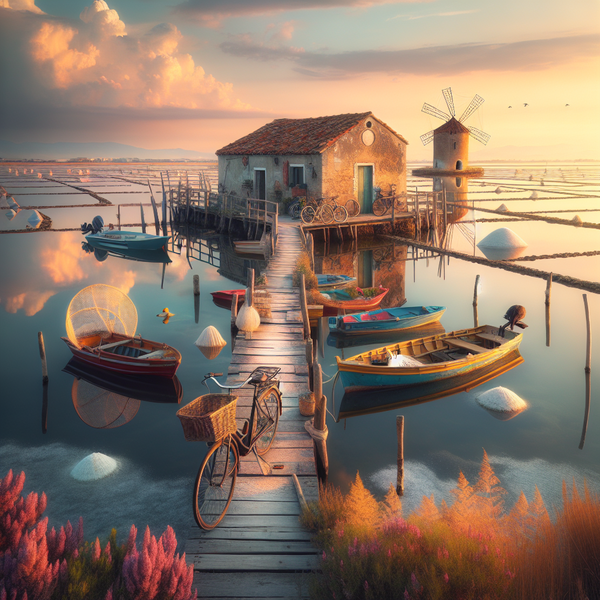
On Sicily’s western tip near Marsala lies the Stagnone Lagoon, a dazzling interplay of sea, salt, and sky. It’s the largest in Sicily, enclosed by a string of low islands including Mozia, an ancient Phoenician settlement that archaeologists began excavating in the 19th century. The salt pans glint rose and gold at sunset, framed by restored windmills that once pumped seawater into evaporation ponds. Visitors can walk narrow causeways where trucks once hauled salt, now part of a protected reserve managed by the Riserva dello Stagnone di Marsala.
One of the easiest and most poetic ways to experience Stagnone is by ferry to Mozia from the small pier at Saline Infersa, where boats depart every half hour in summer. On the island, footpaths lead through citrus groves to open-air archaeological remains, while the surrounding waters are shallow enough to wade in barefoot at low tide. Kite surfers favor the southern end of the lagoon because its steady wind and flat water create perfect conditions for beginners. Between sport, archaeology, and salt heritage, Stagnone feels like three worlds overlapped — and all within ten kilometers of Marsala’s downtown cafés.
Practical Tips for Visiting Italy’s Coastal Lagoons
Exploring Italy’s lagoons is unlike visiting the open coast. Water levels fluctuate daily due to tides and wind, and some areas restrict motorized boats to protect birds. Visitors should always check local park authorities for access permits or guided options. Nighttime in lagoon zones often brings biting insects, so natural repellent and long sleeves are advisable. Spring and autumn offer the best combination of mild temperature, fewer crowds, and active birdlife.
For travelers building a coastal itinerary, consider linking the lagoons into a slow-travel route: Venice’s lagoon for urban beauty, Comacchio for heritage, Orbetello for wildlife, and Stagnone for Sicilian light. Each marks a specific ecological type — from delta wetlands to saline basins — and no two look or smell the same. The payoff is a deeper sense of Italy’s living geography, one tidepool at a time.
Why Italy’s Lagoons Matter Beyond Tourism
Visiting lagoons is not just a matter of scenery: these ecosystems buffer coastal erosion, purify water, and sustain centuries-old fishing techniques. Local cooperatives in Orbetello and Comacchio still manage eel and mullet fisheries through rotational systems that trace back to Roman times. In Venice, the fight to regulate cruise ship traffic is tied directly to preserving lagoon depth and oxygen levels. Choosing a guided boat with low-emission engines or staying in eco-certified lodgings contributes tangibly to this balance.
As the Mediterranean faces rising seas and warmer winters, Italy’s lagoons become indicators of change. Travelers who walk quietly along their reed-lined banks may witness subtle but crucial rhythms — a reminder that beauty and fragility so often share the same shoreline.