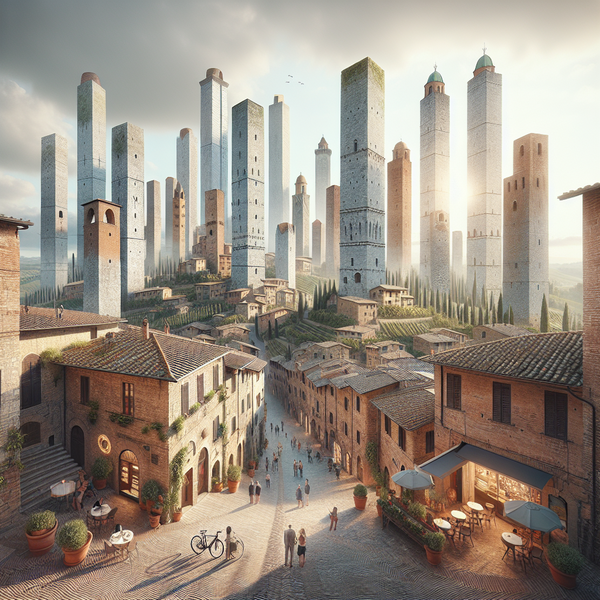
There’s a particular kind of silence that greets you inside a medieval tower in Italy — the thick masonry muffles sound, and the air feels older somehow, infused with the centuries of footsteps that once echoed upward. Climbing them isn’t just about panoramic views. It’s a direct line to an era when towns measured prestige by height, and defensive towers marked both pride and practical foresight. From San Gimignano’s skyline to Bologna’s dizzying tilt, these towers are living witnesses to Italy’s layered medieval past.
Go to the section
ToggleSan Gimignano’s Towered Skyline: Tuscany’s Stone Manhattan
San Gimignano offers one of the most recognizable profiles in Italy — a serrated line of fourteen medieval towers rising over terracotta rooftops. These stone giants were once nearly seventy in number, built by rival families eager to prove their dominance. Today, the Torre Grossa, at 54 meters tall, remains the highest accessible tower in town. You can climb its 218 steps to the viewing platform for a breathtaking view across the Elsa Valley and toward the vineyards of Vernaccia di San Gimignano, the town’s famous white wine.
Inside, the Civic Museum at the base holds frescoes from the late medieval period, allowing visitors to pair art appreciation with architecture. For a quieter climb, locals recommend the lesser-visited Torre Rognosa, tucked beside the Palazzo Vecchio del Podestà, where you’ll almost always find fewer tourists.
Bologna’s Leaning Towers: Asinelli and Garisenda
No other Italian city integrates its medieval towers so completely into modern life as Bologna. The twin towers, Asinelli and Garisenda, have guarded the city center since around the 12th century. The Asinelli Tower, still standing at nearly 97 meters, challenges visitors with 498 wooden steps to reach its summit. The climb rewards you with a commanding view of Bologna’s terracotta sprawl and the portico-lined streets below. Avoid midday in summer; the interior can become suffocatingly hot.
Garisenda, famously referenced by Dante for its pronounced lean, is closed to visitors but easily admired from Piazza di Porta Ravegnana. Visit in the early evening when the slanting light emphasizes its precarious angle. Around the base, locals gather for aperitivo in tiny bars where mortadella slices come paired with Lambrusco — a fine reward after your ascent.
Torres of Lucca: The Guinigi Tower’s Surprise Garden
In Lucca, the Torre Guinigi surprises most people the moment they look up. Sprouting from its rooftop are a cluster of ancient holm oaks — an improbable garden suspended above the city’s medieval walls. Commissioned by the Guinigi family, once among Lucca’s wealthiest merchants, the tower rises 45 meters. Climb the 230 internal steps and you’ll surface among the trees themselves, the scent of leaves mixing with the breeze off the Serchio River.
From this rooftop grove, the view extends to the Apuan Alps and the unmistakable oval of Lucca’s Roman amphitheater piazza. Below, Lucca’s cycling paths along the old city walls make it easy to cross from tower to tower — locals rent bikes beneath Porta San Pietro, just five minutes’ ride from the Guinigi entrance.
The Torrazzo of Cremona: Lombardy’s Musical Tower
Cremona’s Torrazzo stands in a different category — part watchtower, part belfry, fully an emblem of civic pride. At over 110 meters, it’s Italy’s tallest premodern brick bell tower, even taller than Bologna’s Asinelli. Beyond its height, it houses one of the world’s largest astronomical clocks, whose intricate dial signals planetary movements using hand-painted constellations visible from the cathedral square below.
Inside, an Museum of Vertical Time connects the concept of music and mathematics — fitting in a city that gave the world Stradivari. Time your visit to coincide with the midday chime and then explore the Violin Museum nearby. Combining the two makes for a thematic loop of sound, space, and structure found nowhere else.
Torri degli Sciri and del Cassero in Perugia: Umbrian Symbols of Power
Perugia once bristled with defensive towers, built mostly by noble families whose fortunes depended on the shifting alliances of medieval Umbria. Today, only the Torre degli Sciri and Torre del Cassero remain largely intact. The Torre degli Sciri, 46 meters tall, still stands along Via dei Priori, and visitors can climb to the top for an unobstructed view of Perugia’s layered rooftops and the distant Apennines. It opens occasionally for guided tours organized by local cultural associations — checking times in advance at the tourist office on Piazza IV Novembre is essential.
Nearby, the Cassero Tower defines the Rocca Paolina complex, repurposed into underground passageways beneath modern Perugia. Here, the experience is less about the climb and more about walking through layers of stone that once supported a fortress dominating the town. These surviving towers tell the story of a city that, though smaller, rivaled the regional might of Florence centuries ago.
Venice’s Campanile of San Marco: A Medieval Giant Reborn
The Campanile di San Marco, though rebuilt after its dramatic collapse in the early 20th century, preserves the form and function of its medieval predecessor. Rising 98.6 meters from the corner of the Piazza, it originally served as a lighthouse for sailors entering the Venetian Lagoon. The ascent via elevator — unusual among Italy’s historic towers — makes this one accessible even for those with limited mobility. From the top, you’ll see the maze of canals and the gleam of the Adriatic on clear days.
Early mornings before 9 a.m. are ideal to avoid queues. The sound of its five bells, each historically assigned a different civic purpose, still regulates the rhythm of local ceremonies. Standing at its base beside the Loggetta, you can trace the line of sight that once guided merchant vessels into the Serenissima’s heart.
The Towers of Pavia: A Quiet Cluster Beside the University
Pavia’s medieval towers often surprise visitors because they rise suddenly amid quiet university courtyards. Once numbering around seventy, only a handful remain grouped near Piazza Leonardo da Vinci — slender, reddish-brick spires connected to the Lombard nobility. The Torre del Municipio and the Torre del Maino define the skyline near the university library. Their alignment shows a medieval obsession with visibility: each tower was built partly to overshadow its neighbor’s.
Unlike Bologna or San Gimignano, Pavia’s towers aren’t open for climbing, but they’re fascinating to photograph in the golden-hour light reflected from the Ticino River. For a fuller context, the nearby Visconti Castle’s museum offers a model of the medieval town, helping visualize how forested the skyline once looked with towers.
Torrazzo of Clusone: Bergamo’s Frescoed Towered Clock
High in the Seriana Valley north of Bergamo, Clusone’s Clock Tower anchors the Piazza dell’Orologio. Its unusual frescoed astronomical clock, dating from the 16th century but installed on a medieval base, moves counterclockwise — a quirk that still confuses visitors watching its wheels spin in reverse. The attached civic tower rises beside the Oratorio dei Disciplini, known for its Danse Macabre frescoes, making the combination uniquely gothic.
Climbing its short internal staircase grants a view toward the Alps, but the real magic is at street level during the chime hour, when the clock’s painted zodiac signs shift under a gilded sunburst. Few travelers outside Lombardy ever make the detour, but it’s one of Italy’s most rewarding small-town discoveries.
Torres of Sardinia: Castelsardo and Alghero’s Coastal Watchtowers
While Sardinia’s medieval towers show a different purpose — coastal defense rather than noble vanity — their beauty lies in their maritime context. In Castelsardo, the Torre Frigiano crowns the rock above the old harbor, its round base catching sea light that shifts from silver to ochre through the day. Climb just before sunset for views across the Gulf of Asinara; local fishermen still mend their nets below, an image largely unchanged for centuries.
In Alghero, several coastal towers such as Torre di Sulis and Torre di San Giovanni are integrated into the fortified walls. These towers are shorter but remarkable for their preservation. The museum inside Torre di San Giovanni traces how Sardinia’s watchtower network once communicated using fire signals — a medieval version of telegraphy across the Tyrrhenian coast.
Why Italy’s Medieval Towers Matter Today
Each Italian tower still fulfills a civic function, though transformed. They are timekeepers, viewing platforms, and living memory anchors for the towns below them. The cost of preservation is immense: local councils invest continuously to maintain stability against earthquakes, which remain a constant threat. Visiting them supports not only heritage conservation but often local artisans too — because many tickets are bundled with museum entry or city passes that fund restoration projects.
For travelers, these towers form a literal vertical itinerary: ascend, observe, descend, and find a cafe nearby to process what you’ve seen. Bring rubber-soled shoes, a water bottle, and patience — most staircases were not designed for modern feet. And always check seasonal opening hours; many towers close during winter months or limit access after heavy rain for safety.
Planning Your Own Tower Trail Through Italy
A rewarding route might connect Bologna’s Asinelli, San Gimignano’s Grossa, Lucca’s Guinigi, and Cremona’s Torrazzo — each within a few hours by train. This path cuts vertically through central-northern Italy and touches both Lombardy’s plains and Tuscany’s hills. You can complement the towers with local specialties: tortellini in Bologna, saffron risotto near Milan, cantuccini in San Gimignano. Trains between these towns are frequent but check regional schedules, especially on Sundays when services reduce.
Many small towns also hold summer tower festivals, where climbs are cheaper and nighttime illuminations add drama. In San Gimignano, night tours sometimes coincide with open-air concerts, letting you enjoy the acoustics between stone walls that once hosted medieval trumpeters. Planning your itinerary around such events transforms your visit from sightseeing into immersion.
At their heart, Italy’s medieval towers are vertical diaries — every stair etched with ambition, fear, art, and dignity. Climb them slowly, breathe in their dust and history, and you’ll understand why Italians still look upward when they speak of their past.