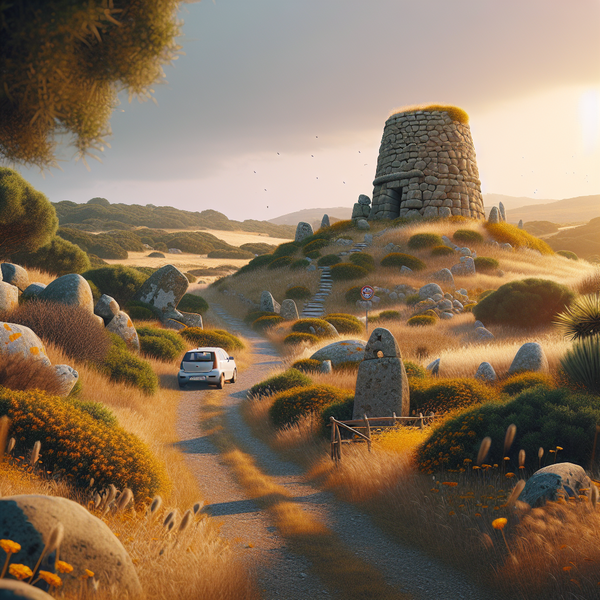
Drive inland from Sardinia’s glittering coastline and the island’s true heart begins to appear: conical towers rising from lonely hillsides, built of massive basalt blocks stacked without mortar. These are the nuraghe, silent witnesses to a prehistoric civilization that flourished here thousands of years ago. You might have passed one unknowingly on the road between Cagliari and Oristano or seen the legendary Nuraghe Su Nuraxi on a postcard. Yet until you stand inside one—cool stone beneath your hands, the Mediterranean light filtering through narrow slits—you don’t truly understand how extraordinary they are.
Go to the section
ToggleUnderstanding Sardinia’s Nuraghe Culture
The nuraghe are fortified towers unique to Sardinia, numbering over 7,000 across the island according to local archaeological surveys. They were built between the Bronze and Iron Ages, long before the Romans arrived. Their form varies: some stand alone amid cork oak groves, while others are the core of entire stone villages. In the village of Barumini, for instance, the vast complex of Su Nuraxi features a central tower nearly 20 meters high surrounded by a labyrinth of smaller ones, connected by walls and courtyards. Visiting it is less about ticking a sight off your list and more about stepping into an ancient blueprint of community life.
Local guides in Sardinia’s archaeological parks often emphasize how each nuraghe was both practical and symbolic: a lookout, a home, and a statement of territorial power. Excavations have unearthed pottery fragments, bronze figurines, and grinding stones inside their thick walls, suggesting that daily life once thrived within these stone fortresses. The mystery still puzzles scholars—were they purely defensive or spiritual centers? Whether in Barumini, Torralba, or Orroli, every site tells a slightly different story.
Where to See the Most Impressive Nuraghe Sites
To explore the nuraghe effectively, plan your route by region. The central and southern provinces—Medio Campidano, Oristano, and Cagliari—hold the highest concentration of well-preserved sites accessible to visitors. Start with Nuraghe Su Nuraxi di Barumini, a UNESCO-listed complex about one hour north of Cagliari. Its multi-towered layout is the island’s most complete, and guided tours take roughly 45 minutes. You’ll climb through narrow stone stairways leading to the upper chambers, a hands-on encounter with prehistory.
If you head northwest, near Sassari, make time for the Nuraghe Santu Antine in Torralba. Locals call it the ‘Sardinian palace,’ thanks to its intricate three-tower structure and massive central corridor you can still walk through today. Early morning visits are best: the light slants dramatically into the inner chamber, and the crowds are smaller. Nearby, the Valle dei Nuraghi offers a landscape dotted with dozens of smaller ruins—perfect for slow exploration by car or e-bike, available in nearby Ozieri.
Further east in the region of Nuoro, Nuraghe Arrubiu near Orroli stands as one of the island’s largest, with red basalt walls that glow at sunset. It’s less visited yet remarkably intact, complete with a small visitor center and useful English-language panels explaining the tower’s structure. Bring a hat and water: the plateau is breezy but exposed, and there’s little shade once you leave the ticket booth.
Connecting With Local Life Around the Nuraghe
Visiting a nuraghe isn’t only about ancient stones—it’s also a way to meet Sardinians whose ancestors have lived beside these towers for millennia. Many guided tours are community-led. In Barumini, for example, the cooperative that manages Su Nuraxi employs local historians and artisans who share personal insights about rural traditions. After visiting the site, wander over to the nearby Casa Zapata Museum, where glass floors reveal another nuraghe discovered beneath a Spanish palace. It’s a rare chance to see past eras literally layered together.
In smaller towns such as Villanovatulo and Gesturi, family-run trattorie serve rustic dishes like malloreddus (Sardinian gnocchetti) and roasted lamb, often accompanied by the local red wine, Cannonau. Pair your visits to nuraghe with these village meals for a more rounded cultural immersion. Time your journey carefully: many nuraghe sites close during midday hours, typically between 1 p.m. and 3 p.m., mirroring the island’s relaxed rhythm.
Driving Routes and Practical Tips for Nuraghe Exploration
Sardinia’s interior is hilly, and public transport between rural sites is infrequent. Renting a car from Cagliari, Oristano, or Alghero is the most efficient way to cover multiple nuraghe in one trip. Plan a circular route: Cagliari → Barumini → Orroli → Oristano → Bosa → Alghero. This loop allows you to experience the distinct landscapes of the Campidano plains, Gennargentu foothills, and the island’s northwestern coast. Roads are well paved but occasionally narrow; always budget extra driving time, especially when navigating mountain bends around Laconi.
Entrance fees to smaller nuraghe range from €3 to €7, while larger archaeological parks like Su Nuraxi cost around €12 including a guide. Many sites now offer combined tickets that include nearby museums. Bring cash, as remote visitor offices sometimes lack card terminals. For photography, keep in mind that tripods typically require a permit, easily requested via email from local councils.
Wear sturdy shoes: even on mild days, expect uneven terrain, steep stairwells, and the occasional goat blocking your path. Early spring and late autumn are ideal for exploration, when temperatures hover around 20°C and vegetation softens the stark, volcanic surroundings. Locals often remark that nuraghe are best appreciated in silence, so visit outside peak times to savor their solitude fully.
Regional Variations and Hidden Nuraghe You Shouldn’t Miss
Though the most famous examples cluster in the island’s south, every region has its own architectural nuance. In the northwestern region of Anglona, for instance, the Nuraghe Majore near Tempio Pausania shows smoother granite construction rather than the basalt used further south. Its name—‘Majore,’ meaning ‘largest’—is apt: the tower’s base measures nearly 20 meters across. The site is accessible via a short forest path lined with wild myrtle bushes, which release their spicy aroma underfoot.
Along the southwestern Sulcis hills, smaller nuraghe such as Seruci and Grutti Acqua are less monumental but atmospheric, often standing beside abandoned shepherd shelters. In these areas, you’re likely to explore alone, accompanied only by the wind and larks. Stop at the nearby coastal town of Sant’Antioco for fresh seafood before looping back inland. For photography enthusiasts, dusk is the golden hour when the dry grass and dark stone contrast most vividly.
Beyond the Stones: Interpreting Sardinia’s Ancient Soul
After several days among the nuraghe, patterns begin to emerge. The towers often align with ridgelines and water sources, echoing a deep respect for landscape continuity. Local archaeologists sometimes point out that modern Sardinian shepherd huts, known as pinnettas, share similar construction principles—corbelled roofs and circular footprints—suggesting an unbroken architectural logic passed down through generations. Even rural festivals occasionally integrate these sites, such as summer evening concerts held at Nuraghe Santu Antine, where traditional launeddas flutes echo through the chambers.
To truly appreciate the nuraghe, linger. Sit on a stone ledge at Barumini after the last tour departs. The basalt still radiates warmth from the afternoon sun. Around you unfolds a landscape almost unchanged since ancient times: olive trees, grazing sheep, the hum of distant insects. It is then, in silence, that Sardinia’s prehistoric architects feel closest—not just as figures of history, but as humans who shaped an island’s identity from volcanic rock.