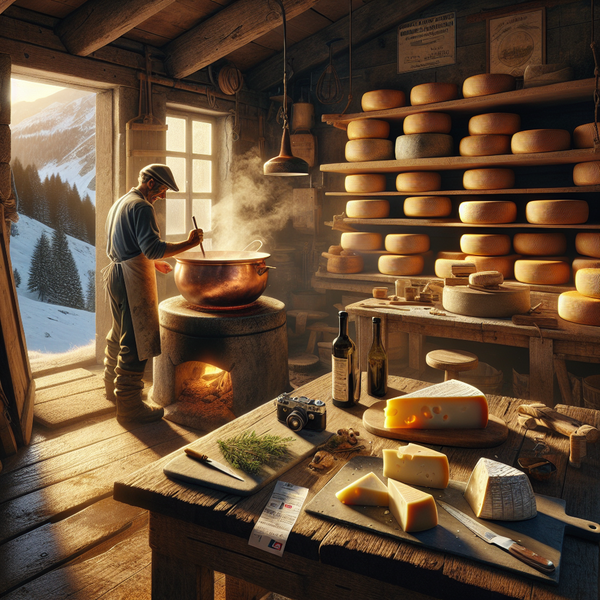
There’s a sound that marks the start of cheesemaking mornings in Italy’s mountain regions: the rhythmic clang of copper cauldrons being filled with warm milk. The mountain air still carries a hint of dew, and cows, sheep, or goats graze nearby meadows that shape every note of flavor. Finding authentic cheesemaking in the Italian mountains isn’t about seeking a factory or museum. It’s about traveling into valleys where cheese still measures time — from fresh curd to aged wheels carved in stone-lined cellars.
Go to the section
ToggleAlpine Cheesemaking in the Valle d’Aosta: The Home of Fontina DOP
In the northwestern corner bordering France and Switzerland, the Valle d’Aosta is compact but fiercely proud of its food heritage. Here, Fontina DOP isn’t just a product; it’s a tradition protected by mountain air and grazing altitude. To find the real thing, visit the high pastures above Cogne or Torgnon between June and September when cows are brought up for seasonal transhumance. At 2000 meters, the milk differs daily — a detail that producers like Cooperative Fontina in Valpelline happily explain as they guide visitors through stone aging caves perfumed with wild herbs.
Fontina curds are cooked gently over open fire, then pressed in wooden molds and rubbed repeatedly with local brine. The resulting cheese bears the red mountain brand that certifies its origin. You can buy genuine wedges directly at roadside huts marked “fontina di alpeggio” — these wheels rarely leave the region and taste nothing like supermarket Fontina.
The Dolomites and Trentino’s Malghe: Where Cheese Meets Altitude
Across the country’s northern spine, the Dolomites rise in jagged limestone beauty. Hidden among the ski lifts and hiking trails are the malghe — seasonal alpine dairies producing limited batches of cow and sheep cheese. The best time to experience them is early morning, when vats are still steaming and cheesemakers pour coffee from enamel mugs. In Trentino, ask locals for Malga Campo di Vattaro near Lake Caldonazzo or Malga Ritorto above Madonna di Campiglio. Each malga maintains its own signature: some make Puzzone di Moena DOP, others a crumbly Vezzena prized since Austro-Hungarian times.
Cheesemaking visits in Trentino are informal but deeply educational. You may be invited to taste fresh curd, or tosela, barely an hour old — sautéed in butter with polenta for breakfast. Bring cash: many mountain dairies sell only on-site, and quantities are small. If you’re hiking, these stops double as rustic lunches accompanied by berries and mountain honey.
The Secrets of Piedmont’s Occitan Valleys: Tomme and Toma on Ancient Paths
South of Turin, the Val Varaita and Val Maira carry echoes of the ancient Occitan language and a cheesemaking culture preserved by geography. The steep roads and isolated hamlets limit industrial access, leaving the field to families who still stir curds by hand. One of the most striking finds here is Toma di Maira, a semi-hard cow’s cheese aged in cellars lined with chestnut planks. Small cooperatives near Prazzo and Elva open their doors to travelers who schedule ahead via local agriturismi. The drive alone is reward enough, winding past frescoed chapels and stone barns with external milk coolers powered by mountain springwater.
Another treasure is Seirass, a creamy ricotta-like cheese made from whey. Buy it early before noon: it spoils quickly and locals eat it drizzled with honey. In these valleys, cheese isn’t just food — it’s a lifeline keeping the younger generation connected to the land. Many producers work cooperatively to maintain bilingual Occitan-Italian labels that certify authenticity.
Apennine Cheesemaking in Emilia-Romagna: From Parmigiano to Mountain Pecorino
The Apennines dividing Emilia-Romagna from Tuscany tell another story — one of rugged practicality and long storage. North-facing slopes around Castelnovo ne’ Monti and Toano produce Parmigiano Reggiano di Montagna, a DOP version made above 600 meters. Visit the Caseificio Santa Lucia or Caseificio Vallesina to watch the king of cheeses being stirred in enormous copper vats by a master casaro using a beechwood paddle. Slightly less salty and often sweeter than its lowland twin, mountain Parmigiano reflects higher-quality grass and slower curing due to cooler cellars.
Don’t skip the sheep’s-milk corner of Emilia’s Apennines — the pastoral zone of Brisighella and Tredozio. Here, small producers make Pecorino aged under chestnut leaves or clay. Some host weekend workshops teaching the temperature-sensitive art of rennet setting, where you’ll gently cut curds with a lyre-shaped tool called a spino. These hands-on sessions typically book through local agritourism cooperatives and cost under €20.
Sardinia’s Mountain Heartland: The Wild Heritage of Pecorino Sardo
If the Alps shape Fontina, Sardinia’s interior mountains shape Pecorino Sardo and its wilder cousin, Fiore Sardo DOP. The latter is almost smoky, a flavor born from open-flame drying in shepherd huts. In the Barbagia region, particularly near Gavoi and Ollolai, you can watch shepherds drain curds into reed baskets identical to those used centuries ago. The cheese is then salted by hand and aged for at least two months in stone cellars where humidity comes naturally from volcanic soil.
Many workshops happen informally: a chat at the weekly market may lead to a family demonstration the following day. The small Caseificio Puddu near Gavoi accepts visitors who arrange ahead through local B&B hosts. Tastings often include cannonau red wine and house-baked carasau bread — both essential companions for the cheese’s robust notes.
Cultural Etiquette When Visiting Mountain Cheesemakers
Visiting mountain dairies in Italy differs from a standard tour. These are family spaces, where work and life overlap. Always call ahead, even if you’re told visits are informal. Bring your own containers or cloth to wrap purchases — many malghe avoid plastic packaging. If offered a tasting, accept modestly and leave a small donation or purchase cheese as a thank-you. Photography is usually fine, but always ask before shooting interior work areas.
Local customs often dictate meal sharing after work hours. Don’t refuse lightly: sitting down for polenta or a slice of torte with the cheesemaker’s family turns a visit into a memory. You’ll likely leave with slices wrapped in wax paper and advice on aging them at home — typically, cool and wrapped in linen rather than plastic film.
Tips for Planning a Cheesemaking Road Trip Through the Italian Mountains
To link these regions efficiently, rent a small car and travel from June to early October when alpeggi (summer pastures) operate. Public transport rarely reaches high farm roads; even so, most mountain dairies are within two hours from major airports such as Turin, Milan, or Bologna. Travel times vary, so consider splitting routes:
- Northwest Route: Turin → Val Maira → Valle d’Aosta
- Central Route: Bologna → Modena Apennines → Brisighella
- Island Route: Olbia → Nuoro → Gavoi (Sardinia)
Seek local agriturismi that double as working farms. They often provide homemade meals based on their own cheese and lend insight impossible to find in city restaurants. Always carry a cooler bag if you plan to transport cheese — a small detail that keeps your treasures safe even on a warm Italian afternoon.
Preserving the Taste: Learning to Identify Authentic Mountain Cheese
Authenticity begins with controlled origin labels, but the real hallmark is sensory. Lift a slice of Fontina di Alpeggio or Toma di Maira to your nose — the aroma should recall herbs, wild flowers, or stable straw, never ammonia or excess salt. Textures in genuine mountain cheeses vary by altitude and season: summer wheels are softer, winter ones denser. Look for natural rinds rather than waxed coatings, and small irregular eyes within the paste, evidence of fermentation in traditional wood vats.
Many cheesemakers sell only limited volumes. Buying directly supports them against industrial scaling that threatens Italy’s food biodiversity. When you taste these cheeses back home, you’re also tasting a living landscape — one crafted by air, altitude, feed, and patient human touch.
Whether in a misty Alpine valley or on a Sardinian ridge, tracing authentic cheesemaking in the Italian mountains means trading convenience for connection. Every turn of the ladle and every damp cave shelf holds centuries of quiet persistence. You leave not just with cheese, but with an understanding that flavor, here, still depends on hands, animals, and the slow rhythm of the mountains.