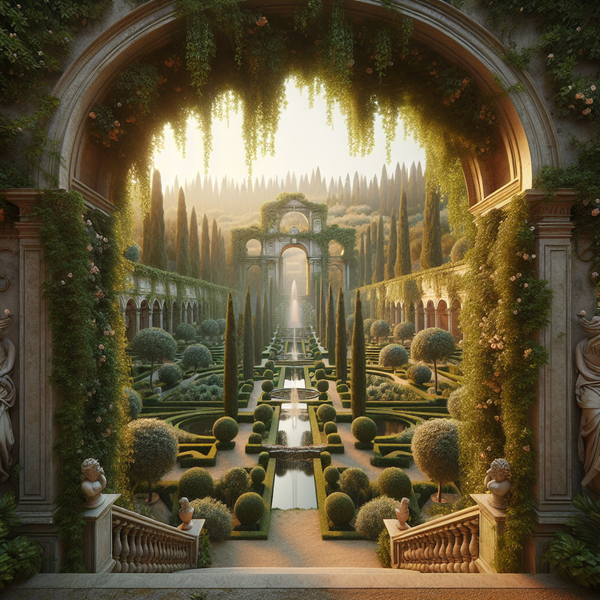
There’s a moment, somewhere between the cypress-lined drives of Lazio and the rolling hills of Tuscany, when central Italy’s gardens reveal their genius. These landscapes are not just ornamental; they are the distilled expression of centuries of philosophy, politics, and art. From papal retreats to Medici estates, the region’s historic gardens blend discipline and sensuality, symmetry and wilderness. To wander here is to walk through history that still blooms.
Go to the section
ToggleRenaissance Geometry and Water Wonders at Villa d’Este in Tivoli
No other garden in central Italy captures the theatrical ambition of the Renaissance quite like Villa d’Este in Tivoli, about a 40-minute train ride from Rome. Commissioned by Cardinal Ippolito II d’Este in the 16th century, this UNESCO-listed villa is famed for its elaborate hydraulic engineering, which powers over 500 fountains by pure gravity.
Start your visit early, before the midday tour buses arrive, and you’ll hear the organ fountain play its baroque melody echoing off the cypress trees. The Viale delle Cento Fontane—the Avenue of a Hundred Fountains—unfolds like a watery poem leading toward views of the Roman countryside. For full effect, climb to the upper terraces to see how the architects used perspective to make the fountains align with the villa’s façade. A local tip: Tivoli’s train station has a convenient bar called Caffè d’Este where the morning espresso costs €1.30 and the view of the old town sets the mood perfectly.
Botanical Majesty and Olive Shade in Florence’s Boboli Gardens
Behind the massive walls of Palazzo Pitti, the Boboli Gardens spread across Florence’s southern hills like a living museum of Renaissance landscape design. Originally laid out for the Medici in the 16th century, the garden later inspired Versailles. Its carefully planned terraces and dramatic perspectives showcase statues, obelisks, and grottos that merge myth with geometry.
The experience changes with the light. In the early evening, the cypress alleys cast long shadows over the amphitheater where the Medici once hosted masquerades. The Viottolone, the garden’s main avenue, leads to the Isolotto Basin, crowned by Giambologna’s Neptune. Bring water and sturdy shoes: the walk from the Pitti courtyard to the hillside Belvedere gate involves significant elevation, but the panoramic reward—Brunelleschi’s dome glowing over the rooftops—is unforgettable. Tickets for the garden also grant access to the ornate Porcelain Museum, tucked into one of the upper terraces.
The Mystical Simplicity of Sacro Bosco at Bomarzo
Halfway between Rome and Orvieto lies the strangest and most haunting of central Italy’s historic gardens: the Sacro Bosco, or Sacred Wood, of Bomarzo. Designed in the mid-16th century by Prince Pier Francesco Orsini, this forested park rejects the formal symmetry of the Renaissance in favor of surreal stone monsters and poetic inscriptions. Inscriptions like “Sol per sfogare il core” (“Only to set the heart free”) recall Orsini’s mourning for his late wife Giulia Farnese, whose memory permeates the site.
Visitors wander among moss-covered giants—a tilted house that defies balance, a dragon locked in stone combat, and the famous Orcus mouth whose inscription means “All thought departs.” The park is open year-round; in cooler months, mist often curls through the trees, intensifying its dreamlike feel. Pair your visit with a quick lunch of local pecorino and north Lazio wines from the nearby Osteria Belvedere. Parking is easy, and entry tickets can be purchased directly at the gate or online through the official Bomarzo website.
Baroque Grandeur Meets Volcanic Views at Villa Lante in Bagnaia
Just outside Viterbo, on the slopes of Monte Cimino, stands Villa Lante—a marvel of balanced geometry and water artistry. Built for Cardinal Gambara, the twin palazzine flank an intricate formal garden that descends in terraces. Every element is part of a symbolic narrative about civilization taming nature. The crown jewel is the Fountain of the Moors, where four Moors hold the Gambara coat of arms high above a circular basin.
The entire hydraulic system still functions via 16th-century gravity-fed channels. Follow the sound of trickling water, and you’ll pass sculpted stone tables where water once flowed as a built-in cooling feature during summer banquets. Local buses from Viterbo’s Porta Romana station stop near the villa entrance, and from the upper terrace the view over the volcanic landscape of northern Lazio hints at the Etruscan past that precedes the Renaissance order.
The Secluded Harmony of the Gardens of Villa Garzoni in Collodi
In the small Tuscan village of Collodi, known as the birthplace of Pinocchio’s author Carlo Lorenzini, lies a baroque garden that feels like a miniature universe. The Villa Garzoni Gardens unfold on a steep hillside, blending Renaissance rigor with playful theatricality. What distinguishes them is the unexpected combination of botanical variety—camellias, citrus terraces, and rare palms—with dynamic staircases and water jets that seem designed to amuse as much as impress.
These gardens once symbolized the transition between human control and natural abundance. The butterfly house near the entrance adds a modern ecological touch, housing tropical species within restored 18th-century walls. Tickets can be bought in combination with the Pinocchio Park next door, making Collodi a worthwhile stop for families traveling between Lucca and Florence. Evening visits are particularly atmospheric, when the fountains are softly illuminated and the air carries the faint citrus scent from the terraces above.
Tuscan Refinement in the Gardens of Villa Reale di Marlia near Lucca
Hidden a few kilometers northeast of Lucca, Villa Reale di Marlia offers 16 hectares of manicured gardens that seamlessly integrate Renaissance, baroque, and romantic influences. Once home to Elisa Bonaparte Baciocchi, Napoleon’s sister, the estate still reflects her flair for both drama and discretion. The Green Theatre, built entirely of laurel hedges, continues to host open-air performances every summer.
Don’t miss the Spanish Garden, with its geometric parterres and colored gravel, or the Lemon Garden, where hundreds of antique terracotta pots are arranged every spring. The villa’s owners have restored the hydraulic network, so the fountains once again dance across the lawns. Access is easiest by car or rented e-bike from Lucca (the ride takes about 30 minutes), and tickets can be booked via the official website for time slots that limit crowding. Early morning visits capture the most flattering light for photography.
The “Secret Rome” of Villa Torlonia’s English and Moorish Gardens
Rome’s Villa Torlonia rarely makes the cut for first-time visitors, but for garden enthusiasts it’s a treasure. Once the residence of Mussolini, this public park on Via Nomentana blends English landscape design with whimsical Moorish motifs. The Casina delle Civette (House of the Owls) is worth the detour: its stained glass and grotto-like construction mimic nature within art. The garden features rare cork oak trees and carefully preserved palm avenues, reflecting 19th-century taste for exotic flora.
Unlike the formal elegance of Tivoli or Florence, Villa Torlonia invites lazy afternoons. Locals spread picnic blankets under camphor trees while children explore secret pathways near the Moorish greenhouse. The park’s café serves solid espresso and sandwiches; avoid midday heat by arriving around 9 a.m. when the city noise hasn’t yet reached this green bubble. The nearest metro stop—Policlinico—makes it an effortless morning excursion from central Rome hotels.
Medieval Serenity in the Orto Botanico of Siena
Tucked against Siena’s medieval walls below Porta Tufi, the city’s Orto Botanico belongs to the University of Siena and mixes academic precision with quiet beauty. Its lower terraces preserve 16th-century plant beds that once served as a medicinal resource for professors of natural philosophy. Today, the garden shelters an impressive collection of alpine flora and endangered Tuscan species, carefully labeled for visitors who appreciate detail over spectacle.
Entrance is free on certain weekdays (check university schedules), and a small greenhouse displays native orchids and carnivorous plants. From the shaded benches of the highest terrace, you can glimpse Siena’s Torre del Mangia framed by olive branches. The botanical garden’s atmosphere—half classroom, half sanctuary—makes it a restful contrast to the busy Campo above. A modest snack bar nearby, Café Porta Tufi, is ideal for a cappuccino before climbing back into the city’s labyrinthine streets.
Planning Your Historic Garden Route Through Central Italy
To truly appreciate the range of central Italy’s garden heritage, organize your trip geographically. Start from Rome, where Villa d’Este and Villa Torlonia illustrate the evolution from Renaissance order to romantic leisure. Continue north through Viterbo to Villa Lante, then pivot into Tuscany for Boboli, Marlia, and Collodi. Each expresses a different dialogue between art and nature, faith and pleasure.
Travel is straightforward: regional trains connect Rome, Florence, and Siena; smaller towns like Tivoli or Bagnaia require brief local bus journeys. Renting a compact car gives flexibility, especially for the countryside estates. Spring (April–June) offers mild temperatures, blooming roses, and functioning fountains; autumn brings softer light and fewer crowds. Always check opening hours—many gardens close mid-afternoon or for lunch breaks typical of Italian museums.
Central Italy’s gardens are more than scenic attractions: they’re living archives of ambition and contemplation. Each terrace, fountain, and hedge whispers a story of creators who sought harmony between human craft and natural beauty. Take your time, bring comfortable shoes, and let the rhythm of cypress and water guide your exploration.