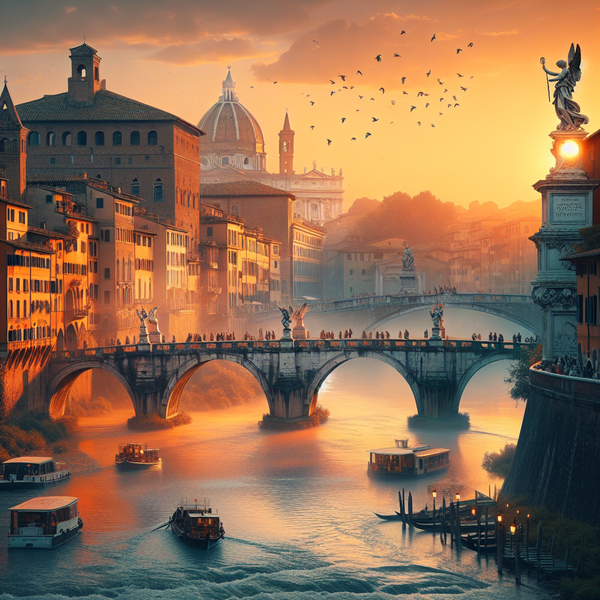
If there’s one architectural detail that quietly threads Italy’s landscape together, it’s the medieval bridge. Beyond their stone arches and muted colors, these crossings tell centuries-old stories of pilgrims, merchants, and strategic wars. Many still stand gracefully over rivers that have not changed course in hundreds of years. For photographers, they offer structure, reflection, and atmosphere — from dawn mists to the golden light of late afternoon. Below is a journey through Italy’s most photogenic medieval bridges, with practical details on where and when to capture them best.
Go to the section
TogglePonte Vecchio in Florence: Capturing Light on Living History
You could spend days in Florence and never tire of the play of light over the Ponte Vecchio. Spanning the narrowest part of the Arno River, this bridge dates to the 14th century and remains lined with goldsmiths whose shop shutters gleam at sunrise. Arrive at first light to catch the Arno reflecting creamy tones of the bridge and its shops before the day’s traffic starts. For the most balanced composition, stand at the midpoint of Ponte Santa Trinita and use a 50mm lens: this viewpoint aligns all three arches in a near-perfect perspective.
In the evening, photographers often prefer the warm artificial lights that illuminate the Ponte Vecchio from below. If you’re using a tripod, note that police occasionally restrict extended setups on the bridge itself, so it’s best to photograph from the south bank near the Uffizi exit.
Bridge of Ponte della Maddalena in Tuscany: The Devil’s Arch Reflected in Calm Waters
North of Lucca, near the village of Borgo a Mozzano, stands the Ponte della Maddalena, often called the Devil’s Bridge. The largest arch creates a surreal reflection forming a perfect oval in the Serchio River on still mornings. The best time to photograph it is between 7 and 9 a.m. in summer, when the morning sun hits the stone from the east and the village background remains lightly misted. There’s ample parking near the walking trail on Via Ludovica, just 200 meters west of the bridge.
Travelers interested in lesser-known detail should explore the north side, accessible by a footpath leading under the first arch. Few visitors realize that a small chapel tucked there once received tolls from merchants moving silk and olive oil inland. Drones are permitted only if flown above 50 meters, following Lucca’s municipal guidelines.
Ponte di Castelvecchio in Verona: Medieval Fortifications Framing the Adige
The Ponte Scaligero, part of Verona’s Castelvecchio complex, is among Italy’s most photogenic fortified bridges. Built in red brick and crowned with battlements, it aligns precisely with the city’s medieval defense walls. Walk along the parapets in late afternoon light, when shadows sculpt the brick crenellations. The tower on the western side—reachable via a spiral staircase inside the castle museum—offers a sweeping view of both the Adige River and the bridge’s reflection below.
For the perfect long-exposure photograph, head down to the paved riverbank below Ponte Risorgimento about 400 meters east. Use a neutral density filter to soften the fast-flowing Adige. This technique highlights the strong linear rhythm of the bridge’s arches. Before visiting, check the Verona Card options: it often includes combined access to the bridge, castle museum, and Lamberti Tower for panoramic city shots.
Find all the best hotel deals
Book now on Booking.com
Ponte Gobbo in Bobbio: Uneven Beauty Across the Trebbia Valley
The Ponte Gobbo, also known as Ponte del Diavolo in the town of Bobbio, is one of Italy’s most irregular and photographically fascinating bridges. Each of its 11 arches appears different in size and height, resulting in a zigzag profile that seems to defy gravity. Built between rocky outcrops of the Trebbia River, it offers a dynamic composition at nearly any angle. To catch its full silhouette, walk 10 minutes downstream to the right bank near Parco Avventura Bobbio, where you can frame the entire serpentine line against a backdrop of rolling hills.
In winter, low sunlight reveals the textures of its sandstone blocks, while summer evenings bring warm contrasts against green water. Bobbio itself remains a quiet town of fewer than 4,000 residents, making early morning photography blissfully uninterrupted. Local legend attributes the asymmetrical design to the Devil’s interference when monks needed to cross the river overnight — an origin story as crooked as the bridge itself.
Discover the best local experiences
Book tours and activities across Italy
Ponte delle Torri in Spoleto: Engineering Elegance on a Dramatic Scale
South of Umbria’s quiet hill town of Spoleto stands the Ponte delle Torri, a staggering medieval aqueduct-bridge nearly 80 meters high. Built likely upon Roman foundations, this bridge connects the Rocca Albornoziana fortress to Monteluco hill. The best photographic angle is from the panoramic terrace of Via del Giro della Rocca, where all ten pointed arches appear suspended over deep forested valleys. Bring a zoom lens to capture the fine vertical slots that once carried the water channel.
Morning fog often lingers along the valley until about 9 a.m., giving the structure an ethereal outline. Note that pedestrian access may close temporarily during restoration periods, but the view remains freely accessible from town. A circular walking route of roughly 4 kilometers lets you combine the bridge view with olive groves and monastery paths—a quiet complement to Spoleto’s Roman theater and frescoed churches.
Ponte delle Torri in Cividale del Friuli: A Bridge of Lombard Legends
Further north in Friuli Venezia Giulia, Ponte del Diavolo in Cividale del Friuli provides a compact but powerful composition for any photographer exploring Italy’s northeast. The single main arch of 22 meters spans the Natisone River, revealing turquoise waters framed by limestone cliffs. From the Belvedere on Piazza San Francesco, late afternoon shots catch the bridge backlit, producing reflections that double its dramatic height.
Within a 5-minute walk, the Lombard Temple and the medieval cloister of Santa Maria in Valle offer shadowed alleys that contrast nicely with the bridge’s brightness. It’s worth timing a visit on a weekday morning when local school traffic is minimal and the river surface remains glass-like. The bridge’s name, again tied to a devilish folklore, refers to its audacious stonework completed in exceptionally short time—a story that delights every local guide.
Ponte di Tiberio in Rimini: Roman Precision with Medieval Survival
Though its origins were Roman, the Ponte di Tiberio in Rimini continued functioning through the medieval period and beyond, surviving floods, wars, and modernization. Five harmonious arches cross the Marecchia River at the northern end of Corso d’Augusto. Visit early in the morning to capture fishermen’s boats moored below, their reflections sharp in calm water. A tripod is convenient here—local police are used to photographers as long as they don’t block foot traffic.
After sunset, the bridge gains soft illumination from embedded footlights, emphasizing its perfectly symmetric voussoirs. Rimini residents often walk across to the Borgo San Giuliano district, where murals of Fellini’s films create vivid street scenes—an ideal juxtaposition for those who love blending architectural and cultural photography.
Ponte di Bassano in Veneto: Covered Timber Heritage Along the Brenta
Finally, in the alpine foothills of Veneto, the Ponte degli Alpini in Bassano del Grappa offers a different medieval aesthetic: wood instead of stone. Although repeatedly rebuilt, its medieval form remains, resting on red-painted timber trusses that mirror in the Brenta River below. Stand on the north embankment near Piazza Terraglio to photograph its full reflection framed by Mount Grappa’s slopes.
Visit near sunset when the wood glows copper against the cool blue current. The bridge links directly to the Museo degli Alpini, which tells of mountain soldiers who later restored it. After your photo session, step into the historic Nardini Grappa distillery on the east side for a taste of the local spirit that once fortified builders after freezing shifts above the river.
Practical Tips for Photographing Italy’s Medieval Bridges
Italy’s historic bridges often lie within active neighborhoods, so accessibility varies. To plan efficiently:
- Light and timing: Aim for early morning or post-sunset glow. Many rivers in central Italy face east-west, giving symmetrical reflections twice a day.
- Tripod rules: Historic centers like Florence or Verona may restrict tripods on the main bridge decks. Set up from adjacent riverbanks or parks for stability and better angles.
- Seasonal color: Autumn foliage in Umbria and Emilia-Romagna adds ochre tones that enhance stone contrast. Spring melt delivers strong river flow for dynamic reflections, while late summer allows easier close access to riverbeds.
- Lens choice: A 24–70mm zoom covers most needs; carry a polarizing filter to reduce glare off water surfaces.
Above all, explore patiently. Italy’s medieval bridges often reveal their best side quietly, when wind settles and the water mirrors the centuries back at you.