There’s something eternally captivating about Italy’s historic fountains. They’re more than urban decoration—they are time capsules of artistry, engineering, and civic life. From Rome’s exuberant baroque creations to hidden marble basins in hill towns, each fountain reveals how water once shaped the pulse of Italian streets. Many locals still fill bottles with cool, drinkable water from antique spouts marked “acqua potabile,” proof that these monuments continue to serve both beauty and function.
Go to the section
ToggleThe Trevi Fountain in Rome: A Living Baroque Theater
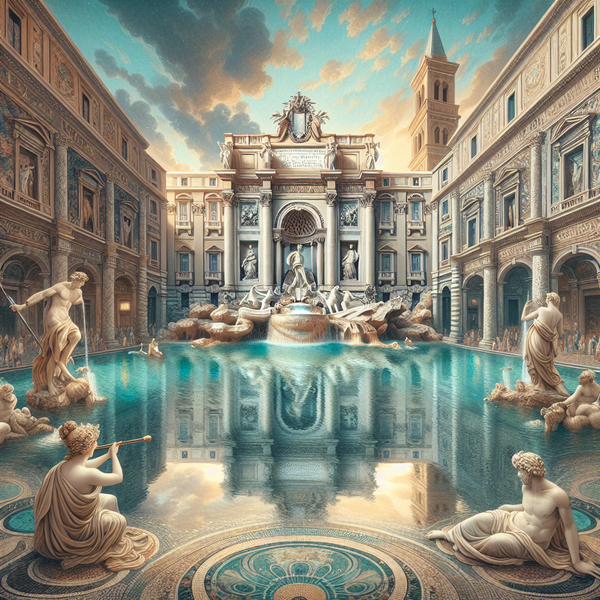
Any exploration of Italy’s historic fountains begins with the Fontana di Trevi, the undisputed queen of Roman waterworks. Rising almost 26 meters high, the Trevi Fountain cascades dramatically across an entire piazza wall, fronting the Palazzo Poli. Designed by Nicola Salvi and completed under Giuseppe Pannini, it channels water from the ancient Acqua Vergine aqueduct, first engineered in imperial times. If you stand close enough, you can feel the vibration of the torrents—a real reminder that Rome’s aqueducts still flow after two millennia.
Arrive early morning, around 7 a.m., when the marble glows in golden light and the square is almost silent except for the crash of water. Local legend insists that tossing one coin ensures your return to Rome, two coins bring love, and three mean marriage—but for residents, it’s the restoration work that matters most. Every few years, the marble is scrubbed of calcification from the water itself, preserving its theatrical clarity.
The Fountain of Neptune in Bologna: A Renaissance Image of Power
In the heart of Piazza del Nettuno stands Bologna’s Fontana del Nettuno, a symbol as much civic as artistic. Sculpted by the Flemish artist Giambologna, Neptune towers in bronze, surrounded by cherubs who once scandalized the city with their suggestive symbolism. The fountain was built to celebrate Bologna’s role under papal sovereignty, but its mechanical sophistication was revolutionary: a hidden network of metal pipes delivers precise jets through each sea creature’s mouth. The entire piece still relies on these 16th-century hydraulic innovations, refurbished but functioning.
Walk around the base and notice how locals use the lower marble ledge as a resting spot while eating cones of gelato from nearby Cremeria Funivia. In the evenings, light reflects off the bronze so dramatically that even short exposures can produce stunning night photographs—use the tower of the Palazzo Re Enzo as a framing backdrop.
Florence’s Fountain of Neptune: The Sea God Above the Arno
Florence’s own Fontana del Nettuno, planted at the far end of Piazza della Signoria, has always divided local opinion. Crafted by Bartolomeo Ammannati and inaugurated with fanfare during the city’s Medici era, this marble Neptune was carved from a single block from the Apuan Alps. Locals nicknamed it “il Biancone,” the big white man, sometimes with affection and sometimes mockery. Yet when restored, its figures emerge as a riot of Renaissance myth—sea nymphs, satyrs, and horses frozen mid-motion.
What makes this fountain striking is its position near the Palazzo Vecchio, Florence’s political center. It celebrated the Medici family’s maritime ambitions even though Florence had no direct port. If you sit on the stone steps opposite, in front of the Loggia dei Lanzi, you can watch evening gatherings of locals basking in the amber lights that make the white marble subtly transparent.
Rome’s Four Rivers Fountain: Bernini’s Dynamic Masterpiece in Piazza Navona
The Fontana dei Quattro Fiumi dominates Piazza Navona and marks the height of Bernini’s creative rivalry with Borromini. The four giants symbolize the Nile, Danube, Ganges, and Rio de la Plata—rivers representing continents then known to the Catholic world. Its engineering feat lies beneath: the hollow travertine rocks disguise a central column supporting the obelisk, allowing water to surge from unseen channels while giving the illusion of free-floating stone.
It’s most impressive at dusk when buskers start to play and the piazza glows with candlelight from café terraces. Take a seat at Caffè Domiziano, order a Campari-soda, and study how each figure interacts with the fountain’s stream: you’ll see Bernini’s intention to show the Earth submitting to faith through water’s flowing motion. Though built as a public display of papal power, it remains one of the most artistically complex hydraulics in Europe.
The Fountain of the Turtle in Rome’s Jewish Ghetto: Intimacy in Bronze
Rome’s Fontana delle Tartarughe is smaller but infinitely charming. Hidden on Piazza Mattei, it’s a paradigm of late Renaissance delicacy. Four bronze youths rest their feet on dolphins, each lifting a playful turtle toward the basin above. The turtles themselves were later additions—attributed to Bernini or his workshop—and they complete the sculpture’s whimsical perfection. Nearby, the cobbled lanes of the Ghetto retain a hush rare in central Rome, with trattorias like Sora Margherita serving unforgettable artichokes alla giudia.
Visit around midday when sun pierces the narrow lane and briefly illuminates the turtles’ faces. The fountain is fed by the Acqua Felice aqueduct, whose same water also runs through the Moses Fountain at Largo Santa Susanna. Bring a reusable bottle; it’s among the cleanest public sources in Rome.
Palermo’s Pretoria Fountain: A Marble Metaphor for Civic Pride
In Sicily, the Fontana Pretoria in Palermo pours with as much political symbolism as water. Created in Florence and later reassembled on Piazza Pretoria, it’s sometimes called the “fountain of shame”—not for moral reasons alone, but because the city spent extravagantly on it amidst financial decline. The circle of nude deities surrounding the tiers embodies mythological abundance while hinting at municipal ambition.
The approach along Via Maqueda opens suddenly into its luminous expanse. Morning light angles across the white marble figures, casting intricate shadows over their superbly carved limbs. Metropolitan residents sometimes place fresh flowers on the lowest tier, making it a living artwork. Unlike the fountains in northern Italy, this one uses limestone and marble that absorb and refract the island sun, giving it an almost glowing texture.
Naples’ Fountain of the Spouses: Baroque Symbolism by the Sea
Naples, brimming with water symbolism of its own, offers the Fontana del Gigante (often called the Fountain of the Spouses) near the Castel dell’Ovo waterfront. Originally designed for a different site near the Palazzo Reale, it was relocated several times—an echo of the city’s turbulent history. Its trio of arches and heraldic lions stand against the Gulf of Naples like an open gate to the sea.
Just steps away, you can watch fishermen repairing nets beside small boats at dawn, while joggers use the promenade as their morning route. The contrast between the baroque opulence of the fountain and the working harbor highlights Naples’ essential duality—a city both noble and popular at once. Early risers catch it best, when Vesuvius blushes pink across the bay.
Venice’s Modest Treasures: Hidden Fountains Beyond the Grand Canal
Because of its saltwater foundations, Venice has relatively few monumental fountains—but several smaller ones carry immense character. The Fontana delle Tette (“Fountain of the Breasts”), for example, in the San Cassiano district, once poured white and red wine during civic celebrations. The present version is a 16th-century replica, discreetly tucked in a courtyard behind the Palazzo Zane. Another example sits on the Campo Santa Maria Formosa, a 19th-century cast-iron spout used daily by residents filling pitchers.
To experience Venice’s historic water culture, visit during early spring when the tides are moderate and you can appreciate how cistern systems beneath every campiello once filtered rainwater. The city’s current project “Venice Resilient Heritage” focuses on restoring these drinking-water fountains, blending conservation with function—something rare among tourist cities built on lagoons.
Tivoli’s Fountain Gardens: Villa d’Este’s Hydraulic Symphony
East of Rome, the villa town of Tivoli shelters the Villa d’Este, an UNESCO-listed masterpiece of garden hydraulics. Its hundred-odd fountains include the Fountain of the Organ—whose underwater pipes actually play music powered solely by water pressure. The engineering marvel was invented by hydraulic master Pirro Ligorio, adapting Roman aqueduct logic to create an endless water ballet. You can still hear the faint organ-like tones when the mechanism activates toward late morning.
Don’t miss the central Avenue of a Hundred Fountains, where stone masks and animals spill shimmering veils of water into a long terraced canal. Come midweek if possible, as weekends attract heavy tour buses from Rome. The villa’s ticket includes access to its gardens and palace interiors, allowing a full afternoon immersed in Renaissance garden philosophy—a blend of architecture, science, and poetry in motion.
The Reggio Calabria Fountain of the Three Columns: Southern Elegance Revived
Few travelers reach Reggio Calabria’s waterfront, yet the Fontana delle Tre Colonne rewards the detour. Originally conceived to mark the city’s post-earthquake rebirth, its neoclassical lines stand at the end of the Falcomatà promenade, facing Sicily across the Strait of Messina. Each column symbolizes one of the city’s historic districts, linked by a sculpted basin whose constant flow uses underground sources from the Aspromonte mountains. The spray even carries faint minerals from that high terrain, giving the fountain a distinctive soft sheen.
Even locals pause here at sunset, when ferries glimmer across the channel and faint music drifts from nearby beach cafés. It’s a fitting end point for an Italian fountain pilgrimage—proof that the country’s devotion to water continues through both restoration and daily urban life.
Traveling Italy through its fountains reveals how every gush of water encapsulates centuries of craftsmanship. They are not quaint relics but living organs of the cities they adorn. Whether sipping from a nasoni in Rome or marveling at Bernini’s grand spectacle, remember: in Italy, history still flows freely from every spout.