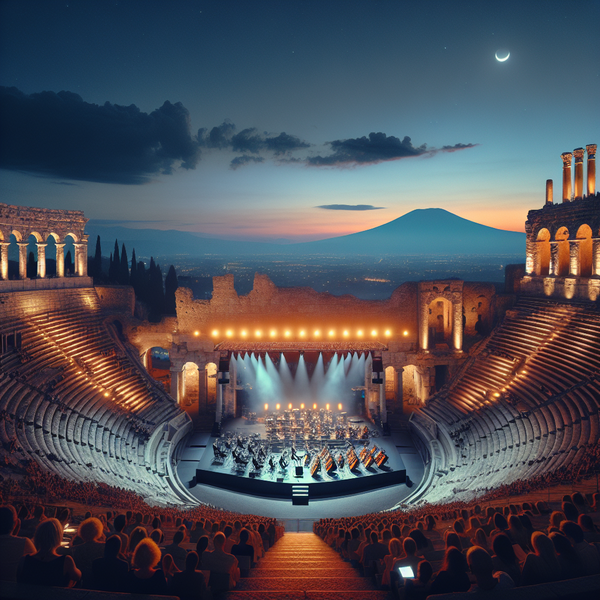
In Italy, history doesn’t just sit behind glass cases—it takes a bow under the stars. Across the peninsula, the most impressive **Roman theaters still in use** today continue to host concerts, operas, and festivals against limestone tiers carved by ancient hands. These living monuments connect past and present in a way few places can. Here’s where that continuity between antiquity and artistry is most alive.
Go to the section
ToggleThe Verona Arena: A Roman Masterpiece Still Singing
The **Arena di Verona**, right in Piazza Bra, has hosted performances since the first century, but modern audiences know it best for its summer opera festival. With acoustics so refined that microphones are unnecessary, the arena welcomes over 15,000 spectators each season. If you attend, buy your ticket early through the official Arena di Verona website—stone seating fills fast for productions like *Aida* and *Carmen*. Arrive at least an hour before sunset to watch the light soften on the pink Valpolicella marble while the orchestra tunes.
It’s remarkable how well the Romans engineered for resilience here: the outer ring partially collapsed after an earthquake, yet the inner arc remained intact. Local volunteers still guide guests to their seats just as stewards did 2,000 years ago. For the best combination of comfort and atmosphere, book a numbered seat close to the stage; if you bring a cushion, even the unnumbered stone steps become a lovely choice.
The Roman Theatre of Ostia Antica: Culture Near the Coast
Only 30 km from central Rome and accessible via the FL1 train line to Ostia Antica station, this theater stands inside the vast archaeological park of the ancient port city. The **Roman Theatre of Ostia Antica** is less famous than Verona’s arena but offers a more intimate experience. With about 3,000 seats, it’s still used for classical concerts and open-air plays during summer—an especially magical setting when late-light filters across the Tiber delta.
The site’s charm lies in its integration with the ruins around it. After a performance, you can stroll through the mosaicked warehouses of ancient merchants or stop at the on-site café overlooking cypress trees. During local festivals, performers often mix Latin verse with modern Italian improvisation—proof that Romans’ theatrical spirit never left. Do bring insect repellent: at dusk, the proximity to wetlands can draw mosquitoes.
The Ancient Theatre of Taormina: A Mountain Stage Above the Sea
Few places compete with Sicily’s **Teatro Antico di Taormina** for sheer drama. Built by the Greeks and restructured by the Romans, its semicircle faces Mount Etna on one side and the Ionian Sea on the other. Every June to September, international artists headline the Taormina Arte festival here, ranging from jazz greats to symphony orchestras. Tickets are sold through Fondazione Taormina Arte Sicilia’s official portal, and seating can extend up to nearly 10,000 spectators.
If you plan to attend, start your walk up from Corso Umberto in the late afternoon; that way, you’ll arrive as the sun dips behind the mountain, painting the stage in copper tones. The red-brick steps are uneven but stable—comfortable shoes are essential. The adjacent public garden designed by Lady Florence Trevelyan offers serene pre-show picnicking spots with panoramic benches.
The Roman Theatre of Benevento: The Quiet Star of Campania
Benevento’s **Teatro Romano** sits beyond the city’s Arco di Traiano and remains one of southern Italy’s most overlooked gems. The preserved cavea, partly built against the hillside and partly free-standing, hosts theater companies and community orchestras every summer. Festival Benevento Città Spettacolo uses the site’s layered history as inspiration for its programming, pairing Roman tragedies with contemporary Italian drama.
Even when no events are scheduled, walking through the arches into the orchestra bowl is moving—a sound check alone feels like time folding in on itself. Before or after a show, visitors often dine nearby on *strangulaprievete* (handmade pasta typical of Samnium). The theater’s small museum explains how ancient sound amplification worked through vaulted corridors beneath the seats.
The Roman Theatre of Orange’s Italian Cousin: Gubbio’s Surprising Arena
Though known more for its medieval palazzo, **Gubbio** hides an impressive Roman theater at the town’s edge. Built with local limestone blocks resembling those of Umbria’s quarries, the structure can seat around 6,000. It’s actively used for open-air film nights and for the Festival dei Due Mondi satellites when regional troupes need a venue slightly off the main circuit.
Visitors enter via Via del Teatro Romano, just below Gubbio’s cable car to Mount Ingino. Evening performances begin around 9:00 p.m., and the illuminated arches offer terrific photo angles. Tip: pick up a combined ticket that includes the theatre and the nearby Antiquarium, where you can trace the reconstruction through scale models.
The Teatro Romano of Cagliari: Sardinia’s limestone gem
Set into the hillside of the Buon Cammino area, the **Teatro Romano di Cagliari** is smaller than mainland counterparts but equally atmospheric. Carved directly into calcareous rock, it once held about 2,000 spectators. Today, it’s revived for local opera and symphonic evenings under the Sardinian summer sky. The municipal cultural office posts the calendar from June to August—check early since seats are limited.
An advantage of attending here is location: within a 10-minute walk, you can reach Cagliari’s Castello district and the panoramic Bastione Saint Remy for a post-show aperitivo. Glasses of chilled Vermentino and views over the Gulf of Angels complete the night perfectly. Accessibility ramps are discreetly built into ancient pathways, making it friendly for visitors with limited mobility.
The Roman Theatre of Trieste: A Northern Surprise by the Adriatic
Wedged right below San Giusto Hill, Trieste’s **Teatro Romano** was uncovered only in the 20th century, yet concerts and literary readings now animate these restored tiers. Because Trieste has a strong Central European cultural influence, its programming often blends Italian opera with Slovenian dance or German cabaret. Performances are small-scale but acoustically remarkable due to the stone’s reflective properties.
A highlight is the “Trieste Estate” series in July and August, when entry is sometimes free. Bring a light jacket—the Bora wind can sweep through even on mild nights. Before or after, visit the café-lined Piazza Unità d’Italia just downhill for late-night espresso and a view of the harbor lights.
The Roman Theatre of Fiesole: Tuscany’s Hilltop Cultural Heart
Above Florence, the **Teatro Romano di Fiesole** is the oldest active venue in Tuscany. Built into an amphitheatrical slope with a view over the Arno valley, it’s best known for its *Estate Fiesolana*, one of Italy’s longest-running summer cultural series. The lineup spans classical concerts, contemporary jazz, and open-air cinema. Tickets are sold through the Teatro di Fiesole website, and the site’s museum access is included.
Getting there is simple: bus route 7 from Piazza San Marco in Florence runs every 15 minutes, and the ride takes under half an hour. The walk from Fiesole’s main square to the theater is gently downhill—easy even in warm weather. Sit along the upper tiers during sunset to catch Florence’s Duomo glowing gold in the distance.
Planning an Itinerary Around Italy’s Active Roman Theaters
For travelers designing an art-filled route, you can connect these stages easily by train. Start in Verona, travel south to Ostia Antica near Rome, then continue to Benevento or across the strait to Taormina. Alternatively, focus on regional gems: the north’s Verona–Trieste corridor offers contrasting settings—one monumental, the other intimate.
A few practical tips help your experience:
- Bring a cushion or rent a padded seat—ancient stone was not designed for long operas.
- Pack a light jacket: even in summer, night air in open theaters can cool quickly.
- Buy tickets from official festival websites to avoid unofficial markups.
These active Roman theaters are not museum exhibits but living architecture—still fulfilling the same purpose for which they were designed. To experience one is to understand Roman civility not just as a historical curiosity but as a continuing tradition of public joy. When the stage lights fade and applause echoes through stone, you realize that two millennia of performance have never truly ended in Italy.