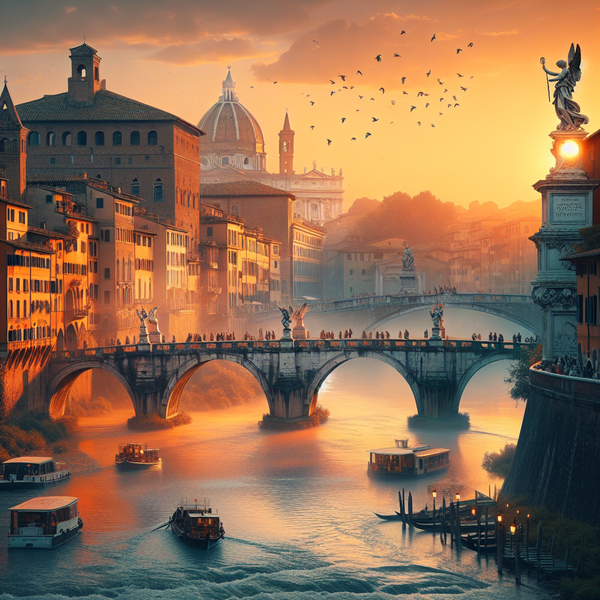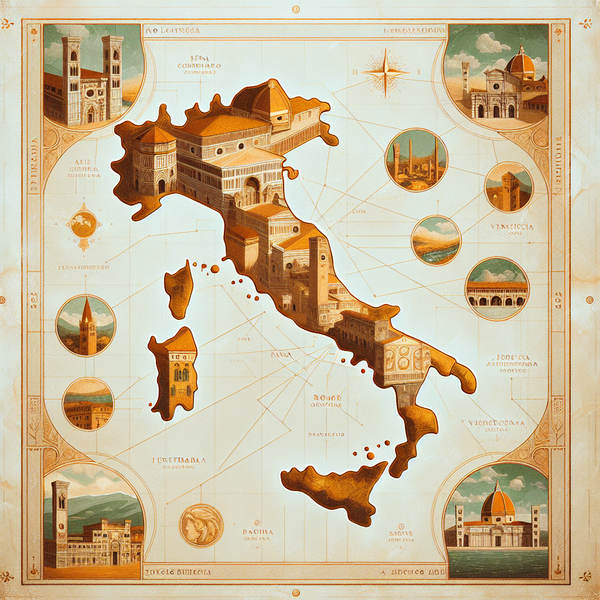
If Florence is the beating heart of the Renaissance, then the rest of Italy is the bloodstream carrying its art, innovation, and genius far beyond the Arno. Travelers often make the mistake of stopping in Florence alone for Botticelli and Michelangelo, but the same painters, architects, and patrons left treasures scattered across Tuscany, Umbria, Emilia-Romagna, and the Veneto. Some even rest quietly in small-town churches where there’s no queue and you can stand nose-to-nose with a fresco that changed history.
Go to the section
ToggleThe Renaissance Legacy in Siena: From Simone Martini to Pinturicchio
Siena’s Piazza del Campo may draw the crowds for the Palio, but the city’s quieter claim to fame is its school of painting that predated and influenced Florentine art. Inside the **Palazzo Pubblico**, the civic museum houses Ambrogio Lorenzetti’s *Allegory of Good and Bad Government*, a fresco cycle that every serious student of Renaissance art should see at least once. The nearby **Pinacoteca Nazionale** offers an unbroken timeline of Sienese masters, including Simone Martini and Sodoma, allowing you to see how Siena’s golden glow evolved into a humanist realism distinct from Florence’s. Don’t miss **the Libreria Piccolomini** inside the Siena Cathedral—its illuminated frescoes by Pinturicchio shimmer under daylight, and the marble floor beneath has inlaid scenes that took 200 years to complete.
Renaissance Art in Urbino: Piero della Francesca’s Geometry of Beauty
Perched on an eastern hilltop of the Marche region, **Urbino** feels untouched by time. The entire old town is essentially a living museum of Quattrocento ideals. At the **Galleria Nazionale delle Marche** inside the Palazzo Ducale, you can see Piero della Francesca’s serene *Flagellation of Christ*, a painting whose perfect geometry seems to prefigure 3D modeling. The same museum displays works by Raphael’s father, Giovanni Santi, revealing how the young Raphael absorbed mathematics, perspective, and light in his hometown before heading to Florence and Rome. For the best view of Duke Federico da Montefeltro’s symmetrical city, walk up Via Raffaello to the **Orto Botanico**—the panorama gives you a photographer’s understanding of why Renaissance artists were obsessed with proportion.
Padua’s Humanist Spirit: Giotto, Mantegna, and Donatello in Conversation
While Venice basked in Byzantium’s glow, **Padua** quietly cultivated the Renaissance intellect. In the **Scrovegni Chapel**, Giotto’s frescoes narrate the lives of Mary and Jesus with startling naturalism—every figure grounded, every gesture tender and believable. Only 25 people are allowed inside at a time, and you must reserve online; your group waits in a climate-controlled vestibule that preserves humidity balance for the 700-year-old pigments. Across town, at the **Basilica di Sant’Antonio**, Donatello’s equestrian statue of Gattamelata gazes fiercely toward the square, the first bronze of its kind since antiquity. For Mantegna admirers, the **Eremitani Church** offers fragments of his earliest frescoes, damaged in WWII yet still resonant, with silhouettes sharp as carved marble.
Ferrara’s Hidden Renaissance Palaces and the Este Family Legacy
Ferrara, an easy hour by train from Bologna, is often bypassed by travelers unaware that it was one of the first Renaissance-planned cities in Europe. Duke Ercole I d’Este and architect Biagio Rossetti expanded the medieval core into the *Addizione Erculea*, a visionary urban grid. Inside the **Palazzo dei Diamanti**, more than 8,500 diamond-shaped stones shimmer across the façade, symbolizing ducal power and modern geometry. The museum inside, the Pinacoteca Nazionale, preserves works by Cosmè Tura and Dosso Dossi—painters whose metallic palette and whimsical detail demonstrate that Ferrara’s artists were as experimental as Florence’s. Rent a bike at **Cicli F.lli Marini** near the station and follow the well-paved fortress walls for an hour-long loop through Renaissance terrain.
Perugia and the Umbrian Light: Perugino’s Dreamlike Grace
Umbria often markets itself as *Italy’s green heart*, but for Renaissance art enthusiasts, it’s the birthplace of one of the period’s most lyrical painters: Pietro Perugino. Inside the **Galleria Nazionale dell’Umbria**, you can trace his influence from gentle Madonnas to Raphael’s early sketches. The artist’s clarity and calm balance earned him commissions in the **Collegio del Cambio**, where his frescoes adorn the audience hall—note the ceiling vaults, where geometric schemes frame allegories of virtues beloved by humanist thinkers. For a meaningful side trip, take the local bus to **Città della Pieve**, Perugino’s birthplace, and visit the Oratorio di Santa Maria dei Bianchi, where his *Adoration of the Magi* still glows quietly over the altar, undimmed by the centuries.
Parma’s Grace: Correggio’s Illusionist Vaults and Parmigianino’s Elegance
Few travelers realize that in **Parma**, a small church ceiling once redefined pictorial illusion. Step into the **Cathedral of Santa Maria Assunta** and look upward: Correggio’s *Assumption of the Virgin* explodes into a vortex of light and angels, drawing your gaze heavenward until spatial logic dissolves. A few blocks away at the **Church of San Giovanni Evangelista**, his frescoed dome takes the technique even further, layering figures in dramatic foreshortening that later inspired Baroque masters. The **Galleria Nazionale di Parma**, housed in the Palazzo della Pilotta, adds context with Parmigianino’s *Self-Portrait in a Convex Mirror*, a precise exercise in optics that embodies the era’s fascination with perspective and self-awareness. Afterward, reward yourself with a plate of tortelli di erbetta at **Trattoria Corrieri**, a five-minute walk from the museum.
Venice’s Take on the Renaissance: Bellini, Giorgione, and Titian
Venice interpreted the Renaissance through color and atmosphere rather than strict geometry. To see this evolution, start at **the Gallerie dell’Accademia**, where Giovanni Bellini’s altarpieces seem to breathe humid Venetian air. Giorgione’s enigmatic *Tempest* invites endless speculation while Titian’s early works hum with latent energy. Visit **the Scuola Grande di San Rocco** for Tintoretto’s monumental canvases, arranged as if the whole building were a single visual symphony. Because the scuola operates as a charitable confraternity, entry fees directly support conservation. For a quiet interlude, hop on Vaporetto Line 1 after 5 p.m.—evening light along the Grand Canal gives you the same warm palette that Venetian painters spent their lives trying to capture.
Rome’s Transitional Brilliance: Where the Renaissance Becomes Mannerism
Though the Vatican Museums often overshadow the rest, Rome abounds with lesser-visited Renaissance gems. The **Villa Farnesina** in Trastevere remains a lesson in classical harmony, where Raphael’s *Galatea* looks out from walls painted for a Sienese banker’s garden villa. Entry includes a guided circuit explaining how myth, architecture, and astronomy mingle. For a deeper cut, the **Cappella Paolina** inside Santa Maria Maggiore hosts frescoes by Michelangelo’s contemporaries adapting Florentine ideals to papal tastes. A short walk north, the **Capitoline Museums** preserve pieces by Sebastiano del Piombo that highlight the bridge between High Renaissance idealism and the first signs of Mannerist exaggeration. Stop by **Caffè Propaganda** near the Colosseum afterward for an espresso—the décor channels Deco, but the ingredients come straight from Lazio farms that have supplied Rome’s artists’ tables for centuries.
Practical Tips for Planning Your Renaissance Art Trail
Italy’s regional rail network makes this itinerary surprisingly feasible: Florence to Siena in 90 minutes, Florence to Padua in two hours by high-speed train. Urbino requires a bus from Pesaro station, about 45 minutes through verdant hills. Museum openings can shift with seasons, so confirm via official websites—many close on Mondays. For art-lovers looking to avoid crowds, arrive at major sites at lunchtime (between 12:30 and 14:00), when Italian tour groups take long pauses. The **Italia Pass** rail discount and the **Museum Card of Emilia-Romagna** offer combined ticket reductions for travelers who plan ahead. Booking train seats early saves money, but spontaneous travelers can rely on Intercity trains, which rarely sell out midweek.
Final Reflections: Learning to See Beyond Florence
The joy of exploring Renaissance art outside Florence lies in discovering how ideas traveled—often by mule, patron, or marriage—and transformed every Italian city they touched. Standing in front of a fresco in Città della Pieve or a sculpture in Padua, you realize the Renaissance wasn’t a single Florentine miracle but a national awakening of vision, technique, and human curiosity. Take time to read, linger, and notice how each region shaped its own version of beauty. When the day ends and church bells echo across quiet piazzas, you’ll understand that the Renaissance lives not only in museums but in the rhythm of Italian daily life itself.