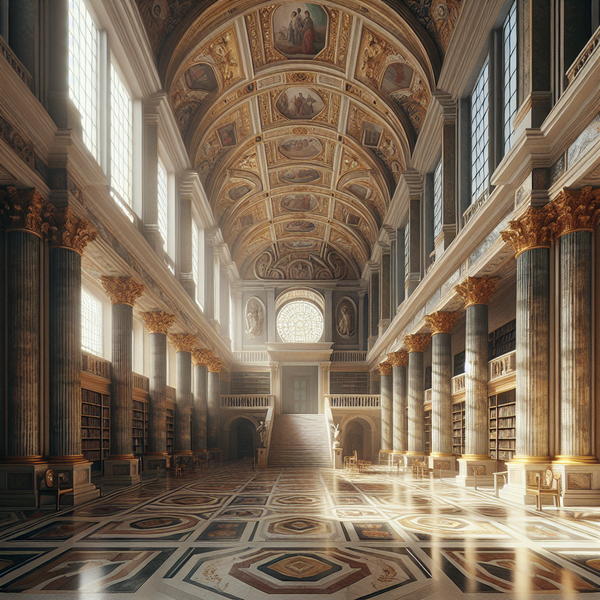
Italy’s love affair with knowledge predates the Renaissance, and nowhere is this more tangible than inside its libraries — living museums of marble, frescoes, and centuries-old manuscripts. Whether you step into a former monastery in Florence or a royal reading room in Turin, these spaces are as much about architecture and atmosphere as they are about books. Exploring the most beautiful libraries in Italy open to visitors offers a quiet yet profound glimpse into the country’s intellectual soul.
Go to the section
ToggleThe Vatican Library: A Hidden World in the Heart of Rome
Tucked inside Vatican City, the Vatican Apostolic Library has been collecting manuscripts since the fifteenth century. Access used to be reserved for scholars, but today the Bibliotheca Apostolica Vaticana welcomes visitors on special guided tours that must be booked in advance through the Vatican Museums. Its courtyard, the Cortile del Belvedere, offers a quiet pause before entering halls where illuminated codices gleam softly under controlled light. Look out for the Barberini Book of Hours and the handwritten letters of Michelangelo—the kind of details you can only encounter here. The library’s architecture blends Bramante’s Renaissance order with later Baroque flourishes, giving every corridor a sense of divine geometry.
Laurentian Library in Florence: Michelangelo’s Architectural Masterpiece
In Florence, every stone tells a story, but few as eloquently as those in the Biblioteca Medicea Laurenziana. Commissioned by Pope Clement VII and designed by Michelangelo, the Laurentian Library occupies part of the Medici’s Basilica di San Lorenzo complex. Visitors can walk up the famous staircase that flows like molten stone into the reading room — a piece of architectural theater unlike any other. The desks still bear the ancient chains used to secure manuscripts, and the high windows let in a silvery Tuscan light that makes even the air seem centuries old. Reservations are needed for entry, managed by the Polo Museale Fiorentino, and guided visits are offered in English several times per week.
Biblioteca Nazionale Marciana: Venice’s Window onto the Classical World
Facing St. Mark’s Square, the Marciana Library could almost go unnoticed amid the grandeur of Venice, but once inside, it’s a revelation. Built in the sixteenth century by Jacopo Sansovino, the library houses one of the world’s richest collections of Greek and Latin manuscripts. The ceiling of the main hall, painted by Titian’s pupils, seems almost to breathe as sunlight filters through high arched windows. Admission is possible via the Museo Correr ticket, which connects several of Venice’s civic museums, making it easy to include this literary gem in a broader cultural visit. Step onto the balcony overlooking the Piazzetta and imagine the scholars who once debated philosophy here while gondolas drifted below.
Biblioteca Malatestiana in Cesena: The First Public Library in Europe
Few travelers detour to Cesena in Emilia-Romagna, but the Biblioteca Malatestiana alone justifies the trip. Founded in the mid-fifteenth century and remarkably preserved, it is recognized by UNESCO as the first public library in Europe. Every element remains as it was: carved wooden stalls, iron chains linking manuscripts, and narrow mullioned windows allowing just enough light for reading. Guided visits, offered daily except Mondays, include access to the cloister and the archives. What makes this place deeply moving is that it was built for citizens, not nobles or clergy — a democratic gesture centuries before public education became a norm.
Biblioteca Palatina of Parma: A Royal Tribute to Enlightenment Learning
Inside the Piacenza Palace in Parma lies the Biblioteca Palatina, an elegant eighteenth-century library founded by the Duchess Maria Amalia of Austria. The neoclassical reading room, lined with walnut shelves and crowned by delicate stucco work, feels almost theatrical in its symmetry. Among its 700,000 volumes are rare editions of Ariosto and early printed works by the Parmesan printer Bodoni, considered one of the greatest typographers in history. Visitors can access the library directly through the adjacent Galleria Nazionale, using a combined ticket that allows exploration of the palace’s art collection afterward—a perfect pairing of visual and literary art.
Biblioteca Nazionale Vittorio Emanuele III in Naples: The Overlooked Giant
While Naples draws visitors for pizza and Pompeii, few realize one of Italy’s largest libraries sits right inside the Royal Palace complex. The Biblioteca Nazionale Vittorio Emanuele III holds millions of volumes, including papyri excavated from Herculaneum. Its location, between the Piazza del Plebiscito and the bay, makes it easy to reach on foot while exploring central Naples. Visitors can view temporary exhibitions that often showcase the city’s literary heritage, from medieval chronicles to scripts by Eduardo De Filippo. Access is free, though security screening at the palace entrance is required. It’s a serene stop away from Naples’ sizzling street life.
Biblioteca Reale in Turin: Leonardo’s Hidden Treasures
Turin’s Biblioteca Reale may look modest beside the Savoy royal palaces surrounding Piazza Castello, but it holds one of Italy’s crown jewels: Leonardo da Vinci’s self-portrait in red chalk. The drawing is stored in a climate-controlled vault, yet regularly displayed in temporary exhibitions that must be booked online. The reading room, with its pale wood and delicate chandeliers, still retains the quiet grandeur typical of nineteenth-century royal institutions. The library also preserves the original engineering notebooks of Giovanni Battista Amici, inventor and botanist whose microscopes are displayed nearby. For travelers following a Leonardo itinerary in northern Italy, this stop connects perfectly with Milan’s Biblioteca Ambrosiana.
Biblioteca Ambrosiana in Milan: Art and Knowledge Under One Roof
Founded by Cardinal Federico Borromeo, the Biblioteca Ambrosiana is inseparable from art history itself. Its galleries host Leonardo’s Codex Atlanticus, accessible via rotating exhibitions throughout the year. The library’s Baroque reading room feels more like a cathedral, with walnut paneling soaring toward a painted ceiling by Johann Christoph Storer. Located just minutes from the Duomo, it’s open to visitors daily save Mondays, and entry includes access to the Ambrosiana Gallery, home to works by Caravaggio and Botticelli. The experience bridges scholarship and art in one of Milan’s most contemplative corners.
Biblioteca Angelica in Rome: A Haven Beside Piazza Navona
Steps from the lively cafés of Piazza Navona, the Biblioteca Angelica offers a time capsule of Roman intellectual life. Established in the sixteenth century by the Augustinian order, it became Rome’s first public library. Today, travelers can enter its luminous reading room where over 180,000 volumes rise in wooden shelves to a frescoed ceiling. The Angelica often hosts free exhibitions about Rome’s urban history, and locals drop in for quiet study sessions between 8:30 a.m. and 7:00 p.m. It’s a space that demonstrates how seamlessly daily life in Italy coexists with history—one moment espresso, the next, seventeenth-century theology.
Biblioteca Marucelliana in Florence: Quiet Among Students and Scholars
Less known than the Laurentian, Florence’s Biblioteca Marucelliana sits along Via Cavour and remains open to the public without reservation. Founded by a nobleman who wished to create a truly free reading library, it maintains that tradition to this day. The main reading hall features busts of classical philosophers, and exhibitions frequently highlight its collection of engravings and early maps. For travelers, it’s worth pausing here to feel contemporary Florentine life blending with centuries of learning—the steady presence of students reminds you that libraries in Italy are not only monuments but working institutions.
Practical Tips for Visiting Italy’s Historic Libraries
Before setting out on a library tour across Italy, remember that many historic libraries require advance reservations or operate on limited hours. Always check the institution’s official website for updates on guided tours and closures. Photography is often restricted, so bring a notebook if you wish to remember details. Consider pairing library visits with nearby cultural sites: the Marciana with the Doge’s Palace, the Palatina with Parma’s Teatro Farnese, or the Laurenziana with the San Lorenzo Market for a local lunch afterward. Traveling by train between library cities is efficient—Frecciarossa connections link Turin, Milan, Bologna, Florence, Rome, and Naples in just a few hours, letting you trace a literary route through the peninsula.
To explore Italy through its libraries is to understand how beauty and knowledge intertwine here. Each stone staircase and fading parchment tells of a country that believes books deserve palaces. Visit slowly, linger in silence, and you’ll find that these libraries—far from dusty relics—remain some of the most inspiring spaces in modern Italy.