When most people think of ancient ruins in Italy, they imagine Rome’s Colosseum or Pompeii’s streets. But long before Roman legions marched across the peninsula, Greek settlers had already built magnificent cities in the south. From Sicily’s golden temples to the coastal sanctuaries of Calabria, Italy still harbors the most extensive collection of ancient Greek ruins outside Greece itself. Exploring them is like tracing the blueprint of Mediterranean civilization while savoring the slow rhythm of Italian life — and yes, most of these sites can be visited without jostling for space with crowds of selfie sticks.
Go to the section
ToggleGreek Ruins in Sicily: Agrigento’s Valley of the Temples
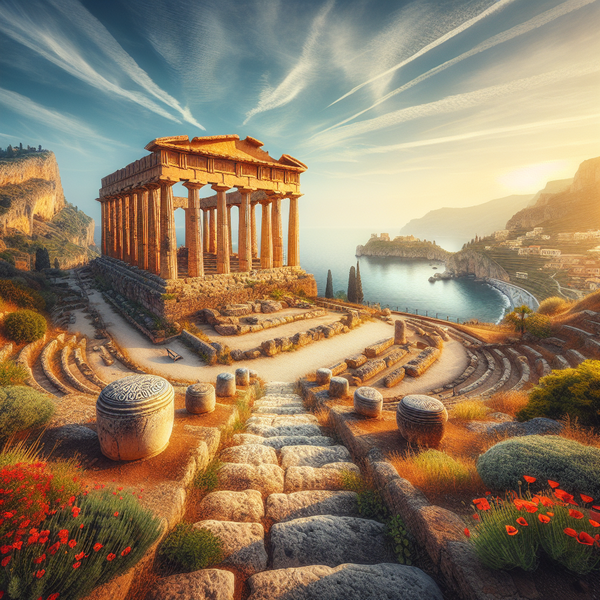
Sicily is the heart of the ancient Greek presence in Italy, and Agrigento — once known as Akragas — remains its crown jewel. The Valley of the Temples stretches across a ridge dotted with ancient sanctuaries built by Greek settlers from Rhodes and Crete. The most impressive structure is the Temple of Concordia, whose Doric columns have stood almost intact for over two millennia. Visiting just before sunset adds a honeyed glow to the limestone, and the footpath between the temples allows you to move entirely on foot from the Temple of Juno to Zeus’s massive, toppled remains.
Practical tip: There’s an entrance near Porta V for those arriving by car, and a frequent shuttle connects the lower and upper gates. For a slower pace, stay at a countryside agriturismo in nearby Villaggio Mosè — many provide rooms overlooking the archaeological park’s lit temples at night.
Selinunte and Segesta: Western Sicily’s Forgotten Giants
Drive west from Agrigento for about ninety minutes and you’ll reach Selinunte, a sprawling archaeological park that once rivaled Athens in size. Its remains overlook the sea, with temples spread across acropolis plateaus and rugged coastal dunes. Unlike in Agrigento, visitors can walk among toppled drums and explore the central sanctuary of Temple E — possibly dedicated to Hera — before descending toward the ancient harbor. The park entrance has an electric buggy service to help you cover long distances, and a small onsite café serves granita made from local lemons, perfect after hours under the Sicilian sun.
Nearby lies Segesta, a single but striking temple set among rolling hills, unfinished yet perfectly preserved. It’s reachable via a short shuttle ride from the visitors’ center, and if you time it right, you can catch open-air performances at Segesta’s ancient theater during summer evenings. These cultural events are an evocative way to experience Greek architecture as it was meant — as a living stage for human stories.
Syracuse and the Ancient Greek Theater of Ortygia
Syracuse was once the most powerful Greek city in the West. Its archaeological park, the Neapolis, still holds a majestic fifth-century BCE Greek theater carved directly into the limestone hillside. Each May and June, the Istituto Nazionale del Dramma Antico stages productions of Sophocles and Euripides there — the acoustics are so perfect that even unamplified actors can be heard across the 16,000-seat structure. Beyond the park, the island of Ortygia preserves remnants of the Temple of Apollo right near the bustling morning market where you can snack on pistachio arancini after exploring the ruins.
For travelers without cars, Syracuse makes an excellent base. The archaeological park is a short bus ride from the city center, and day trips can easily include Noto or the beaches at Fontane Bianche. Locals recommend buying combination tickets that include both the park and the regional museum Paolo Orsi — one of Italy’s most thorough collections of Greek art and inscriptions.
Paestum: The Greek Temples of Southern Campania
Many travelers head south of Naples for pizza and Amalfi views, not realizing they’re driving right past one of Italy’s most intact Greek sites. Paestum, once Poseidonia, features three massive temples that rise from a broad plain five kilometers from the sea. The Temple of Hera I captures the earliest form of Doric architecture on the peninsula, while the Temple of Athena stands against a backdrop of cypress and hazelnut groves. Paestum’s onsite museum displays delicate frescoes from nearby tombs — including the famous Diver’s Tomb, whose imagery symbolizes the passage from life to the afterlife.
The archaeological zone is entirely walkable and open year-round. You can rent a bike from the station or stroll from your hotel through streets lined with buffalo-mozzarella dairies. A private guide here costs less than in Rome and makes a huge difference when interpreting the city grid and defensive walls. Train travelers can easily pair Paestum with a stop in Salerno or the Cilento Coast for a weekend escape that blends archaeology with the sea.
Locri Epizephyrii and the Ionian Coast of Calabria
Locri Epizephyrii, on the southwestern coast of Calabria, offers a quieter look at Magna Graecia, where daily life of Greek settlers unfolded away from Sicilian power politics. Excavations here revealed sanctuaries dedicated to Persephone and Aphrodite, with terracotta votive offerings still visible in the site’s small but well-curated museum. The archaeological park sits a short walk from Locri station on the Reggio Calabria–Taranto rail line — proof that you don’t need a car to reach Italy’s Hellenic past. In summer, the surrounding lido beaches at Siderno and Gerace combine sea swimming with mountain views.
For deeper context, head inland to Gerace, one of Calabria’s best-preserved medieval towns. The cathedral there reused marble from Locri’s ruins, a visible link between Greek antiquity and later Italian history. You can even trace local dialects back to ancient Greek roots preserved in the so-called Grecanic area near Bova.
Metaponto and Heraclea: Basilicata’s Overlooked Greek Colonies
Travelers rarely venture into Basilicata for Greek heritage, yet this sparsely populated region contains two profoundly historic sites: Metaponto and Heraclea. Metaponto’s Temple of Hera — called the Tavole Palatine — rises dramatically beside a modern highway, a stark reminder of how ancient and contemporary Italy coexist. Standing among its fifteen columns, you can almost hear cicadas from the nearby wheat fields that once made this area a breadbasket of Magna Graecia. The small museum exhibits ceramics marked with early election symbols, providing rare insight into democratic practices imported from Greece.
From Metaponto, drive 20 minutes to Policoro, the site of ancient Heraclea. The museum here is unexpectedly excellent, storing painted armor fragments and silver coins stamped with the city’s bull emblem. Policoro also has one of the Ionian coast’s best beaches, allowing you to balance archaeology and relaxation in a single day. For regional authenticity, stay at a masseria-style farm between Metaponto and Bernalda, where homemade bread is still baked in stone ovens.
Reggio Calabria and the Riace Bronzes
Although technically not ruins, no exploration of Italy’s Greek legacy is complete without seeing the Riace Bronzes housed in the National Archaeological Museum of Reggio Calabria. These two life-size warriors, recovered from the Ionian seabed, embody the sculptural perfection of Greek art that once adorned temples across Magna Graecia. They’re impeccably preserved, down to individual eyelashes rendered in copper, and displayed under tight humidity control in their own hall. The museum also features terracotta models from Locri and Croton, offering an ideal indoor counterpart to the region’s open-air ruins.
From Reggio’s seaside promenade, you can see Sicily across the strait — a reminder of how fluid and interconnected the ancient Greek world really was. Nearby ferries link to Messina, creating an easy circuit for travelers following the trail of Hellenic Italy from one shore to the other.
Planning an Ancient Greek Ruins Itinerary in Italy
To design an efficient route, start in Catania and circle clockwise through Sicily — visiting Syracuse, Agrigento, Selinunte, and Segesta — before ferrying to Calabria for Locri and Reggio. Continue north toward Basilicata’s Metaponto and end in Campania at Paestum. This loop covers the most authentic Greek sites in roughly two weeks without rushing. Renting a car offers flexibility, but public transport works well for Syracuse, Paestum, and Reggio Calabria.
Before departure, check each site’s Soprintendenza website for opening hours, as times may shift seasonally. Combining archaeological visits with local food experiences deepens appreciation: ricotta-filled cannoli in Agrigento, swordfish rolls in Reggio, and walnut pesto in Locri all descend from centuries of Mediterranean trade. Italian regions guard their Hellenic treasures quietly — travelers with curiosity and patience will find themselves walking through history’s original crossroads.