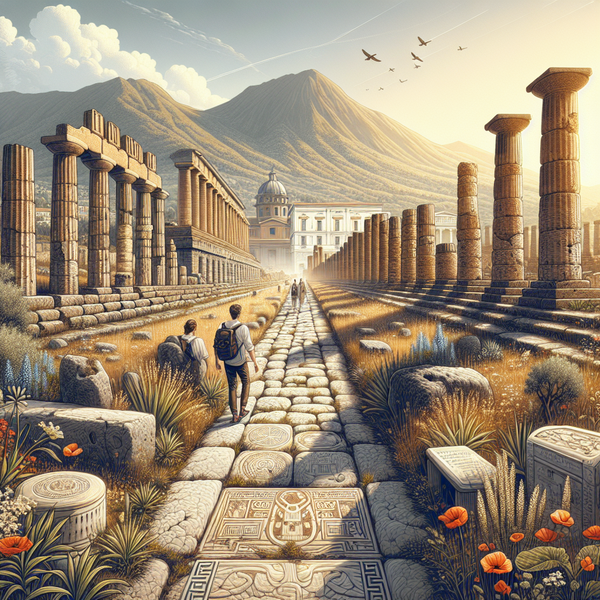
Italy is not simply a collection of ruins behind ropes—it’s a living museum where archaeological parks connect past civilizations with the rhythm of everyday Italian life. From Sicily’s ancient Greek theaters to the Etruscan necropolises of Lazio, visiting these sites is a sensory plunge into thousands of years of human history. Whether you’re an enthusiast tracing Roman engineering or simply curious about where Western culture took root, Italy’s archaeological parks invite immersive exploration that feels both grounded and extraordinary.
Go to the section
ToggleExploring Pompeii Archaeological Park: Life Frozen Under Ash
Few places capture the fragility of civilization like the Archaeological Park of Pompeii near Naples. This site covers about 170 acres, revealing paved streets, frescoed villas, and even snack counters—thermopolia—where residents once grabbed quick meals. Enter through the Porta Marina gate to reach Via dell’Abbondanza, one of the city’s main arteries, where wheel ruts carved two millennia ago remain visible. The plaster casts of victims are haunting but educational, showing human postures captured by volcanic ash during the eruption of Mount Vesuvius.
Visitors should plan at least half a day and download the official Pompeii app, which works offline and geolocates your position within the ruins. Don’t miss the House of the Faun, with its intricate “Alexander Mosaic,” or the Grand Theatre where modern performances sometimes take place. The train from Naples Garibaldi to Pompeii Scavi station runs frequently, making access remarkably convenient.
The Valley of the Temples in Agrigento: Sicily’s Doric Masterpiece
On Sicily’s southern coast, the Parco Archeologico della Valle dei Templi commands one of Italy’s most evocative panoramas. The Temple of Concordia, lit dramatically after sunset, is among the best-preserved Greek temples anywhere—in better shape than many in mainland Greece. The ridge top setting allows visitors to walk among almond trees while gazing toward the Mediterranean, connecting art, landscape, and mythology in perfect alignment.
Entry tickets also cover the Kolymbethra Garden, an ancient irrigated valley managed by the Italian environmental trust FAI. You can wander under orange and carob trees still nourished by channels dating back to 5th century BCE engineers. To fully appreciate the park’s vastness, start early in the morning from the Porta Quinta entrance near the Temple of Juno and finish your visit at the Temple of Hercules by lunch, when Sicilian heat intensifies.
Paestum Archaeological Park: Doric Temples and Buffalo Mozzarella
South of Salerno, the Parco Archeologico di Paestum feels surprisingly pastoral. Three monumental Doric temples stand amid fields where water buffalo graze—the same animals responsible for the area’s creamy mozzarella. The Temple of Hera I, sometimes called the Basilica, is notable for its chunky proportions, while the Temple of Neptune showcases near-perfect columns with fluted shafts that glow honey-colored at dusk. Unlike Pompeii, Paestum’s environment is calmer, allowing time to absorb the architectural geometry without crowds pressing in.
Combine archaeology with gastronomy by stopping at a nearby caseificio (dairy farm) along Via Laura. Many, like Tenuta Vannulo, offer short tours where you can taste mozzarella fresh from production. Reaching Paestum by train from Salerno takes about 35 minutes, and the park entrance lies only a five-minute walk from the station.
Cerveteri and Tarquinia: The Etruscan Necropolises of Lazio
Long before Rome’s dominance, the Etruscans shaped central Italy’s culture, art, and urban planning. The twin Archaeological Parks of Cerveteri and Tarquinia, both UNESCO-listed, preserve their mysterious necropolises. At Cerveteri’s Banditaccia necropolis, visitors can walk along “streets” lined with burial mounds (tumuli) resembling stone cottages. Inside, carved beds and ceiling beams replicate real houses—an eternal dwelling for the deceased. Tarquinia, about an hour north, offers another dimension: its hypogea (underground chambers) are painted with vibrant scenes of banquets and musicians still glowing under soft light.
Both sites can be covered in a day with a rental car. Cerveteri’s museum inside the medieval fortress of Ruspoli exhibits artifacts like the Sarcophagus of the Spouses replica, while the Tarquinia museum houses the original. Bring a flashlight to better appreciate paint details in older tombs where electric lighting is minimal.
Ostia Antica Archaeological Park: Rome’s Forgotten Port City
Most visitors to the capital overlook Ostia Antica, yet it is one of Italy’s most atmospheric archaeological parks. Only 30 kilometers from Rome’s center, this ancient port once served as the main maritime hub of the Roman Empire. Today, you can stroll through remarkably intact apartment blocks, mosaicked taverns, and bath complexes while hearing only cicadas. The mosaic of Neptune in the Baths of the Forums remains one of the most striking depictions of the sea god in the Roman world.
Take the Roma–Lido train from Porta San Paolo station, which drops you just a ten-minute walk from the main gate. An early morning visit ensures cooler temperatures and quieter alleys. Don’t skip the onsite café near the theater—it’s one of the few archaeological spots in Italy where you can sip espresso with ancient marble around you.
Villa Adriana and Villa d’Este: Classical Grandeur in Tivoli
In Tivoli, a short ride east of Rome, the Archaeological Park of Villa Adriana showcases Emperor Hadrian’s architectural ambition. Covering over 120 hectares, it once contained libraries, thermae, and reproductions of monuments Hadrian admired across the empire. The Canopus canal, lined with columns and statues, is the highlight—best seen at midday when reflections shimmer in the water. Tickets often include combination access to nearby Villa d’Este, a Renaissance masterpiece with cascading fountains inspired partly by Hadrian’s layouts, showing how ancient engineering influenced later artistry.
Practical tip: take the Cotral bus from Roma Tiburtina to Tivoli Piazza Garibaldi, then walk or use the shuttle to reach both villas. Buying tickets online saves queue time, particularly during weekends when Romans escape the city.
Segesta and Selinunte: Western Sicily’s Rival Temples
Western Sicily boasts not one but two extraordinary archaeological parks that compete for attention. Segesta’s unfinished Doric temple stands solitary in a valley of wildflowers; its elegant symmetry and lack of roof give it an almost modernist purity. The adjacent hill hosts a Greek theater offering panoramic views toward the Gulf of Castellammare—check the summer calendar for open-air performances timed to sunset. A shuttle bus from the lower ticket office can carry you up if the climb feels steep.
Further southwest, Selinunte sprawls across 270 hectares and ranks among the Mediterranean’s largest archaeological parks. You can explore the Acropolis, the Eastern Temples, and the Malophoros sanctuary via rentable e-bikes from the entrance. The Temple G’s reconstructed columns showcase the scale of ancient construction; each column drum weighs several tons. Combining Segesta and Selinunte in a single weekend drive offers a compact yet diverse narrative of Greek colonization.
Sybaris and Sibari: Calabria’s Underwater City Reemerging
Few travelers reach Calabria’s Archaeological Park of Sibari, yet it delivers a rare chance to witness ongoing excavation. The ancient city was built atop older settlements—Thurii and the legendary Sybaris—creating a layered puzzle that archaeologists are still disentangling. Portions of the site sit below sea level, requiring delicate water-pumping systems after each heavy rain. The onsite museum displays terracotta figurines and trade amphorae testifying to Sybaris’ former luxury and maritime wealth.
A car is essential here; the park lies eight kilometers from the modern town. Combine with a swim at nearby Marina di Sibari, where you can reflect on the paradox that one of antiquity’s richest cities is now a quiet agrarian plain. Stopping for lunch at a local agriturismo completes the Calabrian experience, pairing discovery with regional cuisine.
The Archaeological Park of Herculaneum: Intimate Glimpse of Roman Private Life
Smaller but better preserved than Pompeii, Herculaneum Archaeological Park offers a more intimate look at Roman domestic life. Wooden furniture, carbonized bread, and colorful wall panels survived due to unique pyroclastic material that sealed them. Enter from Corso Resina and take the pedestrian bridge overlooking the ancient boathouses, where dozens sought refuge from the 79 CE eruption. The House of the Deer, with its seaside loggia and marble statues, remains one of the most photogenic spots in Campania.
Allow two hours for a detailed visit; audioguides in multiple languages explain structural reconstruction efforts. Evening openings during summer add atmospheric lighting, revealing colors invisible under the midday sun. Combine Herculaneum with Pompeii using the Circumvesuviana rail line—a fulfilling archaeological day trip circuit from Naples.
The Park of Nora in Sardinia: Phoenician Roots Beneath the Waves
On Sardinia’s southern tip near Pula, the Archaeological Park of Nora showcases successive Phoenician, Punic, and Roman phases. The peninsula setting means mosaics meet the sea—literally, as parts of the city remain submerged offshore. A circular tower, the Torre del Coltellazzo, guards the site, offering a short climb for views over the turquoise coast. Visitors can join guided walks that continue to adjacent Roman baths and the small theater dating from 1st century CE.
The park restricts daily numbers to preserve fragile pavements, so reserving tickets through the Pula Tourist Office is wise, especially in summer. When you finish, the beach of Nora awaits for a swim—a rare combination of history and holiday relaxation in one spot.
Practical Tips for Visiting Italy’s Archaeological Parks
To enjoy Italy’s archaeological wealth fully, plan strategically. Many parks have combined tickets that include entrances to nearby museums, such as Agrigento’s Regional Archaeological Museum or the Antiquarium of Herculaneum. Bring water and head coverings in warmer months; shade is often scarce. Comfortable walking shoes are essential—ancient paving stones are uneven and can be slippery when wet.
If you want to deepen your understanding, consider joining archaeological hikes or volunteering through programs coordinated by local universities—some offer brief fieldwork experiences open to travelers. Above all, linger. These parks aren’t checklist destinations but places where silence, stone, and sunlight blend to reveal how the Mediterranean’s civilizations truly lived.