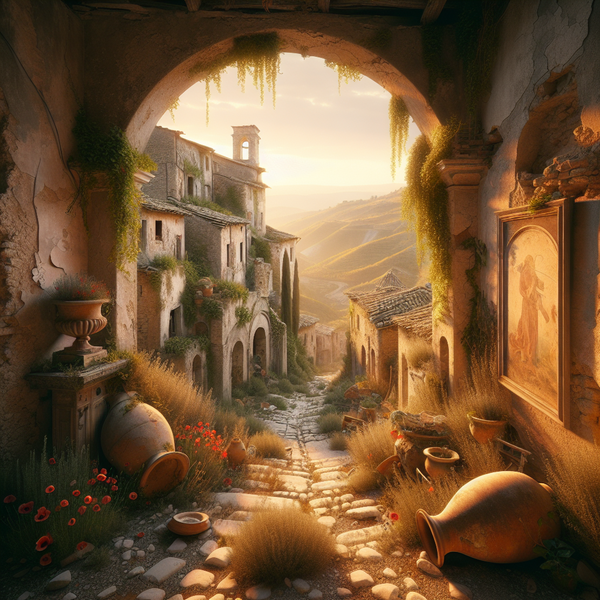
You can still hear the echo of church bells across Italy’s forgotten valleys, where entire villages stand silent above olive groves and river gorges. These abandoned villages — some called borghi fantasma — are scattered across the peninsula, their crumbling stone houses now framing some of the country’s most remarkable panoramas. Exploring them is not a macabre diversion but an extraordinary way to understand Italy’s shifting landscapes, depopulation, and resilience. Each ghost town tells its own story of flight, fortune, and rediscovery.
Go to the section
ToggleCraco in Basilicata: The Cinematic Ghost Town of the South
Perched on a clay hill in southern Basilicata, Craco looks like a movie set from a medieval legend — which it often is. Its deserted alleys have appeared in international films, thanks to the village’s haunting skyline of towers and broken archways. The town was evacuated after landslides made it unsafe, leaving behind a skeletal beauty. Visitors can join a guided tour organized by the Craco Support Association, which provides helmets and access to select structures for about €15.
The viewpoint near the former church of San Nicola offers wide views of the Cavone Valley, where golden wheat fields fold into badlands called calanchi. It’s hot here, even in autumn, so bring water and avoid the midday sun. The nearest base with accommodations is Pisticci or Matera, both about an hour’s drive, where you can enjoy functioning cafes and small agriturismi before venturing into silence.
Bussana Vecchia, Liguria: A Ghost Town Reclaimed by Artists
High above the Ligurian coast, Bussana Vecchia fell silent after an earthquake reduced it to rubble over a century ago. For decades it lay abandoned, its stone arches collapsing into bougainvillea. Then, in the 1960s, a community of artists from across Europe began restoring the ruins by hand. Today it’s both alive and ghostly — a blend of empty corners and open studios.
The structure of the original medieval village remains: narrow stairways twisting up to chapels open to the sky. You can explore on foot from the parking lot below — no cars inside — and buy ceramics or paintings directly from residents. The view from the old bell tower stretches over the Riviera dei Fiori, reminding you how close life and decay coexist. When visiting, respect that people live here again: keep voices low and avoid entering homes, even if half-roofed.
Gessopalena in Abruzzo: White Stone Memories Over a Gorge
Gessopalena sits on a precipice facing the Maiella mountains, its name deriving from gesso, meaning gypsum, the pale stone still crusting its walls. The old town — Gessopalena Vecchia — was partially destroyed during wartime, then left behind as residents rebuilt downhill. Walking among its skeletal remains, you’ll find interpretive signs explaining who lived in each house, creating an open-air museum atmosphere.
The route through the upper ruins ends at a viewpoint overlooking the Aventino Valley. On clear days, you can see all the way to the Adriatic. There’s a small visitors’ center near the entrance, open on summer weekends, where you can buy local honey flavored with acacia flowers collected from nearby slopes. Parking is free but limited, so arrive early if visiting in July or August.
Roscigno Vecchia, Campania: A Museum of Everyday Life Left Intact
Few ghost towns in Italy are as evocative as Roscigno Vecchia, in Campania’s Cilento region. Unlike Craco or Gessopalena, it hasn’t been repopulated by artists or restored for tourism. The village is preserved almost exactly as it was left: wooden chairs still rest beside doorframes, and cracked shutters cover small windows. One caretaker, often referred to affectionately by visitors as the village guardian, maintains the site and welcomes travelers for a chat beneath the central elm tree.
The village is reachable via a scenic road from Roscigno Nuova. Expect no cafes or souvenir stands — just a small museum displaying pottery and farming tools discovered in the ruins. This stark authenticity has earned the town recognition by UNESCO in regional heritage listings. Early morning light ignites the limestone facades, making it one of the most atmospheric photography stops in southern Italy.
Fabbriche di Careggine, Tuscany: The Drowned Ghost Village Beneath a Lake
Among Italy’s most unusual abandoned villages is Fabbriche di Careggine in northern Tuscany. It lies beneath the surface of an artificial lake — Lake Vagli — created for hydroelectric purposes. When the dam is emptied for maintenance, roughly every few decades, the stone village reemerges from the water like a mirage. Narrow streets and the bell tower reveal themselves, drawing thousands of onlookers.
You can visit the lake anytime, even when the town is submerged, for walking trails and stunning views toward the Apuan Alps. The area around Vagli di Sotto offers family-run trattorie serving chestnut gnocchi and wild boar stew. If you’re lucky enough to see Fabbriche di Careggine resurface, it’s an event Italians travel far to witness — but keep expectations measured; access may be limited to guided routes for safety.
What Makes Italy’s Abandoned Villages Worth Exploring
These ghost towns represent more than picturesque decay. They are tangible records of Italy’s demographic shifts, especially after economic migration moved families from mountains to cities. Today, some provinces encourage small-scale restoration by offering symbolic purchase prices — occasionally as low as €1 — to revitalise abandoned homes. Such programs exist in regions like Sicily (Sambuca di Sicilia) and Abruzzo, echoing the survival instinct embedded in these ruins.
Practically speaking, ghost towns are also havens for travelers seeking solitude. Early morning walks reveal no crowds, just the hum of crickets and the faint scent of stone warmed by sun. They challenge you to slow down and notice textures — moss, mortar, faded frescoes — rarely visible in busier destinations. Bring sturdy shoes, as paths can be uneven, and check local municipality websites for opening hours or required permits before driving into remote valleys.
Planning Routes Through Southern Italy’s Ghost Town Belt
From Basilicata through Calabria and into rural Campania, a loose trail of abandoned and semi-abandoned towns forms a fascinating travel route. One efficient circuit starts in Matera (for Craco), heads southwest to Aliano and Guardia Perticara — both partially deserted but quietly reviving — then continues toward Roscigno Vecchia and the Cilento National Park. The drive covers roughly 400 kilometers, ideal for a five-day road trip with overnight stays in nearby agriturismi.
GPS coverage can be patchy in the hills, so download offline maps. Petrol stations may close during midday breaks (pausa pranzo), typically from 1 p.m. to 3:30 p.m. Although these places are remote, Italians remain remarkably helpful; even in solitary hamlets you’ll find a hand-drawn sign pointing to the next ghost village. Spring and late autumn are best for cooler temperatures and clear air — conditions that make photography unforgettable.
Ghost Villages Revived: From Film Sets to Community Projects
Some Italian ghost towns are cautiously stepping back into life. Craco stages guided tours and art residencies; Bussana Vecchia hosts summer painting workshops in its restored chapels; while Valle Piola in Abruzzo has been partially renovated to accommodate volunteers restoring woodland paths. These projects blend heritage with sustainable tourism, often appealing to slow travelers who prefer immersive encounters over checklist sightseeing.
Participating in local initiatives — such as village cleanup weekends posted on regional tourist boards — helps preserve these fragile sites. By traveling responsibly and spending in surrounding communities, visitors contribute to maintaining access roads, signage, and safety barriers. The paradox is moving: to keep these towns ‘abandoned’ yet accessible, someone must always care for them.
The Reward of Exploring Italy’s Abandoned Villages
Visiting Italy’s ghost villages rewires how you experience beauty. The emptiness emphasizes nature — skylarks over the rooftops, breeze moving through cracked shutters, stars unobscured by city lights. Every journey between them adds understanding: why Italians left, and why some are returning. With careful planning, good shoes, and curiosity, exploring these abandoned villages becomes one of Italy’s most contemplative adventures — proof that silence too can be spectacular.