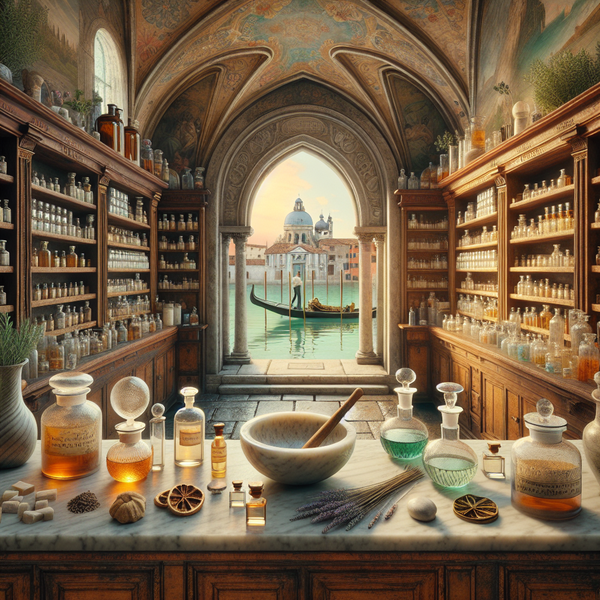
Stepping into Italy’s historic pharmacies and perfumeries is like unlocking a scented time capsule. Behind the carved wooden counters and amber glass apothecary jars lies a lesser-known side of Italian heritage — one that blends monastic tradition, botanical science, and refined design. From Florence’s cloistered Dominican laboratories to Venice’s lagoon-inspired essences, each historic pharmacy tells its own fragrant story about beauty, medicine, and identity. Exploring them offers a sensory journey through centuries of knowledge still alive in every bottle.
Go to the section
ToggleHistoric Pharmacies in Florence: Where Science Met Spirituality
In Florence, the city of the Renaissance, pharmacies were more than dispensaries — they were centers of research and devotion. The most famous, the Officina Profumo-Farmaceutica di Santa Maria Novella near Via della Scala, began as a Dominican friars’ infirmary. You can still visit its frescoed halls and original fragrance laboratory, where monks experimented with healing herbs grown in their cloisters. The secret blend known as Acqua di Santa Maria Novella, once created for Catherine de’ Medici, remains one of Italy’s oldest perfumes still in production.
Just across the Arno, smaller historic shops like Farmacia SS. Annunziata dal 1561 carry on similar traditions with artisanal formulations. The staff here still use 16th-century herbal recipes for creams and elixirs, combining almond oil, rosemary, and lavender sourced from Tuscan hillsides. A visit to these pharmacies isn’t only for shoppers — many welcome visitors for brief consultations or even fragrance blending sessions upon request, booked directly through their official websites or by phone in advance.
Venetian Perfumeries and Apothecaries: Scented Secrets of the Lagoon
Venice’s perfumery heritage stems from its trading past, when merchants brought exotic ingredients like ambergris from the East. Hidden along Calle dei Saoneri, the Farmacia San Giovanni Evangelista exhibits antique scales and pestles once used to grind powders for the Doge’s court. Its original wood-paneled interior is still intact — you can spot shelves stacked with cobalt-blue bottles that predate the Republic’s fall.
Nearby, contemporary artisan perfumers are reviving the city’s olfactory tradition with Venetian flair. At The Merchant of Venice boutique inside Palazzo Mocenigo, you can book a guided scent tour that delves into the city’s perfume history. The museum’s restored rooms showcase Murano glass flacons and rare accords evoking lagoon flora, while trained guides explain how Venice’s trade routes shaped Europe’s fragrance map. Don’t leave without trying their “Rosa Mocenigo,” inspired by the antique roses once cultivated on Giudecca island.
Monastic Pharmacies in Umbria and Lazio: Living Heritage Through Healing Balms
Moving inland, central Italy preserves monastic pharmacies where the slow rhythms of herbal medicine still guide daily life. In the Umbrian countryside, the Antica Farmacia dei Monaci Camaldolesi inside the Camaldoli Monastery near Arezzo offers a rare glimpse into medieval pharmacology. Visitors can explore its small museum displaying handwritten apothecary ledgers and jars filled with dried juniper, gentian root, and angelica. The monks continue producing tinctures, herbal teas, and natural liqueurs using plants grown in their forest garden, which you can purchase directly after your visit.
In Rome, the Farmacia di Santa Maria della Scala in Trastevere remains one of Europe’s oldest continually operating pharmacies. Founded by Carmelite friars, it is open as a small historical museum curated by the friars themselves. The guided tour reveals the toxicology cabinets, ornate 18th-century scales, and terracotta vessels used for camphor and balms. Each summer, the brothers organize short educational visits (bookable via email through their convent site), sharing traditional methods still studied by pharmaceutical historians today.
Find all the best hotel deals on Booking.com
Florentine and Roman Perfumery Houses: Legacy Meets Modern Craft
Beyond monasteries, Italy’s legacy perfumers are redefining heritage through innovation. In Florence, family-run brand Dr. Vranjes Firenze fuses centuries-old aromatic expertise with contemporary Italian interior design. The boutique on Via della Vigna Nuova lets visitors personalize their home diffusion scents — oud, iris, or Tuscan leather — under staff guidance trained in chemistry and design. Behind the counter stands the founder’s original glass laboratory, where natural oils and resins are still measured by hand.
Rome has carved a niche with perfumers like Campomarzio70, a concept store founded by a local family passionate about rare fragrances. Inside its Via di Campo Marzio flagship, marble counters contrast with modern art walls while the staff introduce niche Italian houses such as Meo Fusciuni and Laboratorio Olfattivo. The experience feels more like visiting a small cultural salon than a boutique. Customers can attend workshops on olfactory memory and bespoke blending, typically scheduled through online registration on their portal.
Discover the best local experiences with GetYourGuide
Southern Italy’s Artisanal Apothecaries: Scent and Science Beneath the Sun
While many travelers head north for Renaissance grandeur, southern Italy preserves some of the country’s most authentic apothecaries, often family-run for generations. In Naples, Antica Farmacia di Santa Maria della Sanità still serves both as a functioning pharmacy and a community hub. The vaulted ceiling adorned with Bourbon-era frescoes shelters a working lab where herbal syrups and soaps are produced daily. Visitors may observe preparation demonstrations, arranged through local cultural associations that partner with the pharmacy to promote traditional medicine.
Further south in Palermo, the Antica Spezieria di Santa Caterina d’Alessandria re-opened a few years ago as part of the restored monastery complex adjacent to Piazza Bellini. Here, volunteers and artisans recreate 18th-century balms and perfumes using honey, cinnamon, and lemon from Sicilian orchards. The apothecary’s shop sells these limited batches in blown-glass bottles labeled by hand — a beautiful souvenir and tangible support for the convent’s restoration. The adjoining tea room serves infusions following old monastic recipes, offering respite from Palermo’s lively streets.
The Modern Renaissance of Italian Natural Perfumery
Across Italy today, a wave of modern natural perfumers is reviving historical principles through sustainable practices. In Bologna, laboratory-boutique Erbolario Concept Store on Via Indipendenza prioritizes recyclable packaging and traceable Italian botanicals. Customers can consult certified herbalists for skincare recommendations and sample limited-edition distillations crafted from regional plants like lavender from Emilia and bergamot from Calabria.
In northern Piedmont, Maroma Laboratori di Fragranze experiments with distillation techniques that date to 18th-century monasteries, blending them with modern extraction technology. The family welcomes visitors for short educational tours that showcase copper stills in use. It’s a concise, fascinating look at how Italy continues to marry its monastic roots with forward-thinking ecological design — proof that the country’s fragrant legacy is as dynamic as ever.
How to Plan Your Own Italian Pharmacy and Perfumery Itinerary
To explore Italy’s historic pharmacies and perfumeries effectively, combine major city visits with short countryside detours. Aim to book guided tours or workshops in advance, as smaller monastic pharmacies often limit entry to pre-arranged groups. For travelers prioritizing fragrance shopping, Florence and Rome remain key hubs for heritage perfumery, while Venice offers immersive museum experiences that explain the industry’s origins. In southern regions, timing your trip with local religious festivals often grants access to monastery cloisters otherwise closed to the public.
When purchasing products, remember that many artisanal shops sell directly from their in-house laboratories, offering fresher formulations and transparent sourcing. Always keep receipts for customs-friendly export of alcohol-based perfumes. And wherever you go, allow time simply to breathe in — whether it’s the incense-laced air of a centuries-old pharmacy or the citrus and jasmine drifting through a Sicilian courtyard. Each scent tells a story, and in Italy, those stories still live on, bottle by bottle.