Few travelers realize that Northern Italy, better known for its Alpine peaks and shimmering lakes, harbors some of the most impressive Roman ruins this side of the Apennines. Beyond the shadow of Rome’s Colosseum and southern Italy’s temples, the north preserves an extraordinary mosaic of arenas, gates, baths, and ancient roads woven seamlessly into modern cities. Exploring these ruins is not about chasing dusty husks of antiquity — it’s about discovering how Roman foundations still shape daily life in Milanese courtyards, Veneto wine hills, and Alpine valleys once marched by legions.
Go to the section
ToggleRoman Verona: Amphitheaters and City Walls in Living Stone
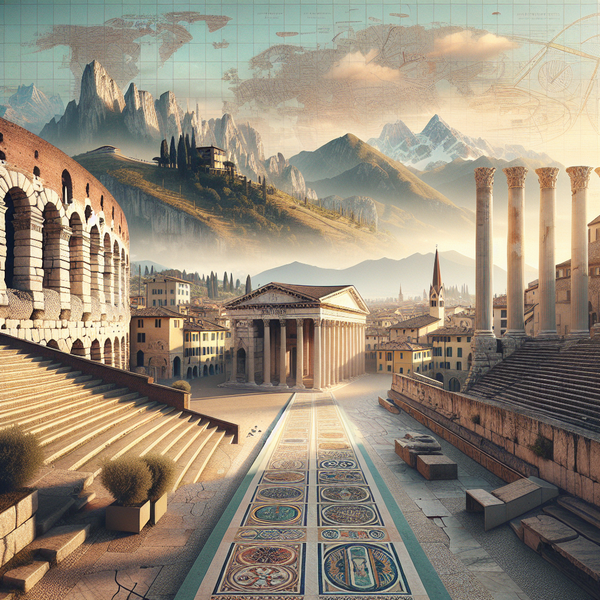
Verona’s Arena di Verona is the north’s crown jewel of Roman engineering. Built from pale pink Valpolicella limestone, the Arena remains one of the best-preserved amphitheaters in Europe. It still hosts summer opera performances where spectators sit on the same tiered stone seats ancient Veronese citizens once did. The acoustics are astonishingly intact, thanks to the original elliptical design that amplifies unamplified voices without distortion. The Arena lies just off Piazza Bra, meaning you can step from a cappuccino straight into the Roman Empire in minutes.
Verona’s Roman heritage doesn’t end there. The Porta Borsari, a restored city gate along Corso Porta Borsari, showcases impeccably carved limestone façades once marking the entrance to the Roman Via Postumia, the main consular road connecting Genoa with Aquileia. If you walk along the Adige River to Ponte Pietra, rebuilt stone by stone after World War II using original fragments, you’ll trace the city’s ancient defensive line. For photographers, the early morning light hits the Arena and the gate at just the right angle to reveal the delicate chisel marks still visible after nearly two millennia.
The Hidden Roman Heart of Milan: Theater, Baths, and City Planning
Milan’s Roman past often hides beneath layers of Renaissance façades and modern business towers, but it’s surprisingly accessible with a keen eye. The Roman Theater of Milan, located behind the Palazzo Mezzanotte in Piazza degli Affari (home of the Italian Stock Exchange), was once one of the largest in northern Italy. You can visit its ruins through a modest underground museum managed by the Archaeological Museum of Milan in Corso Magenta 15. The fragments reveal the city’s former grandeur when Mediolanum was an imperial capital.
Nearby, the Roman walls and tower remains behind San Maurizio al Monastero Maggiore let you visualize Milan’s strategic military design. The brick and stone foundations date to when Milan served as a Roman administrative center for the north. A short walk away, along via Brisa, you’ll reach the remnants of the imperial palace complex, excavated between residential courtyards. Standing among apartment buildings and modern cafés, you can appreciate how Rome’s urban backbone still shapes Milan’s city grid. Locals often joke that when Metro workers dig a tunnel, they find another layer of Rome.
Aquileia’s Roman Legacy: The Silent Giant of Friuli
Few sites in northern Italy rival Aquileia in archaeological scope. Once one of the largest cities of the Roman Empire with a busy port, today Aquileia is a tranquil Friulian village surrounded by vineyards and birdsong. The sheer scale of the ruins — from the Forum to the river port and the mausolea — makes it one of the most compelling open-air museums in Europe. Walking the excavations feels intimate and expansive at once, partly because you can get remarkably close to mosaic floors without the barriers typical of more famous sites.
The most spectacular mosaics, however, are preserved inside the Basilica di Santa Maria Assunta. Its fourth-century floor mosaic — one of the largest Paleo-Christian mosaics in the world — displays vibrant depictions of Good Shepherds and sea creatures rendered in locally quarried stone chips. The adjacent archaeological museum holds relief sculptures that once ornamented the city’s grand forum. Aquileia’s UNESCO designation ensures ongoing conservation, and entry tickets combine access to both museum and open-air remains, making it a manageable day trip from Trieste or Udine by car or local train.
Find all the best hotel deals Book your stay here
Brescia’s Capitoline Temple and Roman Forum: Lombardy’s Archaeological Gem
In the heart of modern Brescia, between Corso Zanardelli and the city’s medieval castle, lies the Capitoline Temple and Roman Forum. Rediscovered in the nineteenth century under several meters of rubble, this site is now part of the UNESCO Longobards in Italy route. The temple’s marble stairway and towering Corinthian columns rise dramatically against Lombardy’s skyline. Inside, inscriptions dedicated to Jupiter, Juno, and Minerva confirm that this was once Brescia’s civic and religious epicenter.
The nearby Roman theater, with seating carved into the natural slope, offers a glimpse of civic life during Brixia’s Roman pinnacle. To deepen your understanding, the Museo di Santa Giulia, located just next door, holds artifacts unearthed during excavations — from bronze statues to fragments of painted stucco. The museum’s combined ticket allows entry to all parts of the archaeological zone, including the forum paved with still-visible cart ruts from Roman chariots. Stand there at sunset, when the golden haze illuminates the temple façade, and you feel the ancient city’s rhythm return for a moment.
Discover the best local experiences Join expert-guided archaeological tours
Trento’s Underground Roman City: Tridentum Revealed
Trento’s sleek Alpine streets conceal one of Italy’s most atmospheric subterranean excavations. Beneath Piazza Cesare Battisti, you can walk through Tridentum, the Roman predecessor of Trento, in a modern gallery-labyrinth lit by soft LEDs. Sections of ancient stone roads, house walls, and drainage channels remain intact, giving visitors a practical understanding of everyday life. It’s accessible via the S.A.S.S. – Spazio Archeologico Sotterraneo del Sass, an entrance discreetly located near the Teatro Sociale. Admission includes an audio-visual guide explaining how the ancient drainage system influenced Trento’s later development.
What makes Tridentum stand out is its integration into the modern city plan. The preserved Roman street pattern corresponds almost seamlessly with present-day via Oss Mazzurana and via del Simonino. For those visiting in winter, the underground temperature stays comfortably mild, making it an ideal stop during the Christmas market season. Families find it engaging due to its tactile models and interactive screens — rare features in Italian archaeological exhibitions.
Aosta’s Roman Theatre and Triumphal Gate: Alpine Monumentality
The Alpine town of Aosta, nestled near the Swiss border, earns the nickname “Rome of the Alps.” Founded as Augusta Praetoria, it was the Roman keystone controlling passes through the Great St. Bernard Valley. The partially restored Roman Theatre remains awe-inspiring, especially its 22-meter-high southern façade with arched windows framed by blue-gray stone quarried from local mountains. During December, an artisan Christmas market takes place right in front of the theater ruins, merging ancient grandeur with Alpine festivity.
Nearby stands the Arch of Augustus, a perfectly proportioned victory arch commemorating Rome’s conquest of the Salassi people. The arch marks the eastern entrance of the Roman city grid that still defines Aosta’s historic center — look down Rue Sant’Anselme, and you are walking the cardo maximus, the main north–south axis of the colony. Continue further to the Porte Praetoria, a double-arched stone gate still connecting old and new quarters. The local tourist office on Piazza Emile Chanoux provides free walking maps with Roman sites clearly marked, making it easy to explore independently in under two hours.
Valle Camonica’s Little-Known Roman Bridge and Military Outpost
In the lesser-visited valleys of eastern Lombardy, the Roman bridge of Cividate Camuno spans the Oglio River with extraordinary simplicity. Two intact arches from Roman times still carry local pedestrian traffic. Adjacent to it are the remains of a small amphitheater and a Roman temple uncovered near the modern town hall. The Museo Archeologico Nazionale della Valle Camonica explains how this settlement served as a frontier post guarding the route from Brescia toward the Alpine passes. For hikers, the Sentiero Archeologico combines Roman and prehistoric rock-carving sites into a 5‑kilometer circular path clearly marked with brown National Heritage signs.
Because Cividate Camuno rarely sees tourist crowds, you can often have the ruins to yourself — a rarity in Italy. It’s practical to visit by regional train from Brescia (about 1 hour 15 minutes) and then walk 10 minutes from Cividate station. Bring sturdy shoes, as the paths can be uneven and set among fields where cows graze just as they did in Roman rural landscapes.
Practical Tips for Visiting Roman Ruins in Northern Italy
Logistics across northern regions vary, but a few strategies simplify exploring multiple Roman sites efficiently:
- Combine urban and rural sites: Large cities like Verona and Brescia offer museums and easy transport, while smaller centers like Aquileia or Cividate provide peaceful, open-air explorations.
- Check joint tickets: Several towns offer cumulative passes, such as Brescia’s integrated Archaeological Park ticket or Milan’s combo ticket covering the Civic Archaeological Museum and Roman excavations.
- Travel off-season: From late autumn to early spring, you’ll find shorter queues, moderate temperatures, and better visibility of stone detail free from summer glare.
- Combine with culinary stops: Near Verona, try Valpolicella wine cellars; in Friuli, pair Aquileia’s mosaics with local white wines like Friulano or Ribolla Gialla; in Aosta, reward a morning of ruins with a platter of Fontina and chestnut honey.
Reaching these ruins is straightforward by train and regional bus: Verona, Brescia, Milan, and Trento all sit on major railway lines, while Aquileia and Aosta require short regional connections. Renting a small car is the easiest way to cover the dispersed sites of Friuli and Valle Camonica in a single itinerary. Many archaeological zones also provide small shaded parking areas — a real advantage during hot months. Remember that most sites close for midday breaks, typically between 12:30 and 14:30, when even the ruins rest in the heat.
Why Northern Italy’s Roman Ruins Matter Today
What sets the Roman ruins of Northern Italy apart is not only their preservation but their coexistence with modern life. Unlike southern archaeological zones fenced from daily use, Verona’s amphitheater or Aosta’s gate remain open arteries of living cities. Standing among them, you grasp how Roman precision adapted seamlessly to Alpine terrain and evolving urban forms. These ruins remind travelers that Rome’s northern legacy wasn’t a distant outpost — it was a thriving heartland that continues to pulse beneath modern cobblestones.
Exploring these sites offers not nostalgia but genuine continuity. Every gate still frames a view of cars and bicycles echoing ancient chariot paths. And when the bells of a nearby duomo sound across a Roman forum at dusk, you realize that time in northern Italy doesn’t so much erase the past as quietly build upon it.