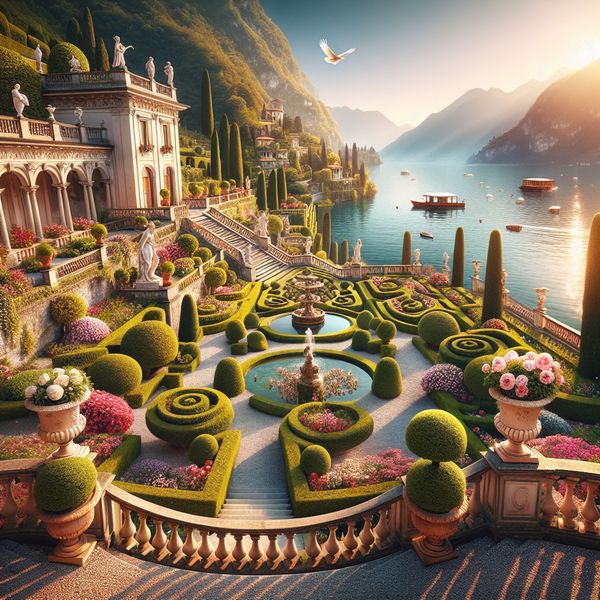
Italy’s northern lakes — Como, Maggiore, and Garda above all — hold some of Europe’s most refined gardens, nurtured by a unique microclimate where Alpine freshness meets Mediterranean softness. Strolling through these lakeside estates, one senses that this landscape is as carefully curated as any museum collection: camellias bloom beside citrus trees, azaleas spill toward the water, and centuries of horticultural passion unfold beneath cypress silhouettes. What makes these gardens remarkable isn’t only their botanical variety, but the way they enhance their lake views — each terrace, pergola, and gravel path designed to frame a perfect perspective on water and mountain.
Go to the section
ToggleHistoric Grandeur at Villa Carlotta, Lake Como
At Tremezzo on Lake Como’s western shore, Villa Carlotta is a benchmark for neoclassical grace and botanical splendor. Its terraced garden descends more than 70 meters toward the lake, layered with camellias, rhododendrons, and towering palms that thrive thanks to the mild Como climate. Inside the villa, Canova sculptures and 18th-century paintings tell of aristocratic tastes that continue in the grounds outside — where geometrical Italianate sections open onto English-style meadows. In late April and May, the azalea bloom paints entire slopes in pinks and reds, a spectacle that locals time their visits carefully to see. A useful tip: morning visits before 10 a.m. usually offer both quieter paths and the best light across the lake toward Bellagio.
Isola Bella & Isola Madre: Floating Gardens of Lake Maggiore
Few experiences compare to stepping off a vaporetto at Isola Bella near Stresa and finding yourself surrounded by cascading terraces that rise like a stage set. The Borromeo family has maintained this 17th-century masterpiece for generations, integrating baroque stonework, lemon trees in giant terracotta pots, and statues aligned with precise theatrical symmetry. Peacocks roam freely on the upper terraces, their turquoise feathers catching the sunlight that dances across the water. The best approach is from Stresa’s main pier, where ticket combinations for both Isola Bella and Isola Madre can be purchased — allowing half a day to explore both islands at an unhurried pace.
Isola Madre, by contrast, is quieter and more intimate. Here, subtropical plants dominate — magnolias, gingko trees, and a profusion of hydrangeas make the island a living lesson in botanical adaptability. Because of its sheltered position, the island maintains an almost constant humidity, ideal for rare bird species and exotic specimens like the ancient Kashmir cypress. Bring insect repellent during the warmer months and a light jacket: even in summer, Lake Maggiore can cool quickly once the sun dips behind Monte Mottarone.
Timeless Romance at Villa del Balbianello on Lake Como
Villa del Balbianello, perched on the tip of the Lenno peninsula, is one of those places where architecture and nature exist in dialogue. The villa’s terraced gardens flow around two charming loggias offering peerless views over both sides of Lake Como. Maintained by the Italian Heritage Trust (FAI), Balbianello’s topiary practices are so precise that the clipped oaks and laurels seem sculpted rather than pruned. Scenes from famous films have been shot here, but the real drama comes from climbing the sinuous path up from the dock while the lake glimmers below. If you’re arriving by ferry from Bellagio, schedule at least two hours: 30 minutes each way for the lakeside walk and one full hour for the gardens themselves. The estate also offers guided tours in English — worth booking in advance on the FAI website, as same-day entry often sells out on weekends.
Secret Corners and Citrus Scents at Giardino Botanico di Villa Monastero, Varenna
Across the lake from Tremezzo, Villa Monastero in Varenna is a long, narrow estate hugging almost two kilometers of waterfront — an unusual feature among Italian lakeside gardens. Once a medieval convent, its terraces now host over 900 species of plants, from rare agaves to fragrant orange blossom. The path winds past pergolas, marble statues, and a formal staircase leading to the lake. Practical details distinguish this spot: the entrance lies just five minutes’ walk from Varenna’s train station, making it one of the most accessible Lake Como gardens for travelers without cars. Spring showcases wisteria climbing the villa walls, while autumn brings russet reflections on the calm waters in front. If time allows, pair a garden visit with the short ferry crossing to Bellagio — one of the most scenic fifteen-minute rides on the lake.
Lake Garda’s Giardino Botanico André Heller: A Contemporary Eden
On Lake Garda’s western shore at Gardone Riviera, the André Heller Botanical Garden reflects the vision of the Austrian artist and landscape designer who transformed it into a living gallery. Paths meander past bamboo groves, miniature waterfalls, and sculptures by Keith Haring and Roy Lichtenstein. The mixture of art and botany gives this garden a different mood from the aristocratic estates farther north — it feels spontaneous, but every rock and pond is placed with artistic intention. The garden is compact enough to explore in under an hour but packed with detail. Don’t rush: peek under the Japanese bridge to spot koi darting beneath water lilies, then pause by the Tibetan-inspired pavilion for a lake view framed by cypresses and olive trees. Tickets are sold at the entrance, just opposite the main road leading through Gardone’s historic quarter, and parking is available a few steps uphill.
Romantic Grandeur at Villa Melzi d’Eril, Bellagio
The Villa Melzi d’Eril Gardens sweep along Bellagio’s lakefront in a succession of calm lawns, azalea-lined avenues, and shaded groves. Built for Francesco Melzi d’Eril, vice president of the Napoleonic Republic of Italy, the estate reveals a neoclassical restraint balancing perfectly with Lake Como’s natural beauty. Every tree and sculpture was selected to align with the villa’s symmetrical architecture: even the Moorish pavilion near the water was placed to mirror the gentle curves of the shoreline. Admission is via a modest gate at the south end of Bellagio’s promenade; once inside, visitors can stroll almost 800 meters along a lake path without encountering crowds. For photographers, the morning brings soft light that illuminates both the white villa façade and the gardens’ deep green sweep toward Varenna.
Villa Taranto in Pallanza: Lake Maggiore’s Botanical Jewel
Situated near Verbania, Villa Taranto encompasses over 16 hectares and about 20,000 plant varieties. Scottish officer Neil McEacharn founded this garden in the 20th century, importing species from Australia, Africa, and South America. The result is an astonishing microcosm of world flora on Italian soil: Himalayan rhododendrons, Amazonian water lilies, and refined avenues of azaleas stretching toward the lake. The garden’s seasonal calendar is precise, with hundreds of tulip varieties planted each autumn for the spectacular Tulip Week each spring. Entry tickets include a detailed map; plan a minimum of two hours to see the highlights, including the Dahlia Avenue and the Terraced Gardens viewpoint. From April to October, boats from the Verbania pier stop directly in front of the main gate — ideal if you want to arrive without driving through the town’s narrow roads.
Vittoriale degli Italiani: A Monumental Garden with a Poet’s Soul
Also in Gardone Riviera, a short climb above Heller’s garden, sits the Vittoriale degli Italiani — the eccentric estate of poet Gabriele D’Annunzio. Its gardens mix Mediterranean shrubs, naval relics, and terraces overlooking Lake Garda. The ship anchored in the hillside (literally a warship built into the landscape) testifies to D’Annunzio’s theatrical vision of life. While statues and inscriptions capture his personality, cypress-lined paths and shaded amphitheaters soften the effect, creating corners that invite quiet reflection. Visits work best in combination with the museum ticket, and the guided tour of the house adds vital context to the garden’s extravagant layout. Comfortable shoes are essential; the estate covers nearly nine hectares of steep terrain.
Tips for Visiting the Italian Lakes Gardens Efficiently
Visiting these gardens in a logical sequence enhances both logistics and enjoyment. Travelers arriving from Milan can reach Varenna and Tremezzo by train and ferry within three hours, making Lake Como an excellent first stop. From there, a train or car journey north leads to Lake Maggiore, less than 90 minutes away. Lake Garda, being farther east, is most comfortably reached afterward via the A4 motorway or Brescia train connections.
For garden enthusiasts planning multiple visits in one holiday, consider purchasing combination ferry passes: on Lake Como, the Navigazione Lago di Como’s daily ticket allows unlimited stops between Menaggio, Varenna, and Bellagio. Equally useful, the Maggiore Express Ticket links trains and boats between Stresa, Locarno, and the islands. If driving, remember that many villas limit parking; leaving the car in town centers and walking or taking ferries often reduces stress significantly.
When to Visit and What to Expect
The best season for the Italian lakes gardens depends on what you hope to see. Spring (March to May) brings azalea and rhododendron explosions, particularly at Villa Carlotta, Villa Taranto, and Villa Melzi. Summer allows leisurely picnics in shaded corners, though June afternoons can be humid on Maggiore. Autumn, surprisingly, offers the richest palette for photographers: ochre leaves contrast sharply with the gleam of the lakes, especially around Varenna and the Vittoriale’s hillside terraces. Most gardens close or reduce hours from November to February, so always check opening calendars online before departure.
Comfort is key. Paths are generally gravel or flagstone, so flat shoes with grip matter more than style sandals. Bring cash for small entrance fees; several gardens charge a modest few euros for access, and not all accept cards. If you want to avoid the heaviest visitor flows, aim for weekday mornings — a simple tactic that often means you’ll have entire paths to yourself, with only the sound of lapping water and church bells echoing across the lake.
Why the Italian Lakes Gardens Remain Unrivalled
Ultimately, what sets the gardens of the Italian lakes apart is how seamlessly they intertwine art, climate, and landscape. The Alpine backdrop and Mediterranean flora produce a hybrid beauty impossible to replicate elsewhere. Here, horticulture has always been inseparable from culture itself: baroque geometry on Isola Bella, English romanticism at Villa Melzi, or artistic provocation at Heller’s garden. Exploring them provides not just visual pleasure but insight into how Italians, past and present, shape nature into an aesthetic experience. Whether you arrive by ferry, rental car, or bicycle, the journey itself — the interplay of road, water, and mountain — feels like an essential part of the story these gardens continue to tell.