Travel across Italy long enough, and you’ll discover that many of the country’s most breathtaking landscapes are not only natural wonders—they’re engineered ones. Beneath the cobblestones of Rome, under the vineyards of Veneto, and across the cliffs of the Amalfi Coast lie feats of Roman and pre-Roman ingenuity that continue to influence how Italians build, irrigate, and travel today. From aqueducts that still feed fountains to volcanic roads carved for chariots, Italy’s ancient engineering isn’t just history—it’s infrastructure that continues to work.
Go to the section
ToggleRome’s Aqueducts: The Arteries of the Eternal City’s Water System
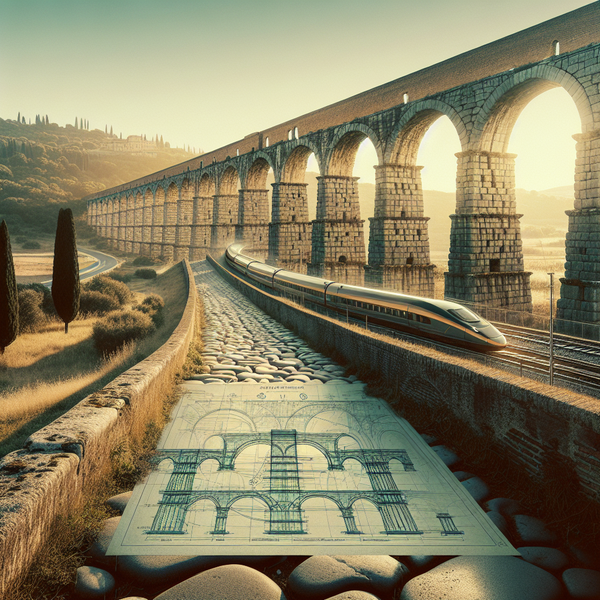
Stand at the Parco degli Acquedotti, just to the south of Rome’s city center, and you’ll see stone arches stretching for kilometers—most of them built nearly two millennia ago. These aqueducts were Rome’s life source, channeling pure water from the Apennine hills into baths, fountains, and private homes. The Aqua Claudia and Anio Novus, both visible from Via Appia Nuova, are prime examples: their alignment and gradient precision—often dropping less than half a meter per kilometer—show how advanced Roman surveying was even by modern standards.
Today, travelers can walk or cycle along these remnants on the Appia Antica route. Rent a bike from any kiosk near Porta San Sebastiano and follow the signage for the Parco Regionale dell’Appia Antica. Early mornings are best, when sunlight filters through cypress trees and the only sounds are birds and the soft hum of Rome waking up. The aqueducts aren’t roped-off relics; they’re built into daily life—a perfect intersection of history and habit.
Pompeii’s Drainage and Street Design: An Ancient Blueprint for Resilient Cities
Few cities demonstrate ancient engineering as intimately as Pompeii. The preserved ruins near Naples offer an entire lesson in urban planning. Look down any street and you’ll see raised stepping stones designed to let pedestrians cross during floods, a clue to the city’s sophisticated drainage channels below. The basalt paving blocks still show wheel ruts from carts—evidence of controlled, one-way traffic, centuries before the concept of traffic management existed.
Visitors can walk the original Via dell’Abbondanza to observe how water flowed from roof gutters into side channels, keeping roads relatively dry. Even the public fountains were strategically placed for equal water distribution. Modern Italian cities like Naples still follow some of these hydraulic principles: narrow streets, controlled slopes, and stone surfaces that manage rain runoff efficiently. Bring comfortable shoes—the cobblestones are authentic and uneven—and a guidebook highlighting the city’s engineering system rather than just its frescoes.
The Cloaca Maxima: Rome’s Unsung Sanitation Triumph
While the Colosseum gets the praise, Rome’s greatest unsung engineering achievement sits quietly beneath it: the Cloaca Maxima. This massive sewer system—accessible today from a small inconspicuous opening near the Church of San Giorgio al Velabro—was built to drain the Forum’s swampy valley and channel wastewater to the Tiber River. Its tunnel, constructed with tightly cut tufa blocks, is still in partial use by the modern city’s drainage system.
If you visit the Roman Forum, take a short detour toward the Ponte Palatino bridge, where you can glimpse the outlet of this ancient network. It’s a humbling reminder that while emperors built monuments to their fame, Rome’s survival depended on engineers who thought about hygiene, water flow, and sustainability long before those were modern buzzwords. The Cloaca’s endurance illustrates how Italians continue to value function married to form.
The Amalfi Drive’s Ancient Roots: Roads Carved from Cliff and Coast
Long before it became a scenic drive, the Amalfi Coast’s route was a logistical masterpiece. Much of the current SS163 traces paths originally cut by coastal settlers and later improved under Roman engineers for military and trade use. Look closely at segments between Positano and Ravello and you’ll notice retaining walls built from local limestone, stacked without mortar but perfectly balanced to withstand both mountain erosion and sea spray.
These ancient roads relied on stone culverts—small arched tunnels under the surface still visible along the Strada Statale—to divert rainwater into terraced lemon groves. If you’re driving, stop at the Belvedere di Furore viewpoint, where the cliffside curves show both the beauty and the logic of the road’s ancient design. Rent a compact car, not just for ease of parking, but to experience its intended narrow-turn geometry, once designed for mule caravans and carts laden with ceramics and fish salt.
Aquileia’s Port Engineering: The Lost Adriatic Superhub
In northeastern Italy, just inland from the modern town of Grado, lie the ruins of Aquileia—one of the most important ports of the Roman world. Today it appears landlocked, but ancient engineers once connected it to the Adriatic through a network of canals and warehouses that rivaled Ostia. Walking among the mosaic floors of the old river port, you can still trace the channels that fed trade ships carrying amber from the Baltic and wine from Dalmatia.
Visit the Museo Archeologico Nazionale di Aquileia, where you’ll see scale models of these harbor systems. They reveal clever tidal gates designed to prevent siltation—an ongoing challenge even for modern Italian ports like Venice. The paved quays, preserved under farmland, demonstrate how Roman surveyors controlled elevation to accommodate seasonal flooding while ensuring year-round trade. Bring a hat and water bottle: the site is open and sunny, with limited shade.
Segovia’s Sister in Sicily: The Aqueducts of Syracuse
On Sicily’s eastern coast, Syracuse hides aqueducts as ambitious as anything in mainland Italy. Carved into limestone along the Anapo Valley, these tunnels—many still used for irrigation—once transported water to the island’s Greek and Roman quarters. The Galermi Aqueduct, in particular, uses natural pressure gradients to supply fountains without mechanical pumps.
Adventurous travelers can book guided tours from Ortigia that lead deep into the channels under Piazza Archimede. Helmets are provided, and you’ll need sturdy shoes because the paths can be slick from condensation. What’s most striking is how seamlessly ancient engineers blended artificial channels with existing karst networks, effectively amplifying nature’s plumbing. Farmers around the valley still divert water from these conduits to cultivate citrus orchards, proof of an infrastructure that continues to feed life centuries later.
Hadrian’s Villa at Tivoli: Hydraulic Power Beyond Aesthetic Grandeur
Forty minutes east of Rome, Tivoli’s Hadrian’s Villa is usually described as a place of imperial relaxation, but for engineers, it’s a marvel of hydraulics. The estate’s massive pools and fountains were part of a complex water circulation system fed by two aqueducts. The Canopus canal, lined with statues and famous for its reflections, was not just decorative—it managed runoff from surrounding hills, functioning as a retention basin against flash floods.
Walk the lower gardens near the Pecile terrace and look for narrow hidden channels cut into the stone. These collected overflow and funneled it downhill to rotate small mills used to grind grain for the villa’s kitchens. Stand quietly and you can still hear water trickling through the channels today. Entrance tickets can be bought online or at the gate, but go early to enjoy the serenity before the tour groups arrive.
Verona’s Arena: Precision and Durability in Stone
In Verona, the Roman Arena commands Piazza Bra not just as a monument but as a functioning blueprint for acoustic and structural design. Its elliptical shape allows even modern pop concerts to carry sound seamlessly to the top rows. Engineers today still study how the outer arches distribute lateral forces using identical limestone blocks from the Valpolicella quarries. Despite centuries of earthquakes, the core cavea remains intact thanks to radial vaults that disperse weight evenly—a system later copied in Florentine Renaissance palaces.
Buy tickets for an evening performance—opera or modern concert—and arrive an hour early to watch how staff handle audience flow. They use the same layout as Roman ushers once did: sequential entrances numbered by arcades. The Arena is more than a relic—it remains a fully functional public space powered by engineering logic so well executed it never needed replacement.
The Aurelian Walls: Defensive Engineering that Survived Centuries
Encircling much of central Rome, the Aurelian Walls stretch for nearly 19 kilometers. Built initially to protect the capital against external threats, they later became a template for European fortifications. What makes them remarkable is their adaptive reuse—watchtowers turned into dwellings, gates expanded for trams, bricks re-laid with medieval mortar without compromising the wall’s stability. Walk from Porta San Paolo to Porta Maggiore to see the best-preserved sections, some standing at full height of over 10 meters.
These walls illustrate how ancient engineering outlasted empires through flexibility. Inspection tours by the Sovrintendenza Capitolina sometimes open rarely seen stretches—sign up on their website if your visit aligns. Even today, parts of Rome’s metro line were routed to follow the wall’s edge, showing continued reliance on its foundational logic.
Legacy of Italian Ancient Engineering: Lessons for Modern Travelers
Every journey through Italy passes some trace of its engineering past, whether visible or quietly functioning. The genius lies not just in the grand gestures—the arches, the domes—but in the invisible networks that made cities livable. When you drink from a Roman fountain in Assisi, traverse a mountain road above Amalfi, or rest under an aqueduct’s shadow, you’re experiencing infrastructure designed to last, maintained not through nostalgia but necessity.
For travelers fascinated by mechanics as much as beauty, Italy offers a living classroom. Ancient Roman engineers didn’t simply build cities; they engineered comfort, safety, and resilience—principles still relevant in modern Italy’s bridges and tunnels. Exploring these sites isn’t merely sightseeing; it’s witnessing the intelligence that shaped Europe’s first truly connected nation.