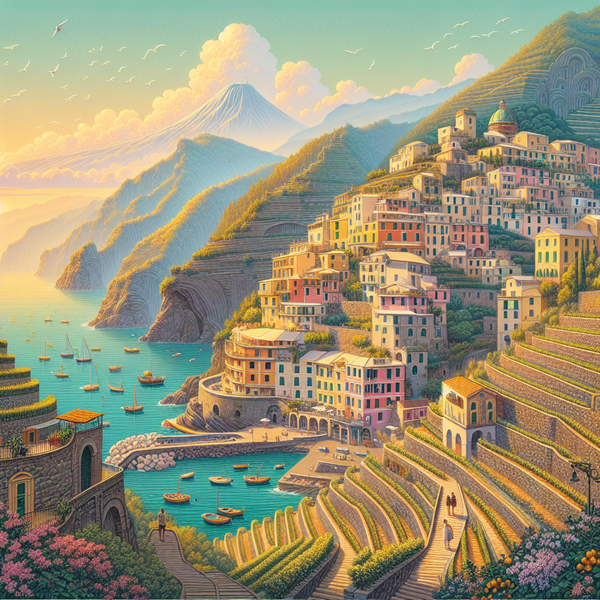
Terraces in Italy are more than scenic patterns carved into hillsides—they are living monuments to human persistence. Across the peninsula, farmers transformed steep slopes into productive vineyards, lemon groves, and olive orchards. These stepped landscapes tell stories of survival and ingenuity, offering travelers a chance to see Italy from a layered perspective that quite literally defines the country’s rural identity.
Go to the section
ToggleCinque Terre Terraced Vineyards and Sea Views
Few Italian views are as iconic as the terraced hillsides of the Cinque Terre on Liguria’s coast. Between Monterosso al Mare and Riomaggiore, over 4,000 dry-stone walls contour the cliffs, supporting narrow vine rows of Bosco, Vermentino, and Albarola grapes. The railway line linking the five villages makes it easy to explore on foot or by short train hops, though many travelers underestimate the steepness of the trails—good walking shoes are essential. For the best light, visit in late afternoon when the sun softens the sea-facing terraces and fishermen’s boats return to shore.
The Via dell’Amore footpath, when open, offers some of the most photogenic terraces just outside Manarola. In Monterosso, local winemakers open their cellars during the Sagra dell’Uva grape festival, letting visitors taste Sciacchetrà dessert wine grown from these same cliffside plots. Each sip contains centuries of backbreaking labor—proof of how terrain and tenacity intertwine on this coast.
Amalfi Coast Lemon Terraces and Ancient Trails
South of Naples, the Amalfi Coast blends terraced agriculture with Mediterranean drama. The cliffs above Amalfi and Minori are lined with lemon groves buffered by stone parapets built to trap precious soil. Locals still climb narrow stairways to harvest sfusato amalfitano lemons by hand, then lower baskets on rope pulleys. The scent is citrus and sea mixed together, particularly in late spring.
Hikers favor the Sentiero dei Limoni—the Lemon Path—linking Minori and Maiori. It takes about 90 minutes one way at an easy pace, passing through 13th-century watchtowers and terraced orchards dripping with fruit. These groves are still family-run, producing limoncello infused with zest collected on the terraces you’ll walk past. A guided visit through one of Amalfi’s lemon farms gives worthwhile insight into how these terraces function as both cultural heritage and economic necessity.
Valtellina’s Alpine Vineyards and Stone Walls
In Lombardy’s northern Valtellina Valley, terraces climb from 300 to 700 meters above the Adda River, forming one of Europe’s longest continuous dry-stone terraced systems. Here, Nebbiolo—called Chiavennasca locally—thrives on sun-drenched southern slopes supported by over 2,500 kilometers of stone retaining walls. The region’s cooperative cellars, such as those around Tirano and Sondrio, often welcome visitors for tastings paired with local pizzoccheri pasta.
The Sentiero del Vino hiking path lets travelers trace centuries of winemaking terraces without needing mountaineering skills. Every September, the Grappolo d’Oro celebrations fill village lanes with music, highlighting harvest traditions that depend entirely on these stepped plots. Access is simple by regional train from Milan to Sondrio—proof that even dramatic alpine terraces are reachable for a weekend escape.
Val d’Orcia’s Hidden Olive Terraces in Tuscany
The famous rolling hills of Tuscany hide smaller networks of ancient olive terraces, particularly around Montepulciano and Pienza. Look carefully along the lower slopes: centuries-old dry walls stabilize the topsoil and catch rainwater, keeping olive yields consistent despite erosion pressure. March and November are particularly beautiful months—silvery leaves shimmer against the gentle wheat fields below.
The town of Monticchiello maintains a scenic walk that descends through active terraces worked by local families. Small producers like Podere Alberese still press olives in stone mills visible to visitors. Pair a tasting session with pecorino cheese from Pienza to understand how these terraces integrate into the area’s greater agricultural ecosystem rather than being mere landscape ornaments.
Terraced Vineyards of the Prosecco Hills near Valdobbiadene
The UNESCO-recognized Prosecco Hills between Valdobbiadene and Conegliano in Veneto are textbook examples of human-shaped beauty. Their mosaic-like terraces—known locally as ciglioni—contain narrow grassy banks where Glera grapes mature in microclimates created by altitude differences. Visitors can follow the Strada del Prosecco Superiore, Italy’s first officially designated wine route, connecting 15 historic villages.
For non-drivers, the regional bus from Treviso to Valdobbiadene runs several times daily. Stop at wineries like Nino Franco or Bisol, many offering terrace-side tastings overlooking vineyards that date back to monastic cultivation. Late afternoon light across the ciglioni makes these landscapes particularly photogenic, and many small agriturismi rent e-bikes for low-impact exploration.
Etna’s Black-Lava Terraces in Sicily
Few places illustrate resilience quite like the terraced vineyards and orchards of Mount Etna. Centuries of eruptions sculpted volcanic soils that locals later tamed with lava-stone walls. On the northern flank between Passopisciaro and Solicchiata, neat ribbons of Nerello Mascalese vines trace the contours of ancient lava flows. The result is a surreal combination of black basalt, emerald leaves, and distant sea views.
Most wineries welcome visitors by appointment, often combining tastings with short 4×4 excursions through historic terraces. Several, such as Tenuta delle Terre Nere, have restored old terraces previously abandoned in the mid-20th century. Come in May or October—the cooler seasons heighten the smell of capers and citrus blooming nearby. The Circumetnea Railway circling the volcano offers a uniquely slow way to see how these terraces persist on an ever-changing mountain.
Val di Noto’s Stone-Patched Terraces and Almond Groves
In southeastern Sicily’s Val di Noto, the baroque towns of Modica, Scicli, and Ragusa Ibla are framed by dry hills patched with almond terraces and carob trees. These smaller-scale plots survive through community effort, particularly around the Cava d’Ispica gorge. The terraces here date to Arab agricultural experiments that once irrigated the valleys through underground channels—or qanat—some of which are still visible.
Local associations in Modica organize short guided treks exploring these residual terraces alongside ancient cave dwellings. During February, when almond blossoms dust the stone walls with pink, the region transforms into a pastel landscape perfect for slow photographic walks. Despite their fragility, these terraces preserve the memory of Sicily’s multicultural agricultural past.
Northern Sardinia’s Granite Terraces of Gallura
Sardinia’s Gallura region in the north offers a rugged, less-visited interpretation of terraced farming. Between Tempio Pausania and Aggius, granite outcrops define the landscape, and small vine terraces cling to improbable slopes. Vermentino di Gallura, a crisp white wine recognized with DOCG status, owes its minerality to this challenging terrain.
Driving the SP27 route between Aggius and Bortigiadas gives visitors spectacular roadside views of these pastoral steps. Unlike mainland terraces, Gallura’s low stone walls are built from uncut granite pieces stacked without mortar. Many shepherd families continue to use them for mixed farming—grapevines alternating with fig and cork oak trees. Visiting a local wine cooperative or agroturismo here provides firsthand perspective on how sustainability extends beyond tourism slogans into physical, inherited geography.
Practical Tips for Traveling Italy’s Terraced Landscapes
Exploring Italy’s terraced landscapes requires both curiosity and planning. Public transport covers most key regions, but local hikes often involve unshaded, steep climbs. Always pack extra water and wear sturdy boots, especially in coastal or volcanic terrain. Hiring a local guide supports preservation efforts and ensures you respect private land boundaries.
For photography, early morning and sunset are best for capturing the terraces’ contours. Many villages maintain small museums explaining dry-stone building techniques—worth visiting to appreciate the human dimension of these structures. For travelers combining regions, focus on one terraced area per trip: Cinque Terre and the Amalfi Coast demand several days each, whereas northern vineyards fit comfortably into a long weekend itinerary.
Ultimately, Italy’s terraces show how geography shapes culture and cuisine. They are landscapes to be walked, tasted, and understood in layers—just like the country itself.