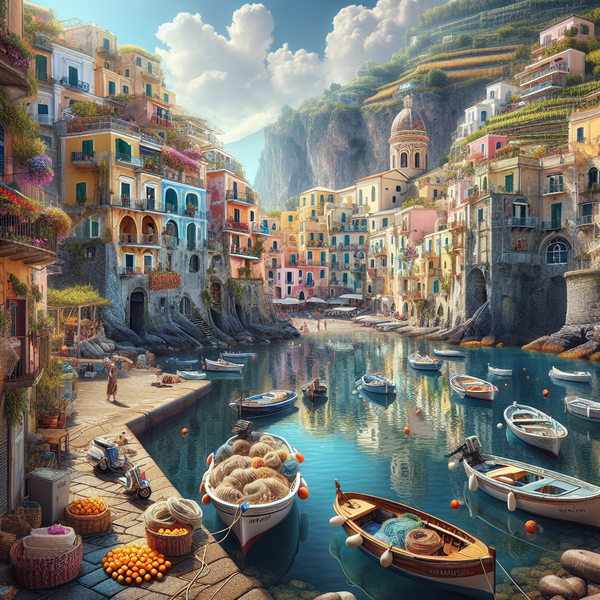
It’s one thing to see Italy’s famous coastal towns in photographs and another to stand on their harbors, camera in hand, waiting for the right shift of light on the water. From pastel villages carved into cliffs to quiet maritime outposts where fishermen still mend nets beside moored wooden boats, Italy’s harbor towns reward every step with postcard-perfect scenes. Whether you’re chasing morning stillness or golden-hour reflections, here are the most photogenic harbor towns across Italy that blend local life, design, and natural beauty in equal measure.
Go to the section
ToggleVernazza in Cinque Terre: The Cliffside Jewel Framed by the Sea
Among the five Cinque Terre villages, Vernazza holds perhaps the most cinematic harbor. From the Doria Castle lookout, you can capture the double curve of the bay, where weathered fishing boats cluster beneath stone arches. The pastel facades, baked by sea salt and sun, range from apricot to coral—no filter needed. Arrive before 8 a.m. to catch locals unloading anchovies at the small pier; this is when the water mirrors the first pink light of day.
To experience Vernazza beyond the Instagram rush, take the trail to Monterosso for a high-angle panoramic shot of the harbor, then stop by Gelateria Vernazza, known among photographers for its shaded terrace with a perfect sightline down to the sea. Just remember that tripods are not allowed on narrow pedestrian lanes, so plan to travel light.
Porto Venere: Liguria’s Quiet Counterpart to Cinque Terre
About thirty minutes by ferry from La Spezia, Porto Venere offers similar chromatic beauty to the Cinque Terre without the same crowd density. The row of tall houses along Calata Doria seems painted for an artist’s palette—terracotta, cream, and olive green—and each window shutter adds texture. The Church of San Pietro, perched dramatically on a rocky promontory, provides one of Liguria’s finest sunset views. The contrast of dark sea, medieval stone, and the fading sky is a natural masterclass in composition.
When photographing Porto Venere, head to Palmaria Island, just across the channel. A short boat ride and a twenty-minute hike bring you to a viewpoint where you can capture the entire harbor from above—ideal for drone-free overhead shots. Afterward, reward yourself with an aperitivo at Bar Lamia, whose outdoor tables overlook the sparkling Gulf of Poets.
Camogli: A Painter’s Palette on the Italian Riviera
If Portofino is all about polished glamour, Camogli balances authenticity with seafront drama. The name itself means “house of wives,” recalling its fishing heritage. The harbor here curves beneath steep pastel buildings whose paintwork looks as if it’s still drying in the sun. Late afternoon is the best window for photos, when long shadows carve depth into every facade.
The town is small enough to explore in an hour, yet packed with visual details—from laundry lines swaying over the port to the intricate trompe-l’œil decorations painted directly onto walls. Serious photographers often climb the steps behind the Basilica of Santa Maria Assunta to frame the church tower with the harbor below. For a snack break, stop at Revello, an old bakery famous for its focaccia col formaggio—thin, blistered, and irresistibly camera-worthy.
Procida: Naples Bay’s Rainbow Harbor
Procida, recently thrust into the spotlight yet blissfully unchanged, is arguably the most photogenic harbor in southern Italy. The Marina Corricella unfolds like a cascading watercolor—tiny houses stacked one atop another, leading to fishing boats painted in pastel stripes. Each doorway still shows traces of volcanic stone beneath layers of color, telling centuries of maritime history.
For the quintessential shot, walk up Via San Rocco until you reach Belvedere dei Cannoni, a panoramic terrace that opens onto the entire cove. Morning light hits the facades at a diagonal angle, emphasizing every contour. Procida’s locals are used to visitors with cameras but appreciate discretion—wave a greeting before lifting your lens. When hunger strikes, La Lampara offers fresh paccheri pasta with clams and a terrace lined with grapevines overlooking the very scenes you just captured.
Trani in Puglia: Limestone Reflections and Maritime Calm
On Puglia’s Adriatic coast, Trani stands out for its sleek limestone harbor shimmering under southern light. The star attraction is the Romanesque Cathedral of San Nicola Pellegrino, which seems to rise directly from the water. Early mornings invite slow exposures—the white stone reflects the pink tones of sunrise, turning the entire marina into a painterly palette. Many local photographers gather on the Molo Santa Lucia pier to capture the cathedral’s reflection before fishing boats stir.
Beyond photography, Trani’s charm lies in its dignity as a working port. The fishermen you photograph might later serve you grilled red mullet or calamari at Osteria La Banchina. For a romantic perspective, stay until blue hour when the lamplight glows along the old harbor walls and seagulls trace loops over the masts.
Chianalea di Scilla: Calabria’s Little Venice
Reaching Chianalea di Scilla means descending into one of Calabria’s most atmospheric waterfronts, where houses practically sit on the sea and narrow alleys double as boat docks. Photographers often call it the “Venice of the South,” but this is no copy: wooden boats are tied directly to stone thresholds, and waves lap against front doors. The castle of Ruffo di Calabria provides a high vantage point over the Tyrrhenian coastline, especially striking at sunset when the horizon turns copper.
For detailed close-ups, shoot from the small rocky ledges along Via Scaro Alaggio. The reflections bouncing between water and walls create a natural chiaroscuro effect reminiscent of Caravaggio’s painting technique. Don’t be surprised if an elderly resident pauses to chat—they’re proud of their village and sometimes offer homemade limoncello to visitors who linger respectfully.
Ortigia in Syracuse: Baroque Elegance Meets Fishermen’s Harbor
On Sicily’s eastern tip, Ortigia pairs classical architecture with daily harbor bustle. The Porto Grande curves around ancient Greek foundations, while small fishing boats rest beside stately palazzi. Dawn here is a secret time—the scent of espresso drifts from cafés on Via Trento, and fishermen quietly prepare tuna nets. Photographically, Ortigia balances grandeur and intimacy: frame the Cathedral’s baroque dome with masts in the foreground for a quintessential Sicilian contrast.
Seafood lovers can find their muse at the morning market near the harbor entrance. Vibrant piles of swordfish, sea urchins, and bright tomatoes fill the stalls, adding texture to travel photography beyond seascapes. When editing, don’t over-saturate; Ortigia’s natural color palette—pale stone, turquoise water, rust-red nets—is already artful as it is.
Portoferraio on Elba Island: Napoleon’s Harbor with a Noble View
Portoferraio, the main harbor of Elba Island, provides a different sort of photogenic charm—more historical layers than pastel whimsy. The curved seafront is guarded by Medici-era fortifications, whose ochre stone glows against the blue harbor. Photograph the symmetry of boats anchored beneath Forte Stella, or climb up to Villa dei Mulini, Napoleon’s onetime residence, for an elevated shot across the bay.
Boats depart regularly from Piombino on the Tuscan mainland, and within an hour you’re in this living museum of maritime power. Evenings are best spent among the narrow steps of the old town, where locals gather outside wine bars sipping Elban Ansonica. The view over the harbor lights resembles a constellation, especially from the terrace above Piazza della Repubblica.
Finale Advice for Capturing Italy’s Harbors at Their Best
Every harbor town in Italy rewards patience. Strong midday light can flatten your images, so plan for early or late hours when shadows carve dimension. Always check local restrictions—some small ports, such as Vernazza and Chianalea, limit tripod setups to protect pedestrian flow. A lightweight camera bag and polarized lens filter go a long way under Italy’s reflective sun.
Above all, engage with the places you shoot. Learn the names of the boats, chat with shopkeepers, taste the day’s catch. The most photogenic harbor towns in Italy aren’t merely scenic—they are living communities whose rhythms you can capture only by slowing down enough to watch, listen, and wait for the right light.