There are few spectacles in Italy as moving or as revealing of its soul as its religious processions. These processions—part devotion, part social gathering—thread through narrow lanes and grand piazzas, binding generations together. For anyone who wants to understand Italy beyond its monuments, witnessing one of these rituals offers a rare window into the country’s living faith. From shadowy Good Friday marches in Puglia to candlelit pilgrimages in Sicily, each region transforms religion into choreography, color, and sound.
Go to the section
ToggleHoly Week Processions in Trapani, Sicily: The Mysteries of Faith at Dawn
The Sicilian town of Trapani hosts one of Italy’s most renowned Holy Week processions, the Processione dei Misteri. Beginning on Good Friday afternoon and lasting an extraordinary 24 hours, this event brings together 20 sculptural groups known as the Misteri, each depicting a scene from the Passion of Christ. These life-sized wooden and canvas figures are carried on the shoulders of devoted confraternities through Trapani’s centro storico, along Via Garibaldi and Corso Vittorio Emanuele, their heavy frames swaying rhythmically to live brass bands playing somber marches.
Travelers can best experience the Misteri by positioning themselves at Piazza Plebiscito around sunset, when the warm light hits the procession’s gilded float of the Madonna Addolorata. Hotels often fill well in advance, and a good base is a small B&B within the old town—many keep their doors open late into Saturday morning to accommodate returning participants.
The Good Friday Procession in Sorrento: Candlelight on the Amalfi Coast
On Good Friday, Sorrento transforms itself into a flickering sea of candlelight for two parallel processions organized by ancient religious brotherhoods. The first, in the early morning hours, is the White Procession (Processione Bianca), symbolizing the Virgin’s search for her son. Participants dressed in white tunics walk barefoot from Corso Italia to the Cathedral, their faces covered by pointed hoods, accompanied only by the haunting sound of their chanting.
At night, the mood shifts for the Black Procession (Processione Nera). Hundreds of men in black robes carry a life-sized statue of the dead Christ. The only light comes from hand-held lanterns swinging in unison. For visitors, the most atmospheric viewpoints are along Via San Cesareo, where the narrow street amplifies both the smell of incense and the echo of distant drums.
The Feast of Sant’Efisio in Cagliari, Sardinia: Devotion on the Road
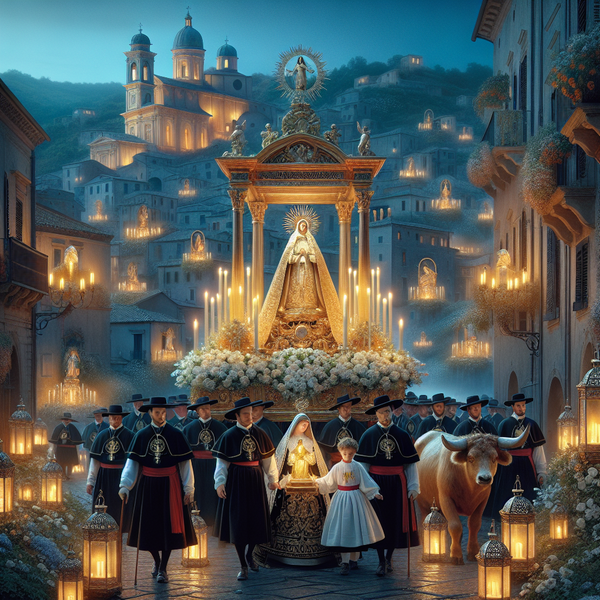
Every May, Cagliari stages one of Italy’s longest and most colorful religious processions: the Festa di Sant’Efisio. It unfolds over 65 kilometers from Cagliari to the coastal village of Nora. Pilgrims in richly embroidered Sardinian costumes accompany the saint’s statue on an elaborately decorated cart pulled by oxen. More than a religious ritual, it doubles as a cultural showcase of Sardinian identity, with each village contributing distinctive embroidery, jewelry, and folk songs.
Visitors can join the opening day in Cagliari’s old quarter near Via Roma, where locals throw flower petals under the saint’s feet. The best photo opportunities come as the procession exits the city walls by Porta Cristina, where sunlight catches the bright blues and reds of traditional costumes. The event concludes days later at the ruins of Nora’s Roman amphitheater, where a seaside mass is held with the sound of waves in the distance.
The Venerdì Santo of Chieti, Abruzzo: The Oldest Penitential Procession
Among Italy’s oldest religious processions, the Venerdì Santo of Chieti dates back to the 9th century. The event starts from the Cathedral of San Giustino, where hundreds of participants dressed in black robes walk silently through the medieval lanes carrying torches. The centerpiece is the chorus performing “Miserere,” composed by Saverio Selecchy in the 18th century and sung without accompaniment. The combination of music, flamelight, and slow pace makes this procession one of the most somber and intimate in Italy.
Visitors should arrive early to secure a viewing spot near Piazza Vittorio Emanuele II, where the acoustic quality is particularly impressive. Cafés open late, allowing you to sip an espresso or a glass of local Montepulciano d’Abruzzo while the solemn parade passes by in the distance.
The Macchina di Santa Rosa in Viterbo, Lazio: A Shrine in Motion
Few processions in Italy can rival the spectacle of the Macchina di Santa Rosa in Viterbo. Every September 3rd, a 30-meter-tall illuminated tower weighing over five tons is carried on the shoulders of about 100 men known as Facchini. This vertical shrine moves slowly through Viterbo’s medieval streets, accompanied by chants of “Santa Rosa!” and the crackle of fireworks. The tower itself changes design every few years but always culminates in a glowing statue of the saint at the top.
Because of safety restrictions, streets are closed hours before the procession begins. The best vantage point is from Piazza del Plebiscito, where you can watch the tower bend as the carriers make the crucial turn. Tickets for balcony views are sometimes available through local accommodations, but they must be arranged well ahead of time.
The Procession of the Patron Saint in Amalfi: St. Andrew’s Triumph by Sea
In Amalfi, devotion takes to the water. The Festa di Sant’Andrea, held twice yearly, celebrates the city’s patron saint with both a land and sea procession. After Mass in the magnificent cathedral with its striped Arab-Norman façade, the bronze statue of the saint is carried down the steep staircase to the harbor. Fishermen join the flotilla in decorated boats, honking horns and setting off flares as they escort the relic along the coastline.
The June celebration is particularly vibrant, ending with fireworks bursting over the Mediterranean. To experience it fully, find a table at one of the cafés along Via Duca Mansone I—you’ll have both a clear view of the procession route and of the returning boats under the fireworks.
The Procession of the Dead Christ in Enna, Sicily: A City in Mourning
High in the heart of Sicily, the town of Enna stages an austere Good Friday procession known for its medieval ethos. Over 2,000 hooded confraternity members march from 15 different churches toward the Duomo, each carrying crosses or torches. There are no modern amplifiers or orchestras—only the synchronized shuffling of feet and the slow tolling of church bells. The entire city darkens its lights in reverence, creating a visual effect that feels suspended in time.
Because Enna sits nearly 1,000 meters above sea level, the air can still be cool in early spring. Dress warmly and bring layers if you plan to stand at the overlook near Castello di Lombardia, where the view of the candlelit city is unforgettable.
The Festa dei Ceri in Gubbio, Umbria: Speed and Spirit on the Slopes
Unlike the solemn processions of Holy Week, Gubbio’s Festa dei Ceri (Feast of the Candles) on May 15 bursts with athletic energy. Three teams—each representing a saint—race up Mount Ingino carrying towering wooden structures shaped like candles that weigh more than 300 kilograms each. The event honors Saint Ubaldo, and while it looks like a competition, locals insist it’s all about spiritual devotion and community pride. As the Ceraioli sprint through the medieval town, bells ring out and the crowd roars encouragement.
The best experience is to watch the start from Piazza Grande, where the energy is electric. Those who want a panoramic view can hike up the mountain ahead of time to see the procession winding its way through a sea of cheering locals.
Practical Tips for Experiencing Religious Processions Respectfully
To experience Italy’s processions respectfully, follow local customs closely. Dress modestly—covered shoulders and knees are appreciated even outdoors. Avoid using flash photography, especially at night or near clergy. If you want a closer view, always ask permission before entering processional paths or church steps. Support the local community by buying candles or small refreshments sold by nearby parishes—proceeds often fund restoration of local churches or charity work.
Transportation can be tricky on processional days. Streets are frequently closed to cars, and finding parking in central zones is difficult. Whenever possible, use regional trains or public buses and plan to walk the final stretch. Arriving early not only ensures a good viewing spot but also lets you feel the pre-procession buzz as stalls and orchestras warm up.
Why Religious Processions Reflect Italy’s Cultural Core
Attending one of Italy’s most beautiful religious processions reveals more than belief—it exposes the country’s rhythm, social ties, and artistry. Each region interprets faith through its landscape: marble streets echoing with drums in Liguria, lanterns reflected in Sicilian harbors, embroidered costumes on Sardinia’s plains. These processions are collective narratives carried forward year after year, and they connect travelers not only to the Italy of churches and piazzas but to an enduring human need for meaning, beauty, and belonging witnessed in real time on the streets.