There’s something about Lake Garda that makes even seasoned travelers slow down — maybe it’s the scent of lemon blossoms mingling with mountain air, or the way ferries glide past pastel-colored ports that look painted rather than built. Straddling three regions — Lombardy, Veneto, and Trentino-Alto Adige — Italy’s largest lake is more than a scenic stop; it’s a collection of distinct little worlds. Choosing which of the most beautiful towns around Lake Garda to visit defines the kind of trip you’ll have, whether that’s lazy days on pebble beaches or hikes up to medieval castles catching the evening light.
Go to the section
ToggleSirmione: Thermal Waters and Fairy-Tale Towers at Lake Garda’s Southern Tip
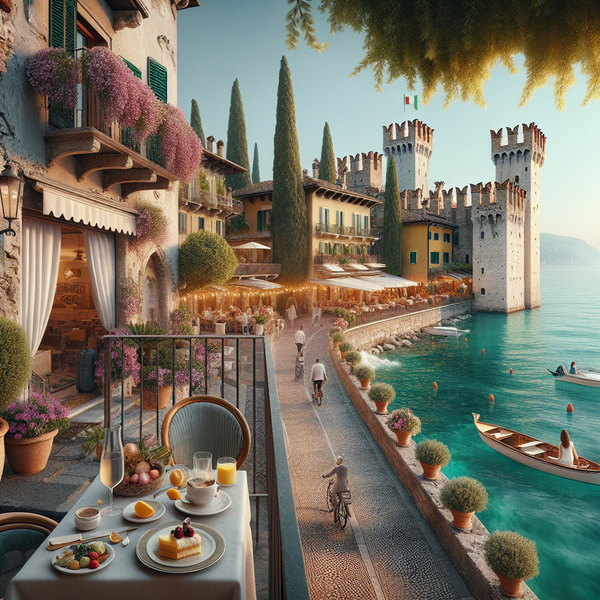
Sirmione occupies a narrow peninsula extending into the lake from its southern shore, guarded by the 13th-century Scaliger Castle whose moated entrance remains one of Italy’s most photogenic gates. Visitors often park at the base of the peninsula — cars are restricted beyond a certain point — and walk or take the tiny electric shuttle into the old town. The cobbled lanes quickly give way to lake-view terraces and historic spas built on the region’s sulfurous springs. For a restorative experience, the Aquaria Thermal SPA offers open-air pools facing the water, open until late evening.
If you walk beyond the castle and through olive groves for about 20 minutes, you’ll reach the Grotte di Catullo — the ruins of a Roman villa with a small on-site archaeological museum. From here, ferries leave regularly to Desenzano and Lazise, letting travelers make easy day trips without needing a car.
Malcesine: Where the Mountains Meet the Lake
Malcesine sits on the lake’s eastern shore under the shadow of Monte Baldo, linked by a rotating cable car that climbs nearly 1,800 meters to alpine pastures. The small harbor below still functions as it has for centuries, with fishing boats tucked among cafés serving lavarello (a local lake fish) grilled simply with lemon and olive oil from nearby Garda olive mills. The main attraction, the Castello Scaligero di Malcesine, houses a museum with detailed exhibits on the lake’s geology and botany — a surprising find for such a compact medieval fortress.
For those who hike, well-marked trails lead from Monte Baldo’s upper station toward refuges like Rifugio Altissimo, offering sweeping views over the lake’s northern edge, especially striking at sunset. Malcesine’s uphill streets can be steep, so wear shoes with grip; the cobblestones can become slick after rainfall.
Limone sul Garda: Terraced Gardens and Lemon Groves Worth the Climb
Once reachable only by boat, Limone sul Garda takes its name from the citrus terraces that cling improbably to rocky cliffs. The town’s Limonaia del Castel, restored as an open-air museum, shows how lemons were cultivated in the pre-industrial era using wooden frames and glass panels to protect from winter frost. It’s easy to find — just follow the small signs from the waterfront near the municipal building — and the walk rewards you with lake panoramas framed by fragrant trees.
Below, the promenade offers gelaterias serving flavors like limoncello and crema di Garda, perfect to enjoy while watching ferries come and go. Accommodation here tends toward boutique family-run hotels with terraced pools, and the newer Ciclabile sospesa, the suspended cycle path hugging the cliffs north of town, gives cyclists and pedestrians one of the best views of the region without steep climbs.
Bardolino and Lazise: Wine, Walks, and Waterfront Life
On Lake Garda’s southeastern curve, Bardolino and Lazise form a pair of neighboring towns that can be explored easily on foot or bicycle via the lakeside path connecting them. Bardolino is known for its DOC red wine, pressed from Corvina, Rondinella, and Molinara grapes grown on the surrounding morainic hills. Many small wineries offer tastings — try Guerrieri Rizzardi or Zeni, both reachable within five minutes of the town center. During autumn, the Festa dell’Uva e del Vino fills the waterfront with stalls serving risotto al Bardolino and roast duck glazed in local wine.
Lazise, encircled by medieval walls still largely intact, offers a calmer rhythm. The Porta San Zeno gate opens to a maze of cobbled lanes lined with osterie where locals gather for early evening aperitivo — typically a glass of Lugana white wine and a few olives from nearby Torri del Benaco groves. The pier at Lazise’s small harbor is one of the best spots for sunset photography, and ferries depart hourly toward Riva or Sirmione.
Riva del Garda: Northern Grandeur Between Cliffs and Culture
Riva del Garda sits at the lake’s northern tip, where the Dolomites seem to drop straight into the water. Once part of the Austro-Hungarian Empire, Riva’s atmosphere still feels Central European, with grand Habsburg-style hotels and lakeside promenades shaded by linden trees. Cyclists and windsurfers know this area for its wind — the Ora and Peler — which blow predictably each day, ideal for water sports that other towns can’t match. Rental shops line the Viale Dante and Piazza Catena area, offering gear for all levels.
Beyond sport, the Museo Alto Garda (MAG) inside the medieval Rocca di Riva castle showcases local art and mountaineering history. For a low-effort panoramic view, follow the marked path up to the Bastione, a gray stone fort visible from almost every corner of town. The climb takes about 20 minutes, or you can now use a small glass elevator newly installed for accessibility — a welcome improvement for visitors with limited mobility.
Garda and Torri del Benaco: Old-World Charm Without the Crowds
Between Bardolino and Malcesine, Garda town gives its name to the entire lake. Despite that fame, it avoids the crowds of Sirmione. The lakeside promenade stretches for over a kilometer, lined with cafés serving local olive oil — one of the lightest in Italy thanks to the mild microclimate. Don’t miss the short uphill walk to Punta San Vigilio, a 16th-century villa headland accessible by footpath from the northern end of town. Its small harbor and lakeside trattoria are perfect for lunch in the shade of cypress trees. Swimming is allowed in the adjoining bay if you bring water shoes for the stony shore.
Just north, Torri del Benaco feels timeless: fishing nets drying by the port and the triple-tower Scaliger Castle standing guard since the 14th century. Inside, the ethnographic museum tells the story of olive growers and fishermen who once dominated the area. For a truly local souvenir, visit one of the cooperative olive mills during November pressing season to buy freshly bottled extra-virgin oil right at the source.
Desenzano del Garda: Urban Life and Ancient Surprises
Desenzano is the largest town on the lake, with direct train connections from Milan and Verona. That accessibility makes it ideal for travelers without a car, yet the vibe remains relaxed. The Piazza Malvezzi terrace fills nightly with both locals and visitors enjoying gelato from Vivaldi or Gattolardo while street musicians play nearby. The Saturday market around the harbor’s arcades is one of the more authentic on the lake, selling everything from handmade leather sandals to Asiago cheese.
Few know that just 10 minutes’ walk from the station lies a remarkably preserved Roman villa dating from the first century B.C., complete with mosaics depicting marine creatures. Desenzano’s small archaeology museum next door adds fascinating context to the site and costs just a few euros — a worthwhile detour before boarding your ferry or train onward.
Salò: Elegant Promenades and Lakeside Style
Salò extends along a graceful bay on Lake Garda’s west coast, often considered the most elegant of Garda towns. It’s known for Italy’s longest lakeside promenade, the Lungolago Zanardelli, stretching almost two kilometers. You can walk from the neo-Gothic Duomo di Santa Maria Annunziata to the small marinas where locals keep their wooden boats. Salò was also the seat of the short-lived Italian Social Republic during World War II, a chapter documented with clear signage for those interested in history rather than nostalgia.
For dining, head just back from the main piazza to Locanda del Benaco, where tables almost touch the water and menus rotate seasonally around lake fish and Franciacorta sparkling wine. The ferry route between Salò and Gardone Riviera makes a perfect mini-cruise — only ten minutes but passing grand 19th-century villas framed by mountains.
Gardone Riviera: Grand Hotels and Intimate Gardens
Gardone Riviera has long been famed as Lake Garda’s ‘garden town.’ The Il Vittoriale degli Italiani, eccentric poet Gabriele D’Annunzio’s sprawling estate, dominates the hillside with its amphitheater and ship set into the garden terrace. Visits take at least two hours; book a guided tour for access inside the historic house, as ticket combinations vary between garden-only and full-entry options. For a contrast in mood, the nearby Giardino Botanico André Heller blends sculptures with exotic plants — open seasonally from March to October.
Many visitors choose Gardone Riviera to experience the lake’s traditional grand hotels like the Grand Hotel Fasano, originally a 19th-century hunting lodge. A sunset drink on their pier bar lets you appreciate that old-world glamour the way European travelers did over a century ago, though now with Wi-Fi and prosecco in hand.
Practical Tips for Exploring Lake Garda’s Most Beautiful Towns
The towns around Lake Garda are connected by a dense network of ferries — Navigazione Lago di Garda publishes updated timetables at every pier. The short routes between Sirmione, Bardolino, Garda, and Torri del Benaco make car-free travel practical. For longer connections to Riva or Limone, plan around the high-speed hydrofoils that operate primarily in peak season. Cycling is increasingly popular: the upcoming Garda by Bike trail aims to encircle the lake entirely, but sections such as those near Limone and Desenzano are already open and safe for leisure riders.
Visiting in the shoulder seasons — late spring and early autumn — gives the best balance of weather and crowd levels. Local buses operated by ATV and Arriva cover most towns, but always check last departures; many stop service around 8–9 p.m. Lastly, cash remains useful in smaller villages, especially for buying olive oil, wine, or ferry tickets at kiosks that may not accept cards.
Lake Garda rewards curiosity: each town reveals a slightly different heritage shaped by the regions surrounding it. Whether you settle into Bardolino’s café rhythm or hike above Malcesine’s alpine ridge, the lake’s beauty never feels generic — it’s a mosaic best appreciated piece by piece.