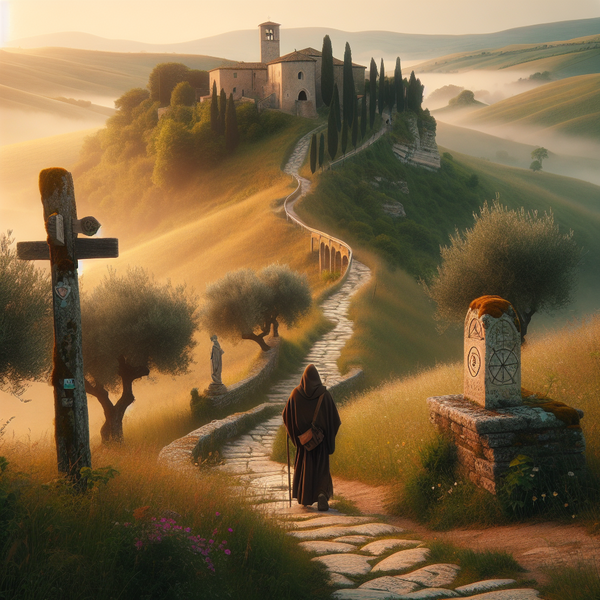
Walking Italy’s pilgrimage routes isn’t just about religion — it’s about slowing down, breathing in landscapes most tourists speed past, and discovering villages that barely appear on a map. Many travelers know the Via Francigena or the Way of St. Francis, but tucked beside these ancient paths lie secluded monasteries, frescoed chapels, and family-run osterie where the pilgrim menu still costs under €15.
Go to the section
ToggleHidden Sanctuaries on the Via Francigena in Northern Tuscany
Few realize how many evocative detours the Via Francigena hides between Lucca and San Miniato. In the hamlet of Galleno, a medieval stretch of stone road still bears the grooves of centuries of pilgrim footsteps — an ideal photo stop before rejoining the main path. Nearby, the Parish Church of San Pietro in Coiano guards an understated Romanesque façade dating back to the 12th century and is open most afternoons, with volunteers happy to stamp your pilgrim’s credential.
For lunch, the Osteria del Pellegrino on Via Cavallotti in Fucecchio serves hand-cut pappardelle al cinghiale made with local wild boar from the Cerbaie woods — a dish that sustains both body and soul. If staying overnight, the Agriturismo Il Poggio in San Miniato offers rustic rooms with views over the Arno valley and often provides a shuttle to nearby trailheads.
Secret Villages on the Via degli Dei near Bologna
The Via degli Dei, or “Path of the Gods,” runs from Bologna to Florence crossing the Apennines. Despite rising popularity, the lesser-visited segments reveal gems few hikers linger for. Madonna dei Fornelli is more than a halfway rest — early morning mist rises from the chestnut woods while locals open the Forno da Margherita bakery at 6:30 a.m., known for its torta di riso scented with lemon.
A small 18th‑century oratory, Oratorio di San Giacomo, stands behind the main road and often goes unnoticed. Its caretaker, Signora Carla, will sometimes open it for visitors who ask politely in Italian. You’ll find fresco fragments of St. James, the patron of pilgrims. Those needing a lighter overnight can book at Rifugio Monte Adone, a simple mountain refuge offering bunk beds for €25 including breakfast of local honey and chestnut jam.
Lesser-Known Stops on the Way of St. Francis in Umbria
While Assisi draws crowds, the real spirit of St. Francis lingers in towns like Valfabbrica and Pietralunga. In Valfabbrica, the narrow Via del Castello leads to the Convent of San Sebastiano, whose cloistered garden grows medicinal herbs still used by Franciscan friars for natural ointments. Visitors can purchase these small jars directly from the monastery shop for around €7, supporting the community.
Further south, the path enters the Carpina Valley. Here, the Sanctuary of Madonna dei Ceri near Gubbio rewards detour‑takers with sweeping views and frescoes faded but still luminous in the low afternoon light. A nearby family-run locanda, Da Mariella, sets tables under fig trees and serves roasted lamb with Umbrian lentils. Try the local red, Rosso di Gubbio, which pairs perfectly at room temperature.
Find all the best hotel deals Book here
Hidden Corners on the Via Francigena del Sud from Rome to Terracina
Once south of Rome, the Via Francigena del Sud unveils a different Italy — one of olive groves, tufa cliffs, and archaeological silence. In the town of Cori, about 50 km south of the capital, few pilgrims know to climb the steep steps to the Temple of Hercules. From its terrace, the Pontine Plain stretches all the way to the sea. The nearby Santissima Annunziata church preserves a 15th‑century fresco cycle recently cleaned and illuminated.
Terracina marks the coastal passage where pilgrims once boarded boats to the Holy Land. The steep Via Posterla lane still passes beneath Roman arches and leads to a hidden gem: the mosaic‑floored Church of Purgatory, open weekends from 10 a.m. to 1 p.m. Locals recommend the Gelateria Piccolo Borgo for their lemon and sage sorbet — refreshing after the descent from the Temple of Jupiter Anxur.
Discover the best local experiences Explore now
Secluded Retreats Along Sardinia’s Cammino di San Giorgio Vescovo
On the island of Sardinia, a relatively unknown route honors St. George, looping from Cagliari through the Sarcidano plateau. The trail crosses the village of Isili, where the 15th‑century Church of San Sebastiano shelters wooden polychrome statues rarely seen by visitors. Artisans in nearby Gergei still handcraft knife handles from mutton horn, which you can purchase at bottegas along Via Roma for under €40.
The most charming night stop lies in Laconi, home of the Servite friars who host pilgrims at Casa San Ignazio. Expect simple dorms, home‑baked bread, and breakfast in the cloister courtyard. A few steps away, the town’s Museum of Menhir hosts towering prehistoric stone figures linking Sardinia’s ancient past with its Christian legacy.
Forgotten Hermitages on the Via Lauretana in Marche
The Via Lauretana connects Assisi to the Marian shrine of Loreto, but beyond Recanati’s poetry‑filled lanes, lie forgotten sanctuaries tucked into limestone folds. The Hermitage of San Silvestro in Montefano, reached by a steep one‑kilometer tract from Contrada San Silvestro, remains an oasis of stillness. Inside, expect no souvenir shop — only a simple stone altar and maybe the perfume of wild thyme from nearby fields.
In Cingoli, often called the “Balcony of the Marche,” the small Museo di San Sperandia displays relics of a 13th‑century hermitess and medieval manuscripts illustrating local pilgrim stories. For a sunset view, climb to the Belvedere Don Marzio; the Sibillini Mountains glow pink when the low sun hits their snowy peaks.
Ancient Chapels Along Sicily’s Magna Via Francigena
Sicily’s Magna Via Francigena runs for roughly 160 km between Palermo and Agrigento — a journey that swaps alpine vistas for dusty ridges and Arabic‑inspired courtyards. Near Prizzi, the tiny Church of San Giorgio dei Greci hides by an olive grove, its faded Byzantine icons hinting at the island’s multicultural faith heritage. The path north of Castronovo di Sicilia crosses Roman paving stones locals call “u strata vecchia” — the old street.
Most pilgrims rest in Sutera, a limestone village clinging to Mount San Paolino. Here, the Sanctuary of the Madonna del Monte sits inside a cave above the town; the key can be borrowed from the mayor’s office if you ask in advance. Post-hike, trattoria La Pineta serves pasta with wild fennel and raisins — a reminder of the island’s Arab‑Norman blend. Public buses connect Sutera to Caltanissetta if legs need a rest day.
Practical Tips for Exploring Italy’s Hidden Pilgrim Trails
To experience these hidden gems respectfully, move slowly and engage with locals. Many sanctuaries keep irregular hours or are opened on request, so always call or ask at the bar nearest the church — small communities still rely on word of mouth rather than signage. Pilgrim credentials (credenziale del pellegrino) can be purchased in major trail towns like Lucca, Assisi, and Palermo, often at diocesan offices for around €5.
Public transport can bridge gaps between remote sections: regional buses link Tuscany’s Val d’Elsa towns, and Trenitalia connects Assisi with Spello and Foligno. Always carry cash for rural trattorie, as card readers sometimes fail on mountaintops. Pack a refillable bottle — Italy’s public fountains (fontane) almost always supply potable water unless marked “non potabile.”
Why Italy’s Hidden Pilgrimage Gems Matter
Beyond architecture and cuisine, these routes offer connection. Staying in a monastery guesthouse or sharing a communal meal with volunteers restores something modern travel often misses: reciprocity. Hidden sanctuaries and forgotten hermitages survive not for spectacle but for continuity. Pilgrimage in Italy, whether spiritual or secular, becomes a slow dialogue with the land. When you close your journey — perhaps on a coastal bluff near Terracina or a mountain plateau above Gubbio — the memories that linger most will be those of silent chapels, generous locals, and the ancient roads underfoot that still remember every traveler who passed before.